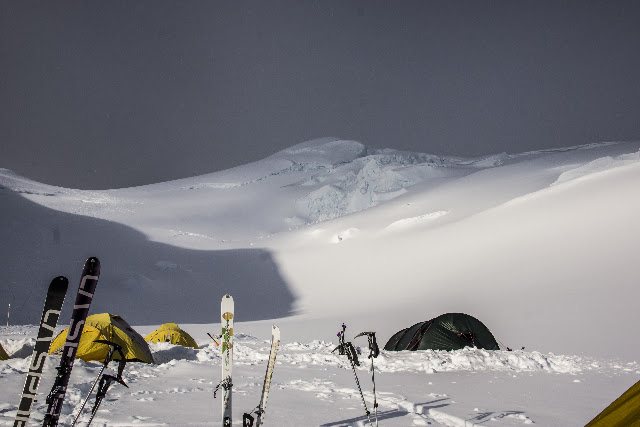
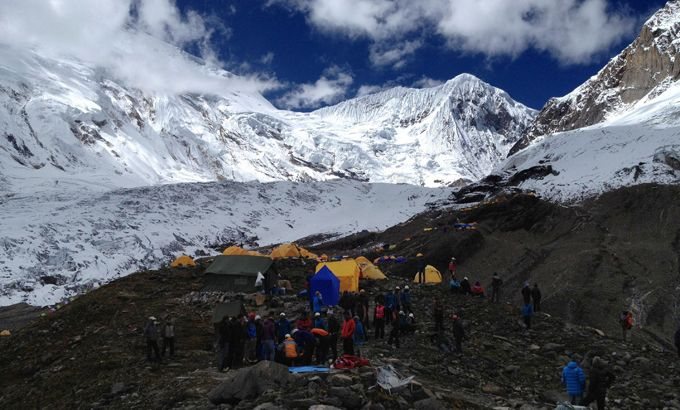
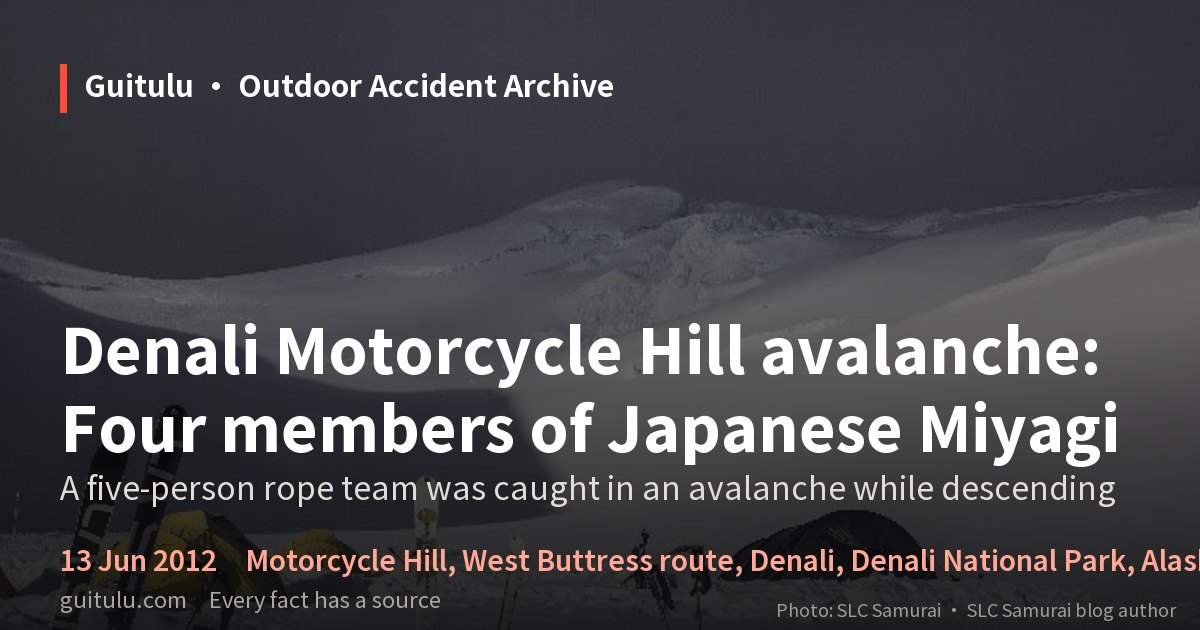
Glacier camp on Denali's West Buttress route in June 2012 (photographed by a climber on the mountain at the time)Photo source: SLC Samurai · SLC Samurai blog author
Tent almost buried in snow after a snowstorm on Denali in June 2012 (photographed by a climber on the mountain at the time)Photo source: SLC Samurai · SLC Samurai blog author
Ice towers and crevasses beside Denali's West Buttress route (photographed by a climber on the mountain at the same time)Photo source: SLC Samurai · SLC Samurai blog author
Snow slope with route marker poles on Denali's West Buttress route (photographed by a climber on the mountain at the same time)Photo source: SLC Samurai · SLC Samurai blog author
The number at the end of a paragraph is how many facts it rests on; open it to see each fact and how well it is sourced:
Multiple sourcesSingle source. Conflicting accounts and speculation are kept out of the narrative.
Reported locations along the route (illustrative)Schematic
Scroll down and the map flies to where each part happened. The line is Schematic, Lines connect the locations mentioned in reports in sequence and indicate only the approximate direction, not the actual track. Sources for the location coordinates are in places.json.
01
Full route
The locations mentioned in reports are connected in sequence to show the approximate route (schematic).
On 5 June, the Miyagi team climbed to Camp 4 at 14,200 feet. F17
There was considerable snowfall on the mountain on 10 and 11 June. F18
On the night of 12 June, wind gusts at the 14,000-foot camp reached 70 miles per hour. F21
On the afternoon or evening of 12 June, the Miyagi team set out from Camp 4 to descend. F20
That evening, two national park rangers flew over the avalanche path in a helicopter to search, but found no sign of the missing climbers or their equipment. F25
Ogi descended alone to Kahiltna Base Camp at 7,200 feet and reported the accident shortly after 4 p.m. on Thursday, 14 June. F23
The broken rope was in avalanche debris about 90 feet below the glacier surface and matched the rope used by the Miyagi team. F28
Given how much time had passed, the National Park Service presumed the four had died. F26
On Saturday, 16 June, rangers descended into the crevasse that Ogi had fallen into to search. F27
Under each fact is a verbatim quote from the original. "Single source" means only one outlet mentioned it; "Accounts differ" means sources contradict each other and this site adopts neither side; "Speculation" is an inference by a reporter or a person involved, not a fact.
At around 2 a.m., the five were caught in an avalanche while descending Motorcycle Hill on the West Buttress route at an altitude of about 11800 feet, and all were swept downhill.
Quotes from the original 3
“was descending Motorcycle Hill near 11,800-feet at 2:00 am Thursday morning when an avalanche swept them all downhill.”
Accounts differ on the date of the avalanche: the National Park Service's 16 June press release and NBC said it occurred in the early hours of 14 June (Thursday); KTNA and a climber who was on the mountain at the same time said it occurred in the early hours of 13 June (Wednesday). Alaska Dispatch said park officials later questioned other climbers and determined that the avalanche had occurred more than a day earlier than initially believed.
Early reports calculated the date from the day the survivor reported the incident; later reports changed it to the previous day.
Quotes from the original 5
“An avalanche on Mt. McKinley's West Buttress during the early morning hours of June 14, 2012”
Beginning on Friday, rangers and volunteers searched the avalanche debris area with probes. On Saturday, the search expanded to ten people, with search and rescue dogs also taking part.
Quotes from the original 3
“By Friday, a team of four searchers probed the area, and on Saturday the search grew to ten people and included Rangers, Volunteers, and a search and rescue dog.”
The search for the bodies was permanently suspended because of the danger of falling ice in the crevasse and the risk that further digging would pose to searchers.
Quotes from the original 3
“Due to the danger of ice fall within the crevasse,”
Accounts differ on how much time elapsed between the accident and Ogi's arrival at base camp: Alaska Dispatch said about 38 hours, KTNA said more than 36 hours, and AP said 14 hours.
The discrepancy stems from different determinations of the date of the avalanche.
Quotes from the original 3
“they were almost certainly dead by the time he arrived at basecamp approximately 38 hours after the accident.”
That evening, two national park rangers flew over the avalanche path in a helicopter to search, but found no sign of the missing climbers or their equipment.
Quotes from the original 3
“That evening, two NPS rangers flew to the avalanche path in the park's A-Star B3 helicopter to conduct an aerial hasty search.”
According to Alaska Dispatch, The broken rope was in avalanche debris about 90 feet below the glacier surface and matched the rope used by the Miyagi team.
Quotes from the original 1
“While probing through avalanche debris an estimated 90 feet below the surface of the surrounding glacier, he found the end of a broken rope end that matched that of the one used by Miyagi team.”
“Out of the 630 climbers that have already returned from expeditions this season, 234 reported reaching the summit, equating to a 37 percent summit rate.”
According to KTNA, A national park spokesperson said that although avalanches were uncommon in the Motorcycle Hill area, they were not unprecedented, especially after heavy snowfall.
Quotes from the original 1
“it is not unheard of for the area known as motorcycle hill to shed snow, especially after periods of high snow fall”
Accounts differ on whether this was the first fatal avalanche on the West Buttress route: KTNA quoted a national park spokesperson as saying it was the first avalanche to cause deaths on the route; blogger Alan Arnette said avalanches had previously caused deaths at both the Autobahn and Windy Corner on the same route, and that this was the first on Motorcycle Hill.
Quotes from the original 2
“this is the first time an avalanche on the west buttress has resulted in fatalities.”
According to Alaska Dispatch, According to reports, avalanches on Motorcycle Hill are extremely rare, and a Mount McKinley climbing guide did not even list it as a hazard.
Quotes from the original 1
“Avalanches are a rare occurrence, so rare McKinley climbing guides don't even mention them as a danger.”
According to Alan Arnette, Blogger Alan Arnette wrote that when there is fresh snow on this route, the usual practice is to wait a day or two for the snow to settle and stabilise before travelling.
Quotes from the original 1
“When fresh snow occurs on this route, the standard process is to wait a day or two for it to settle and consolidate before climbing.”
According to SLC Samurai, According to a climber who was on the mountain at the time, it does not get dark on Denali in June, and snow bridges over crevasses freeze in the early morning, making it safer to travel on the lower glacier, so travelling in the early morning hours is not uncommon.
Quotes from the original 1
“In June, it never gets dark. Moreover, it's safer to travel the lower glaciers during the early morning hours when the snow bridges (over crevasses) are frozen.”
 GuituluGlobal Outdoor Accident Archive