The number at the end of a paragraph is how many facts it rests on; open it to see each fact and how well it is sourced:
Multiple sourcesSingle source. Conflicting accounts and speculation are kept out of the narrative.
According to Simpson, he first travelled by mule for two days, then spent 23 hours in a pickup truck, reaching hospital on the 11th day after breaking his leg. F34
Unable to climb out of the crevasse, Simpson instead descended farther into it on the rope and found an exit below. F20
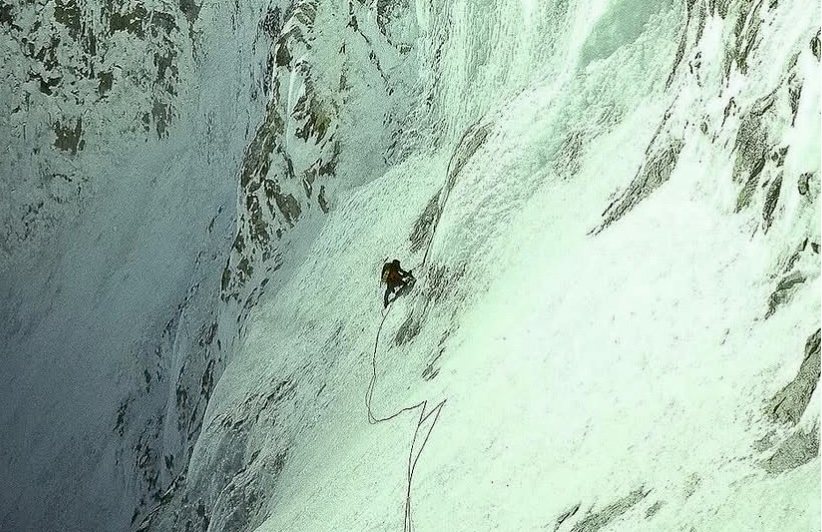
The two completed the first ascent of the previously unclimbed west face of Siula Grande in alpine style. F02
Without realising it, Yates lowered Simpson over the edge of an ice cliff. Simpson was left hanging in midair, with a crevasse below him. F13
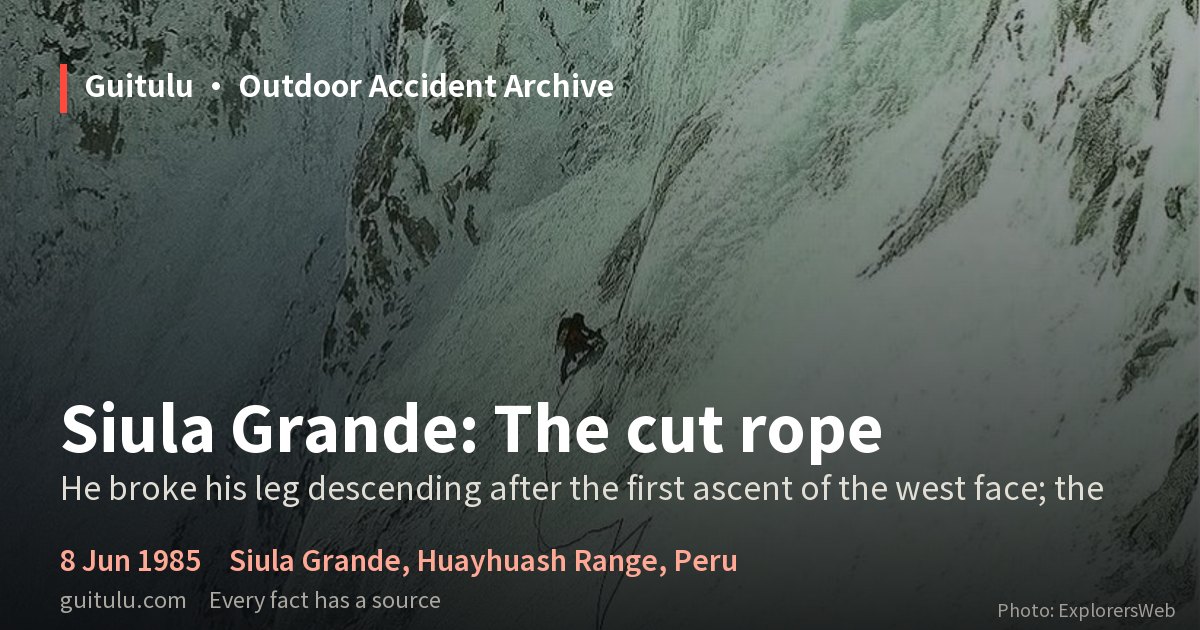
In 1985, British mountaineers Joe Simpson, then 25, and Simon Yates climbed the west face of Siula Grande in the Peruvian Andes. F01
Simpson fell into a large crevasse (a bergschrund between the glacier and the mountain) and came to rest on a snow bridge inside it. F17
Yates believed Simpson had died and descended alone to base camp. F19
Simpson climbed out of the crevasse and spent several days crawling back to base camp, dragging his broken leg. F24
Under each fact is a verbatim quote from the original. "Single source" means only one outlet mentioned it; "Accounts differ" means sources contradict each other and this site adopts neither side; "Speculation" is an inference by a reporter or a person involved, not a fact.
“a tale about two British climbers – 25-year-old Joe Simpson and 21-year-old Simon Yates – who, in 1985, became the first people to scale the West Face”
According to Monmouthshire Beacon, After reaching the summit, both were close to exhaustion and had frostbite. During the descent, they encountered a storm with almost zero visibility and moved very slowly.
Quotes from the original 1
“Near exhaustion and frostbite forced the intrepid duo to make a quick descent. A zero-visibility storm made conditions difficult, and progress was agonisingly slow.”
Accounts differ on how Simpson fell when he was injured: MEF says the two fell in succession when a snow cornice collapsed under them at about 6000 metres, causing Simpson's severe fracture; The Red Bulletin (Simpson's own account) and ExplorersWeb say he fell from an ice cliff.
Quotes from the original 3
“first one, then the other, fell through cornices at 6,000m-Simpson's fall resulting in a severe fracture.”
According to The Red Bulletin, According to Simpson's own account, two ropes were joined together, and after each lowering of about 45 metres, the connecting knot would reach Yates's descender. Simpson then had to take his weight off the rope so that Yates could pass the knot through and continue lowering him.
Quotes from the original 1
“Every 150ft [45m], the knot joining our two ropes would come up and hit Simon’s friction device. That was my signal to get my weight off the rope.”
The rope reached its end, and Simpson was unable to climb back up it. Yates was bearing his full weight and was being pulled away from his position little by little.
In Simpson's own account in The Red Bulletin, the knot joining the two ropes jammed in Yates's descender, preventing him from lowering Simpson any farther.
Quotes from the original 3
“with no more rope to lower Simpson further, Simpson unable to ascend the rope and Yates being slowly pulled off the mountain”
Accounts differ on how long Yates held on before cutting the rope: The Red Bulletin says more than an hour; Monmouthshire Beacon says nearly 60 minutes; Stephen Phelan's article says Yates had only a few seconds to decide.
Quotes from the original 3
“Yates hung on for more than an hour before making a devastating decision: he cut the rope”
According to The Red Bulletin, According to Simpson's own account, he pulled on the rope and its severed end fell down, telling him that Yates had cut it.
Quotes from the original 2
“I pulled on the rope, thinking it would come tied to his body”
According to The Red Bulletin, According to Simpson's own account, he still had about 2.5 kilometres of crevassed glacier and about 10.5 kilometres of moraine and boulders between him and base camp.
Quotes from the original 1
“I was a long way from base camp: a mile and a half [2.5km] of crevasse glacier, then six-and-a-half miles [10.5km] of moraines”
Accounts differ on how many days the crawl took: MEF and Monmouthshire Beacon say four days; Simpson says in The Red Bulletin that he crawled for three and a half days; Stephen Phelan's article says three days; ExplorersWeb says three to four days.
The starting points may differ
Quotes from the original 5
“reach Base Camp after four days without food or water”
According to The Red Bulletin, According to Simpson, he set himself a series of small goals of about 20 minutes each, such as crawling to a particular crevasse or red rock within 20 minutes, to maintain order and discipline.
Quotes from the original 1
“I went, “Right, I’m going to get to that crevasse in 20 minutes. Then I’m going to get to that red rock in 20 minutes.” It created structure and discipline.”
According to The Red Bulletin, According to Simpson, on the final night he was only about 10 minutes from base camp, but took 9 hours to crawl there, losing and regaining consciousness and experiencing hallucinations along the way.
Quotes from the original 1
“On the last night, I started to fail. I was probably 10 minutes’ walk from base, but it took me nine hours. I was in and out of consciousness and experiencing hallucinations”
According to The Red Bulletin, According to Simpson, he called out as he approached camp. Yates and Hawking heard him but thought it was a dog barking.
Quotes from the original 1
“I shouted, hoping that Simon and Richard [Hawking, their camp assistant] would hear me. They did, but they thought I was a dog.”
According to Stephen Phelan, According to Simpson, the first thing he said after crawling into base camp that night was to thank Yates and tell him he had done the right thing.
Quotes from the original 1
“The first thing he said when he crawled into base camp that night was: “Thank you, Simon. You did right.””
According to The Red Bulletin, According to Simpson, he first travelled by mule for two days, then spent 23 hours in a pickup truck, reaching hospital on the 11th day after breaking his leg.
Quotes from the original 2
“Barely conscious, we rode a mule for two days, then spent 23 hours in a pick-up truck.”
Accounts differ on the altitude of Siula Grande: The Red Bulletin, Cherwell and ExplorersWeb give 6344 metres; MEF and Monmouthshire Beacon give 6356 metres.
According to Monmouthshire Beacon, Simpson knew beforehand that if something went wrong on such a difficult route, they could not realistically count on a mountain rescue team.
Quotes from the original 1
“Aware beforehand that if anything went wrong on such a hardcore route, a mountain rescue party was unlikely to turn up”
According to Stephen Phelan, Yates was physically attacked by a critic in the French Alps, and the Alpine Club in Britain also discussed whether to formally exclude him.
Quotes from the original 1
“Yates was physically assaulted in the French Alps by a pro-active critic, and The Alpine Club – the most prestigious mountaineering society in the world – discussed officially ostracising him.”
According to Stephen Phelan, After returning to Siula Grande for the filming of the documentary, Simpson returned to Britain and was diagnosed with post-traumatic stress disorder.
Quotes from the original 1
“On his return to the UK, he was diagnosed with post-traumatic stress disorder.”
According to The Arts Desk, Simpson believes that, given their level of climbing at the time, an accident was not unexpected; what was unexpected was that both survived.
Quotes from the original 1
“That wasn’t an accident, given the level we were climbing at. The surprise was that we survived it.”
 GuituluGlobal Outdoor Accident Archive