The number at the end of a paragraph is how many facts it rests on; open it to see each fact and how well it is sourced:
Multiple sourcesSingle source. Conflicting accounts and speculation are kept out of the narrative.
ImgScene photos all from news coverage; copyright belongs to the original authors
Cover of the 1979 Fastnet Race inquiry report jointly published by the RYA and RORCPhoto source: Yachting MonthlyYachts round Fastnet Rock lighthouse (not in 1979)Photo source: Yachting MonthlyA Wessex helicopter from Royal Naval Air Station Culdrose during the 1979 rescuePhoto source: Yachting World · Royal Navy
Reported locations along the route (illustrative)Schematic
Scroll down and the map flies to where each part happened. The line is Schematic, Lines connect the locations mentioned in reports in order, indicating only the approximate direction, not the actual track. Sources for the location coordinates are listed in places.json.
01
Full route
Locations mentioned in reports are connected in sequence to show the approximate course of events (schematic).
On 11 August 1979, 303 yachts set off from Cowes on the Isle of Wight to compete in the race. F13
Between midday on 12 August and 13 August, a low-pressure system over the Atlantic slowed and rapidly deepened, developing storm characteristics. F16
The Baltimore, Ireland, lifeboat received a call at 10:05 p.m. on 13 August to assist the Irish yacht Regardless, which had lost its rudder. The towline was reconnected five times, and the lifeboat returned to port at 8 a.m. the next day; the captain of Regardless praised the lifeboat crew. F19
On Monday, 13 August, the fleet encountered fog and almost no wind off Cornwall. The fog cleared around midday, and the fleet rounded Land's End. F15
Fastnet lighthouse keeper Gerald Butler heard boat after boat in trouble and calling for help over the radio throughout the night. F26
The rescue was described as Britain's largest peacetime rescue operation and was led by Royal Naval Air Station Culdrose. F36
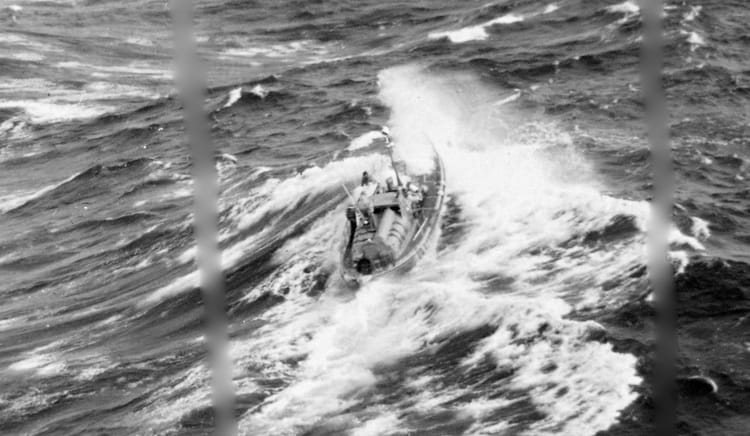
According to the inquiry report, search and rescue aircraft operating in the race area on 14 August reported wind speeds of 60 to 65 knots and wave heights of 50 to 60 feet. F21
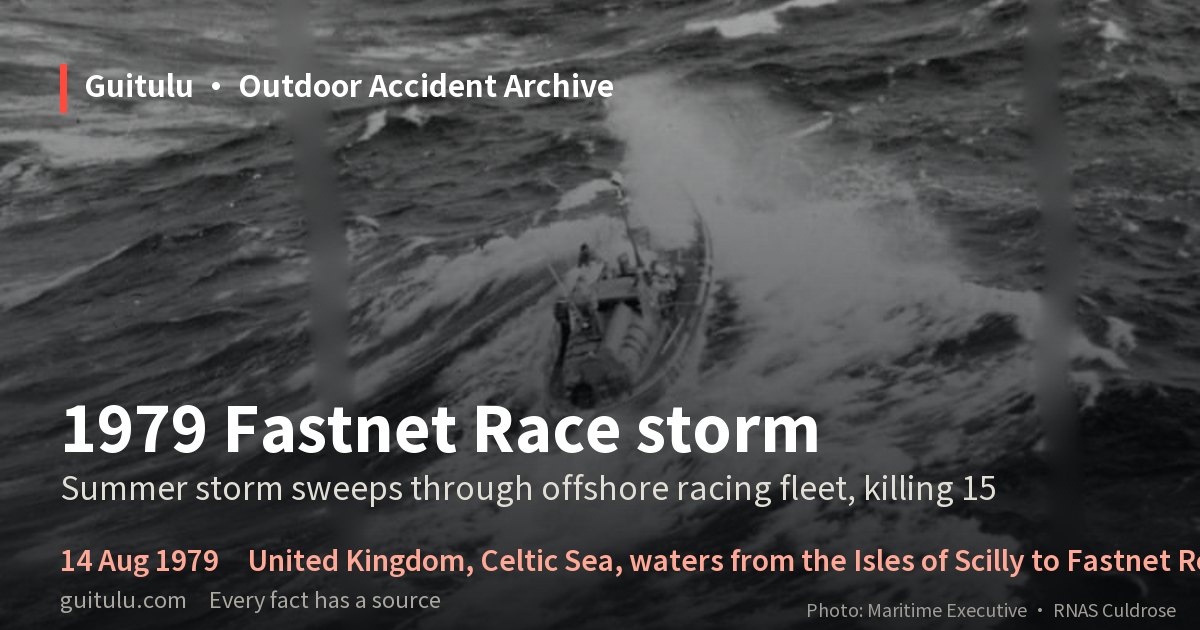
The storm swept through the fleet during the night, with winds reaching Force 10, close to Force 11; reports gave wave heights ranging from 40–50 feet to a maximum of about 60 feet. F20
The crew of Trophy boarded a life raft, and 3 of them died as a result. F31
Culdrose deployed 15 helicopters, and personnel with search and rescue experience were recalled from summer leave; the helicopters flew a total of about 200 hours. F37
The 30-foot Grimalkin was struck from behind by a breaking wave and pitchpoled. F28
The mast and rigging were swinging violently, preventing the helicopter from winching people off the deck, so the aircrew had to have the sailors jump into the sea one by one before winching them up. F35
In 2007, the Met Office warned that the Irish Sea would see extreme weather similar to that of 1979, and the race start was postponed; 207 of the 271 boats took shelter in ports on the south coast. F41
Under each fact is a verbatim quote from the original. "Single source" means only one outlet mentioned it; "Accounts differ" means sources contradict each other and this site adopts neither side; "Speculation" is an inference by a reporter or a person involved, not a fact.
The 1979 Fastnet Race was the 28th edition and the final event in the international Admiral's Cup series; the course ran from Cowes on the Isle of Wight, around Fastnet Rock, and finished in Plymouth.
Quotes from the original 3
“1979 was the 28th Fastnet Race, it was also the climax of the international Admiral's Cup series.”
According to the investigation's figures, 112 boats reported being knocked down to horizontal, and 77 reported capsizing beyond horizontal, including complete inversions and 360-degree rolls.
Both figures come from the RYA and RORC investigation report
Quotes from the original 2
“77 boats reported experiencing knockdowns to substantially beyond horizontal, including total inversions and full 360° rolls.”
The Royal Yachting Association (RYA) and the Royal Ocean Racing Club (RORC) jointly formed a working group to investigate the lessons learned. It sent questionnaires to the skippers and crews of all 303 boats and received 669 responses.
Quotes from the original 2
“Appointed jointly by the RYA and Committee of the Royal Ocean Racing Club, a Working Party was set up to consider what lessons might be learnt.”
According to Yachting Monthly, According to an analysis by Yachting Monthly, the investigation report appears to have accepted that the main cause was extreme sea conditions rather than defects in boat design. The report focused on weather, onboard safety equipment and search and rescue procedures.
Quotes from the original 2
“the severity of the conditions rather than any defect in the design of the boats”
According to Yachting Monthly, An appendix to the report compared the stability of two types of boat: the Contessa 32 had a range of stability of 156 degrees, while a half-tonner had only 117 degrees, making the latter more likely to remain inverted after capsizing.
Quotes from the original 1
“The report showed the Contessa had a range of stability of 156° compared to just 117° for the Half Tonner, making the latter far more likely to stay inverted.”
According to Yachting Monthly, The investigation found that the design and construction of main hatches were the most serious defects affecting the watertight integrity of the hulls; on some boats, stowage was secured effectively only up to 90 degrees of heel.
Quotes from the original 2
“The design and construction of main companionways was ‘the most serious defect’ affecting watertight integrity.”
Accounts differ on the total number of people rescued: Yachting Monthly says 136, Maritime Executive says 140, The Southern Star cites reports from the time saying more than 140, Forces News says 130, and ITV says more than 130.
According to The Southern Star, A total of 31 Royal National Lifeboat Institution (RNLI) lifeboats put to sea, spending a combined 170 hours and towing or escorting 18 yachts and more than 100 people to safety.
Quotes from the original 1
“Some 31 RNLI lifeboats put to sea, served 170 hours and towed or escorted 18 yachts, with more than 100 aboard, to safety.”
Accounts differ on the total death toll: RTÉ says 15 competitors died and another 4 people died aboard a boat following the race; Maritime Executive and Forces News say 19 people died in total; ITV and RYA say 21 in total; The Southern Star says another 2 non-competitors and 4 people following the race died; YACHT says 15 sailors and 4 sea rescue personnel died.
Quotes from the original 7
“Fifteen crew members lost their lives, as did four who had been on board a boat shadowing the race.”
Accounts differ on the number of boats that finished the race: ITV says only 85 finished, while The Southern Star says 86 of the 303 finished. Accounts also differ on the number of boats abandoned, with figures including 19 and 24.
Quotes from the original 3
“Just 85 yachts finished the race, 5 sunk and 19 were abandoned.”
According to The Southern Star, On Monday, 13 August, the fleet encountered fog and almost no wind off Cornwall. The fog cleared around midday, and the fleet rounded Land's End.
Quotes from the original 1
“On Monday they were becalmed in fog off Cornwall, but about midday the fog lifted and they rounded Lands’ End.”
According to RIB & HSC, Between midday on 12 August and 13 August, a low-pressure system over the Atlantic slowed and rapidly deepened, developing storm characteristics.
Quotes from the original 1
“It was only when it began to slow down and deepen in the 24 hours between midday Sunday 12 August and Monday 13 that it appeared to develop storm tendencies”
At the time, most yachts obtained weather information from marine forecasts broadcast at scheduled times. Warnings issued outside those times were very likely not received at sea; for many boats, the storm warning came too late or was not received at all.
Quotes from the original 2
“As the shipping forecast was the primary weather information for most yachts in those days, any warnings out side the scheduled time was unlikely to be heard at sea.”
According to The Southern Star, The crews first learned from a BBC weather forecast that there would be Force 8 gales; a later forecast said a Force 10 storm was approaching.
Quotes from the original 2
“Crews got the first hint of the danger to come when BBC Weather forecast Force 8 winds.”
The Baltimore, Ireland, lifeboat received a call at 10:05 p.m. on 13 August to assist the Irish yacht Regardless, which had lost its rudder. The towline was reconnected five times, and the lifeboat returned to port at 8 a.m. the next day; the captain of Regardless praised the lifeboat crew.
Quotes from the original 3
“Kieran confirmed that the crew received the call at 10.05pm and they were mobilised by 10.15pm”
The storm swept through the fleet during the night, with winds reaching Force 10, close to Force 11; reports gave wave heights ranging from 40–50 feet to a maximum of about 60 feet.
Quotes from the original 3
“By 10pm that night the winds had increased significantly and by midnight they were approaching Storm Force 11. Waves were between 40 and 50 feet high.”
According to RIB & HSC, According to the inquiry report, search and rescue aircraft operating in the race area on 14 August reported wind speeds of 60 to 65 knots and wave heights of 50 to 60 feet.
Quotes from the original 1
“In the Fastnet Race Inquiry Report, search and rescue aircraft operating in the race area on 14 August reported winds of 60 to 65 knots and a wave height of 50 to 60 feet.”
During the storm, the wind direction changed abruptly by about 90 degrees: southerly winds of 40 knots suddenly turned into westerlies of more than 50 knots, creating fast-moving waves with steep faces.
Quotes from the original 2
“considered the effects of 40 knot southerly winds suddenly veering to westerly winds of over 50 knots. This caused fast moving waves with steep or near-vertical-sided profiles.”
According to RTÉ, The storm was at its most dangerous near the Isles of Scilly, where the smaller boats and those with less experienced crews were mostly located at the rear of the fleet.
Quotes from the original 1
“it was nearer to the Scilly Isles that the storm was at its most threatening. It was also in this area that most of the less-experienced and smaller boats were located at the back of the fleet.”
After some of Grimalkin's crew left the boat, they learned only later that crew member Nick Ward, who had remained aboard, was still alive; he was rescued after being battered by wind and waves alone on the boat for about half a day.
Quotes from the original 2
“Only later did they discover that at least one of the crew left on board was still alive – Nick Ward”
According to RTÉ, Many boats did not have suitable radios, safety harnesses broke, crews lacked offshore experience, and many people abandoned their boats for life rafts.
Quotes from the original 1
“Many boats did not have proper radios, safety harnesses broke, the lack of experience of ocean sailing became apparent and many abandoned ship and took to life rafts.”
According to RTÉ, RTÉ's report attributed the high death toll to life rafts rolling in the waves for hours; those who were able to stay on their boats survived.
Quotes from the original 2
“The rafts were tossed about on the waves for hours. This is why so many died.”
Golden Apple of the Sun lost control near the Isles of Scilly when its carbon-fibre rudder broke; its crew were later rescued by a Royal Navy Sea King helicopter.
Quotes from the original 3
“Then they lost their rudder as the carbon cracked. The boat was out of control.”
The mast and rigging were swinging violently, preventing the helicopter from winching people off the deck, so the aircrew had to have the sailors jump into the sea one by one before winching them up.
Quotes from the original 2
“they could not pick up casualties from the yacht decks because of the violently swaying masts and rigging”
Culdrose deployed 15 helicopters, and personnel with search and rescue experience were recalled from summer leave; the helicopters flew a total of about 200 hours.
Quotes from the original 2
“Fifteen helicopters from RNAS Culdrose were committed to the operation, and any personnel with search and rescue experience was recalled from their summer holiday.”
“75 people were saved by Fleet Air Arm crews and another 65 were picked up by lifeboats, good samaritan vessels, the Dutch Navy and the Irish Naval Service.”
Those involved in the rescue included lifeboats from ports in Britain and Ireland, Royal Navy and Irish, French and Dutch naval vessels, French and British aircraft, and the Irish ferry St Killian.
Quotes from the original 3
“naval ships from Ireland, France and Holland, and planes from France and Britain”
According to Yachting Monthly, The Channel Handicap System (CHS) was introduced in 1983 and later renamed IRC; the Safety and Stability Screening (SSS) system was added in 1988 to measure boat stability.
Quotes from the original 2
“From 1983, the Channel Handicap System (CHS) was introduced, initially alongside IOR and eventually, as the renamed International Rating Certificate (IRC), supplanting it.”
According to Yachting Monthly, In 2007, the Met Office warned that the Irish Sea would see extreme weather similar to that of 1979, and the race start was postponed; 207 of the 271 boats took shelter in ports on the south coast.
Quotes from the original 2
“the start of the race was delayed after the Met Office warned of extreme conditions in the Irish Sea, similar to 1979”
Rules changed after the accident: VHF radios became mandatory equipment, and every boat must now carry two VHF radios and a spare storm sail; crews must first complete qualifying races and have a certain amount of offshore experience.
Quotes from the original 4
“Each yacht must carry two VHF radios and a backup storm sail.”
According to RTÉ, Baltimore lifeboat crew member Kieran Cotter's view: leave your boat only if it is going to sink, or if you can board a lifeboat, rescue boat or helicopter directly.
Quotes from the original 1
“Only leave your boat when it sinks or you step up to a lifeboat, a rescue ship or a helicopter”
According to The Southern Star, According to the RNLI, the fatal outcome resulted from a combination of factors: a sudden storm, inadequate communications, and the absence of safety measures that are now standard in yacht racing.
Quotes from the original 1
“The RNLI says a combination of factors – a freak storm, inadequate communications and a lack of safety measures that are standard in yacht racing today – was to prove fatal in 1979”
 GuituluGlobal Outdoor Accident Archive