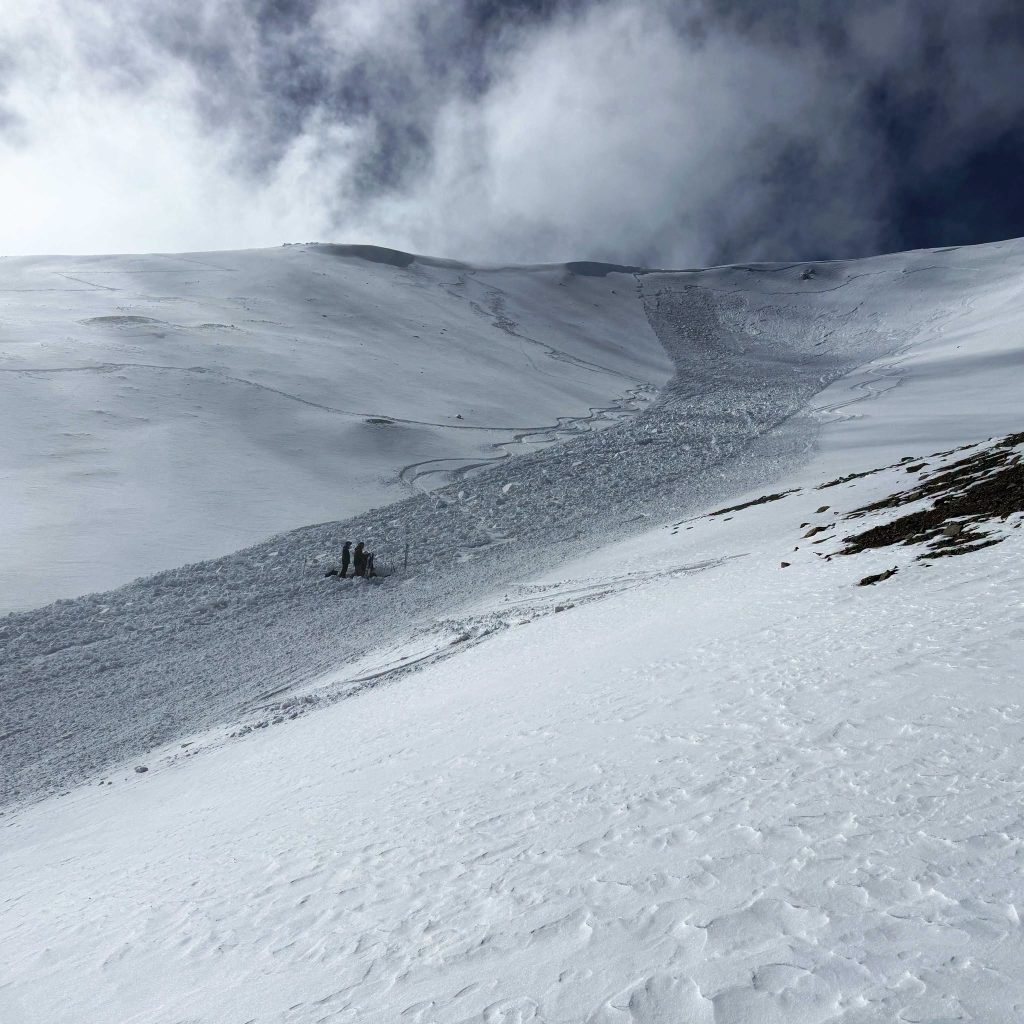
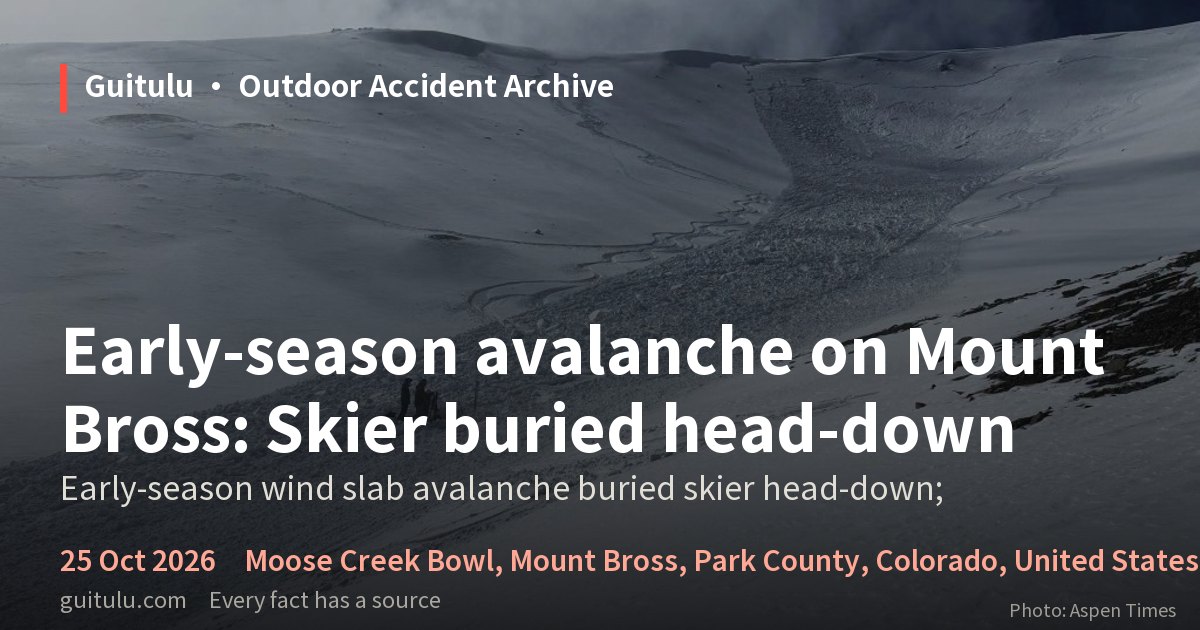
Avalanche debris on the snow slope where the incident occurred on Mount Bross, with ski tracks and the fracture line visible on the slopePhoto source: Aspen Times
The number at the end of a paragraph is how many facts it rests on; open it to see each fact and how well it is sourced:
Multiple sourcesSingle source. Conflicting accounts and speculation are kept out of the narrative.
A companion dug down to the buried skier's airway and cleared their mouth and nose, then found that the skier had stopped breathing. F12
According to the CAIC report, another wave of snow came from behind after the first wave. Because the ski leashes held the skier's feet in place, the skier was buried face-down, with their head pointing downhill. F08
According to the CAIC report, the first skier descended at about 11:30 a.m., and the snow slab broke after three turns. F04
The companions rescued the buried skier in about five minutes. F13
The second skier used an avalanche beacon to search for the buried skier, while the third person called for help. F11
The group then evacuated on their own and cancelled the Park County Search and Rescue team's deployment. F15
It was a wind slab avalanche that broke at about 14092 feet, with an estimated size of R2/D2, and ran down to about 13550 feet. F05
Under each fact is a verbatim quote from the original. "Single source" means only one outlet mentioned it; "Accounts differ" means sources contradict each other and this site adopts neither side; "Speculation" is an inference by a reporter or a person involved, not a fact.
According to Denver Gazette, It was a wind slab avalanche that broke at about 14092 feet, with an estimated size of R2/D2, and ran down to about 13550 feet.
Quotes from the original 1
“a slab ripped off of a bowl at about 14,092 feet. The wind slab avalanche, estimated at R2/D2 in size, reportedly ran down to 13,550 feet of elevation.”
According to FOX31, According to the CAIC report, another wave of snow came from behind after the first wave. Because the ski leashes held the skier's feet in place, the skier was buried face-down, with their head pointing downhill.
Reports differ on the extent of the burial; see the related facts.
Quotes from the original 1
“A second later, another wave of snow hit [the first skier] from behind and fully buried them in the snow face down, because the [ski's] leash had anchored their foot and buried their head downhill”
Accounts differ on the extent of the burial: FOX31, citing the CAIC report, said the skier was completely buried; Denver Gazette, citing a field report, said the skier was partially buried, with their mouth and nose under the snow.
Part of the body may have been exposed while the head was completely buried, with the accounts using different descriptions.
According to FOX31, A companion dug down to the buried skier's airway and cleared their mouth and nose, then found that the skier had stopped breathing.
Quotes from the original 1
“The skier dug a hole to the skier's airway, using a "finger sweep," and that's when the two discovered their friend had stopped breathing.”
According to FOX31, Before ascending, the entire group discussed the avalanche risk, but believed that even if an avalanche occurred, it would be a small, localized one.
Quotes from the original 1
“The whole party discussed the risk of an avalanche before ascending the mountain, but thought it would be isolated and small.”
According to FOX31, According to the CAIC report, two people were nervous about skiing the slope, but did not speak up because the snow cover was thin, they thought an avalanche was unlikely, and the others were enthusiastic.
Quotes from the original 1
“Both felt nervous about skiing this slope, but didn't say anything because the snow cover is so thin, an avalanche seemed unlikely, and the rest of the group seemed stoked,”
According to FOX31, CAIC said the outcome was very fortunate and that, had the rescue been much slower, the outcome could have been completely different.
Quotes from the original 1
“The positive outcome of this incident was very lucky, and had the rescue time been much slower, things could have ended much differently,”
According to Denver Gazette, CAIC said this was an extremely close call and a reminder that it does not take much snow to create dangerous avalanche conditions.
Quotes from the original 1
“This was an extremely close call and a stark reminder that it doesn’t take much snow to create dangerous avalanche conditions”
Park County Search and Rescue suggested that storm patterns in an El Nino year, combined with people's expectations of a big snow season, could lead to more incidents of this kind.
The search and rescue team's speculation
Quotes from the original 1
“I suspect with storm patterns typical of El Niño years combined with everyone anticipating a big winter after a poor 25-26 winter, we may see more of these.”
According to Aspen Times, Lazar said that early in the season, people are often drawn to the slopes with the best snow coverage, which may be the most dangerous slopes.
Quotes from the original 1
“What’s really common in the early season is that we are naturally drawn to potentially the most dangerous slopes because they have the best (snow) coverage”
According to Aspen Times, Lazar cautioned that a few ski tracks on a slope are far from proof that the snow has stabilized, and that people should not assume it is safe because others have skied it.
Quotes from the original 1
“A few tracks on a slope doesn’t get you anywhere near stabilizing the snow.”
According to Aspen Times, Lazar said that even a very small avalanche can have serious consequences if it drags a person over rocks or fallen trees, or carries them over a cliff.
Quotes from the original 1
“Even really small avalanches can lead to pretty severe outcomes because you’re essentially being dragged across the ground”
According to Aspen Times, Experts recommend carrying a beacon, probe and shovel and being trained to use them when entering avalanche terrain; companions should be similarly equipped and trained.
Quotes from the original 1
“carry a transceiver, probe and shovel, have the proper training to use that gear and travel with a partner who is carrying the same gear”
 GuituluGlobal Outdoor Accident Archive