The number at the end of a paragraph is how many facts it rests on; open it to see each fact and how well it is sourced:
Multiple sourcesSingle source. Conflicting accounts and speculation are kept out of the narrative.
Reported locations along the route (schematic)Schematic
Scroll down and the map flies to where each part happened. The line is Schematic, Connects the locations mentioned in reports in sequence, showing only the approximate direction, not the actual track. Sources for the location coordinates are in places.json.
01
Full route
Locations mentioned in reports are connected in sequence to show the approximate route (schematic).
Under each fact is a verbatim quote from the original. "Single source" means only one outlet mentioned it; "Accounts differ" means sources contradict each other and this site adopts neither side; "Speculation" is an inference by a reporter or a person involved, not a fact.
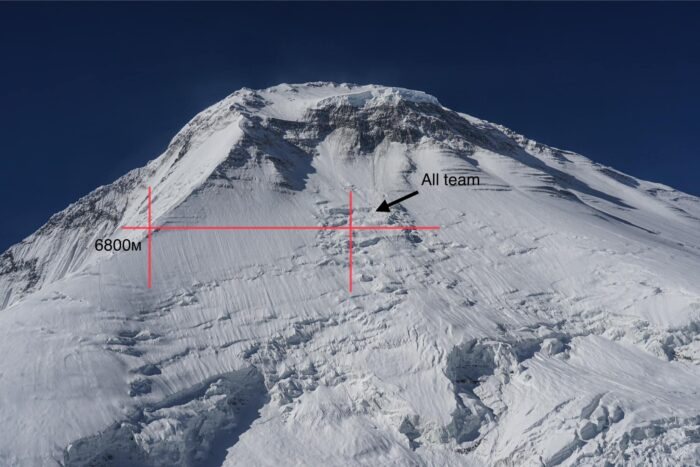
According to StarHit, According to the leader's blog, there was little snow on the route, the glacier was exposed and had many crevasses, and the team mostly moved together while roped up, moving alternately in only three places.
Quotes from the original 2
“Снега на маршруте очень мало, ледник весь открытый и сильно порванный.”
According to Деловой Петербург, According to the leader's post, during the second acclimatisation climb the team marked the route up to an altitude of 7238 metres.
According to The Kathmandu Post, On 28 September, the organiser posted a video filmed by the leader on Facebook, showing heavy snow and damage to the camp.
Quotes from the original 1
“heavy snowfall and damage to the campsite were visible”
According to StarHit, Shamalo told the media that he thought the slope was steep and dangerous, and that gusts at night could also knock people down. He told his teammates that he was not prepared to descend at night.
Quotes from the original 2
“Мне показалось, что склон крутой, опасный, на нем трудно задерживаться.”
Accounts differ on the departure time and the time of last contact: The Kathmandu Post says the last contact was at 11 p.m. on 6 October, when the team had reached an altitude of 8000 metres; ANI says the team departed at 11 p.m. on Sunday and lost contact after passing 8000 metres; Meduza says they departed on the morning of the 6th and last made contact at 11:00 that day; PTI and Деловой Петербург say they left the high camp at 6 a.m.
This may be due to confusion between 11 a.m. and 11 p.m.
Quotes from the original 5
“They had last been in contact on October 6 at 11 pm, after reaching an altitude of 8,000 metres.”
According to PTI, According to the head of Heli Everest, which took part in the search and rescue, the five were moving towards the summit on the same rope when contact was lost.
Quotes from the original 1
“with the help of a single rope when they went missing”
Speculation: The head of the organising company believed the five may have been tied to the same rope, and that one slipped and pulled the others down; the editor-in-chief of a Russian mountaineering outlet also described it as a «roped fall».
Quotes from the original 3
“One of them could have slipped on the slope and all five fell together.”
According to Explorersweb, The helicopter picked up team member Alekseenko, who had summited on 5 October and was waiting at base camp, to join the search along the route.
Quotes from the original 1
“The helicopter picked up Denis Aleksenko (who had summited on October 5 and was waiting in Base Camp) to help search the route.”
Reports differ on the altitude at which the bodies were found: Setopati and ANI say 7600 metres; Everest Chronicle and PTI say 7700 metres; the first Explorersweb report and Meduza say 7100 metres; a later Explorersweb report says the bodies came to rest at approximately 6900 metres.
Some reports may have treated the presumed altitude from which the fall began as the altitude at which the bodies were found
Quotes from the original 6
“the bodies of five Russian climbers were found at an altitude of 7,600 meters on Tuesday morning”
“A helicopter flying up to nearly 7,000m retrieved the bodies of Alexander Dusheyko, Oleg Kruglov, Vladimir Chistikov, Mikhail Nosenko, and Dmitry Shpilevoy via a long line.”
According to Explorersweb, Using a helicopter to transport the bodies meant rescuers did not have to take risks on the mountain; Russian climber Nilov had previously died while recovering a companion's body on Gasherbrum IV.
Quotes from the original 2
“The helicopter allowed rescuers to avoid the potentially dangerous conditions on the mountain.”
According to Деловой Петербург, Team leader Dusheiko was head of the St Petersburg Mountaineering School and had previously been head coach of the Leningrad Region mountaineering team.
Quotes from the original 1
“руководитель Школы альпинизма Санкт-Петербурга Александр Душейко, который работал старшим тренером сборной команды Ленобласти”
 GuituluGlobal Outdoor Accident Archive