GuituluGlobal Outdoor Accident Archive 中文
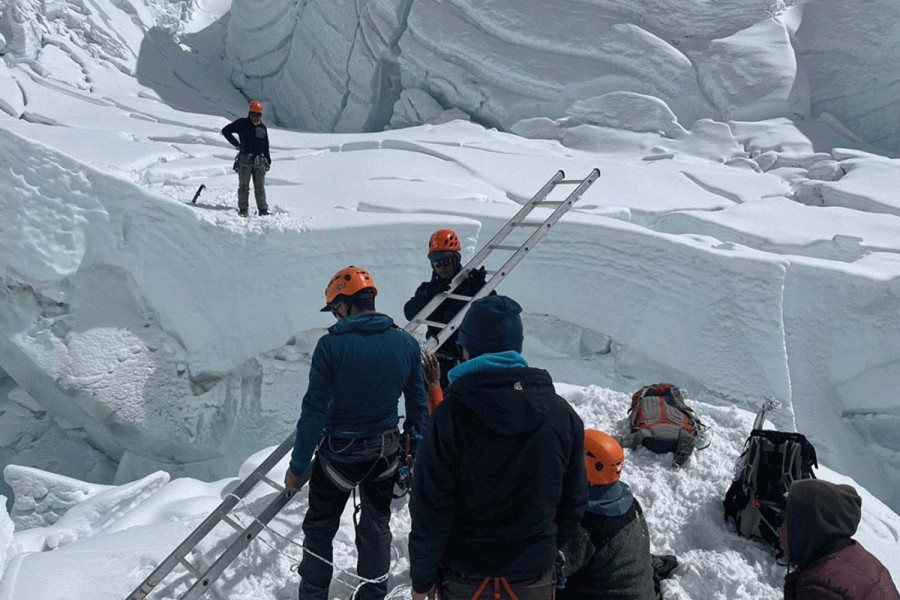
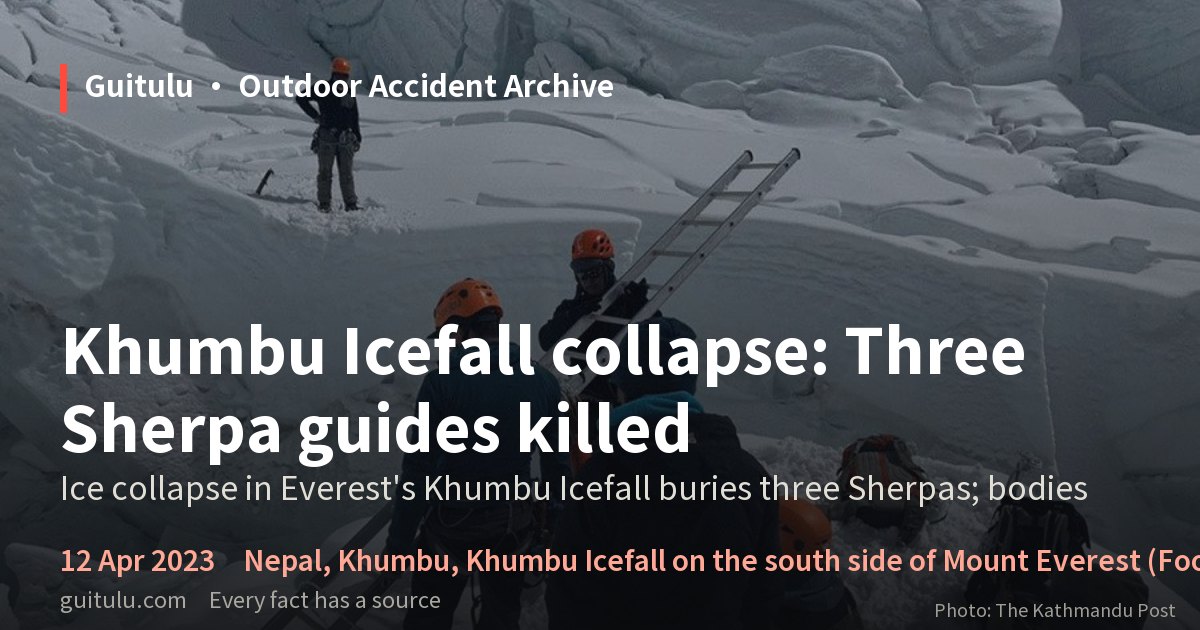
A metal ladder set up in the Khumbu Icefall, with climbers crossing it

Archive / Mountaineering

Khumbu Icefall collapse: Three Sherpa guides killed

Ice collapse in Everest's Khumbu Icefall buries three Sherpas; bodies not recovered

Search and rescue suspended; bodies not recovered

Photo: The Kathmandu Post

Date
Spring
Place
Nepal, Khumbu, Khumbu Icefall on the south side of Mount Everest (Football Field)Nepal › Koshi Province · Himalaya86.870°E 28.002°N
Activity
MountaineeringInvolves: AvalancheThree Sherpas from an approximately 25-person mountain guide team employed by Imagine Nepal
Casualties
Dead 3 Three people were buried under ice; search and rescue was suspended, their bodies were not recovered, and authorities declared them dead
Material
45 facts · 14 sources5 accounts differ and are shown side by side

01What happened

In spring 2023, Imagine Nepal was contracted to establish the route above Camp II on the south side of Everest. Multiple reports said the three victims belonged to an approximately 25-person mountain guide team employed by the company. According to reports, the Icefall Doctors had previously opened the route from Base Camp through the Khumbu Icefall to Camp II.Facts it rests onF03Multiple sourcesImagine Nepal was contracted to establish the route and fix ropes from Camp 2 to the summit that season.F17Multiple sourcesSeveral reports said the three belonged to an approximately 25-person Imagine Nepal mountain guide team responsible for establishing the route above Camp 2.F08Single sourceThe 'icefall doctors' sent by the Sagarmatha Pollution Control Committee (SPCC) had completed the route from base camp through the Khumbu Icefall to Camp 2 on the Thursday before the incident.

A metal ladder set up in the Khumbu Icefall, with climbers crossing itPhoto source: The Kathmandu Post

On 12 April 2023, three Sherpas died in the upper Khumbu Icefall, the first fatalities on Everest that season. The accident occurred below Camp I, at an altitude of about 5700 metres, in an area known as the “Football Field”. According to reports, a massive block of ice more than 50 metres across fell from the mountain, burying the three beneath it.Facts it rests onF15Multiple sourcesOn Wednesday, 12 April 2023, three Sherpas died in the upper section of the Khumbu Icefall.F16Multiple sourcesThis was the first fatal accident on Everest in the spring 2023 climbing season.F20Multiple sourcesThe incident occurred on the Khumbu Icefall below Camp 1, in an area known as the 'Football Field', at an altitude of approximately 5,700 metres.F21Single sourceLakpa Norbu Sherpa, the Himalayan Rescue Association's base camp coordinator, said a huge mass of ice more than 50 metres in size broke off the mountain and buried the three beneath it.

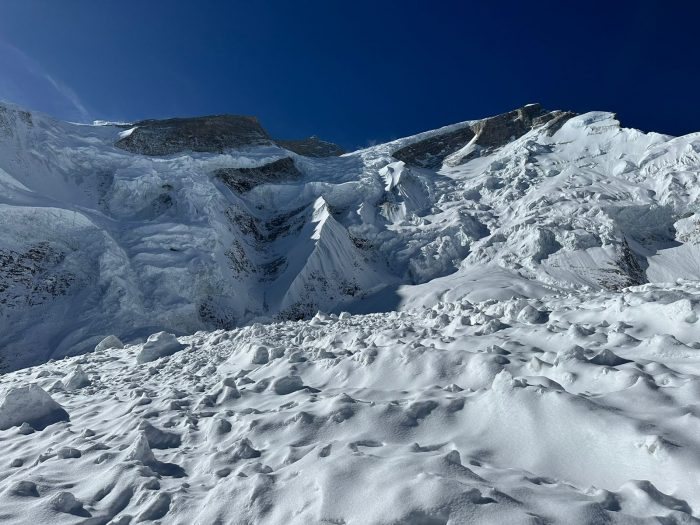
Ice and snow falling from Everest's West Shoulder onto the Khumbu Icefall (file photo, not from this incident)Photo source: Alan Arnette · Alan Arnette

On the day of the accident, rescuers used a helicopter to search the area. According to rescuers at the scene, the three were buried under five or six metres of ice, and the blocks were as large as houses, making excavation impossible. According to reports, Imagine Nepal personnel later went up again to search and identified the area, but were unable to bring the three back; a tourism department official subsequently said search and rescue had been suspended and that the three were buried too deeply for their bodies to be recovered.Facts it rests onF25Multiple sourcesOn the day of the incident, rescuers deployed a helicopter to search the area around the site.F23Multiple sourcesAccording to Lakpa Norbu Sherpa of the Himalayan Rescue Association, the three were buried under five or six metres of ice.F29Single sourceLakpa Norbu Sherpa said the fallen blocks of ice were as large as houses and could not be dug through.F34Single sourceMingma Gyalje Sherpa of Imagine Nepal said on social media that they went up again to search and identified the area, but were unable to bring the three back.F35Single sourceThe search and rescue operation was ultimately called off. Tourism department official Bigyan Koirala said the three were buried too deep and it appeared their bodies could not be recovered.

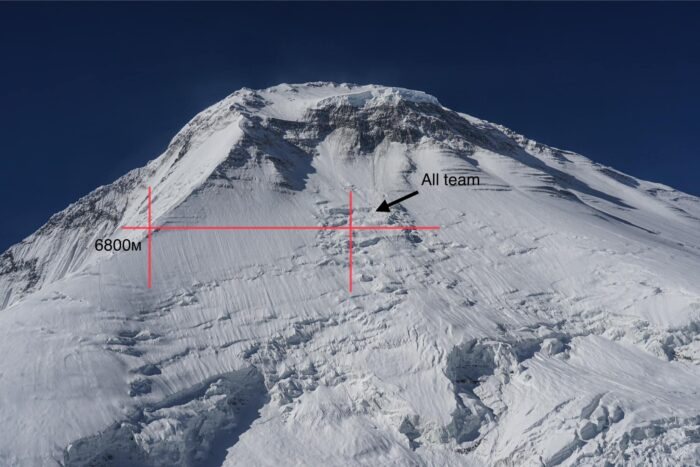
Khumbu Icefall route diagram (2015 new route)Photo source: Alan Arnette · Madison Mountaineering

The bodies of the three were ultimately not recovered, and authorities reportedly declared them dead. A statement from Imagine Nepal confirmed the victims as Dawa Tseri (Da Chhiri) Sherpa, Pemba Tenzing Sherpa and Lakpa Rita Sherpa. The Icefall Doctors rebuilt the damaged section of the route; the route was closed and climbing suspended in the meantime. According to the Himalayan Database, 18 people died on Everest that spring, and the three were the first on the list.Facts it rests onF09Multiple sourcesThe bodies of the three could not be recovered.F14Single sourceAuthorities declared the three dead.F06Multiple sourcesImagine Nepal issued a statement confirming that the three people killed were Dawa Tseri (Da Chhiri) Sherpa, Pemba Tenzing Sherpa and Lakpa Rita Sherpa; Nepali media and other reports also gave these three names, with slightly different spellings.F11Multiple sourcesThe damaged section had to be rebuilt by the icefall doctors; the route was closed and climbing suspended in the meantime.F04Single sourceAccording to updated Himalayan Database statistics, 18 people died on Everest in spring 2023; the first three people on the list were the three Sherpas killed in the serac accident on the Khumbu Icefall.

The number at the end of a paragraph is how many facts it rests on; open it to see each fact and how well it is sourced: Multiple sourcesSingle source. Conflicting accounts and speculation are kept out of the narrative.

ImgScene photos all from news coverage; copyright belongs to the original authors

Satellite imagery Sentinel-2 cloudless 2024 © EOX · Terrain AWS Terrain Tiles · Position is schematic, geocoded from place names · Place coordinates not individually verified

Route review

5 scenes to understand what happened

Scroll down and the map flies to where each part happened.

01

Accident area

The reports do not identify enough points along the route, so the map shows only the approximate location and terrain of the accident area.

04

Excavation impossible

A helicopter searched that day; rescuers said the three were buried under five or six metres of ice, with blocks as large as houses.Facts it rests onF25Multiple sourcesOn the day of the incident, rescuers deployed a helicopter to search the area around the site.F23Multiple sourcesAccording to Lakpa Norbu Sherpa of the Himalayan Rescue Association, the three were buried under five or six metres of ice.F29Single sourceLakpa Norbu Sherpa said the fallen blocks of ice were as large as houses and could not be dug through.

05

Search and rescue suspended

According to reports, search and rescue was ultimately suspended and the bodies were not recovered; the Icefall Doctors rebuilt the damaged section of the route.Facts it rests onF35Single sourceThe search and rescue operation was ultimately called off. Tourism department official Bigyan Koirala said the three were buried too deep and it appeared their bodies could not be recovered.F09Multiple sourcesThe bodies of the three could not be recovered.F11Multiple sourcesThe damaged section had to be rebuilt by the icefall doctors; the route was closed and climbing suspended in the meantime.

02Timeline

  1. According to updated Himalayan Database statistics, 18 people died on Everest in spring 2023; the first three people on the list were the three Sherpas killed in the serac accident on the Khumbu Icefall. F04

  2. The 'icefall doctors' sent by the Sagarmatha Pollution Control Committee (SPCC) had completed the route from base camp through the Khumbu Icefall to Camp 2 on the Thursday before the incident. F08

  3. Authorities declared the three dead. F14

  4. The damaged section had to be rebuilt by the icefall doctors; the route was closed and climbing suspended in the meantime. F11

  5. Rescue expert Ang Tashi Sherpa said the ice and snow could not be dug through and that rescuers had given up. F28

  6. On the day of the incident, rescuers deployed a helicopter to search the area around the site. F25

  7. On Wednesday, 12 April 2023, three Sherpas died in the upper section of the Khumbu Icefall. F15

  8. Surendra Paudel, the Simrik Air pilot who carried out the search and rescue operation, said the helicopter transported three rescuers to a location near the site in three trips. F26

  9. Lakpa Norbu Sherpa said that day that a search could not be conducted because there was still a risk of an avalanche; they had established the location but could not reach it. F24

  10. The incident occurred on the Khumbu Icefall below Camp 1, in an area known as the 'Football Field', at an altitude of approximately 5,700 metres. F20

  11. Lakpa Norbu Sherpa, the Himalayan Rescue Association's base camp coordinator, said a huge mass of ice more than 50 metres in size broke off the mountain and buried the three beneath it. F21

  12. The day after the incident, ExplorersWeb reported that the exact sequence of events remained unclear and Imagine Nepal had not yet released an official report. F32

  13. Mingma Gyalje Sherpa of Imagine Nepal said on social media that they went up again to search and identified the area, but were unable to bring the three back. F34

  14. The search and rescue operation was ultimately called off. Tourism department official Bigyan Koirala said the three were buried too deep and it appeared their bodies could not be recovered. F35

03Lessons

Avalanche and high altitude

Spend less time and make fewer trips through the most dangerous sections

By convention, people cross the Khumbu Icefall in the early morning, when temperatures are low and the ice is more stable, but it remains the most dangerous section of the south-side route on Everest. The “Football Field” section is particularly exposed to the threat of falling ice towers. Mountain guides make multiple trips through such sections each season to carry supplies for expeditions; after the accident, authorities reportedly approved the use of helicopters to carry some supplies up.Facts it rests onF37Multiple sourcesPeople usually cross the Khumbu Icefall at night or early in the morning, when temperatures are lowest and the ice is more stable.F36Multiple sourcesThe Khumbu Icefall lies between Everest Base Camp and Camp I and is considered the most dangerous section of the route on Everest's south side.F38Single sourceThe “Football Field” is in the middle section of the icefall and is the section most exposed to the threat of collapsing ice towers.F41Single sourceNepali guides account for about one-third of deaths on Everest; for each expedition, they make multiple trips through dangerous sections, carrying tents, food and oxygen cylinders to high-altitude camps.F12Single sourceAccording to Montagna.tv, after the accident Nepal's tourism authorities approved the use of helicopters to transport supplies including ropes, tents and food from base camp to advanced base camp.

Avalanche and high altitude

Route alignment determines exposure

In recent years, the Icefall Doctors' route has gradually shifted towards Everest's West Shoulder because it is faster to establish a route that way. According to Alan Arnette, this makes the danger from ice towers overhead apparent, and experienced people have recommended returning to the old route closer to Nuptse.Facts it rests onF39Multiple sourcesIn recent years, the route opened by the Icefall Doctors has gradually shifted towards Everest's West Shoulder because it is faster to establish the route that way.F44Single sourceAlan Arnette wrote that after the route shifted towards the West Shoulder, the danger from ice towers overhead was obvious; veterans Pete Athens and David Breashears recommended returning the route to the 1950s line closer to Nuptse.

Teams and decisions

Take danger warnings from frontline guides seriously

According to one expedition leader, for about a week before the accident, the Sherpas on his team had been saying that the icefall above the “Football Field” looked dangerous. According to reports, the new snow had not settled that season, and the Icefall Doctors had difficulty opening the route. Frontline personnel's assessments of route conditions deserve serious attention.Facts it rests onF13Single sourceGarrett Madison said that for about a week before the incident, the Sherpas on his team had been saying that the icefall above the 'Football Field' looked dangerous.F05Single sourceAn official from the Sagarmatha Pollution Control Committee said the new snow had not settled and that the icefall doctors were having difficulty opening the route through the heavy new snow.

Rescue and self-rescue

Self-rescue and search and rescue are nearly impossible after burial in an ice collapse

According to rescuers at the scene, the three were buried under five or six metres of ice, the blocks were as large as houses, and there was still a risk of another collapse, making it impossible for rescuers to reach them or excavate. The bodies of the three were ultimately not recovered.Facts it rests onF23Multiple sourcesAccording to Lakpa Norbu Sherpa of the Himalayan Rescue Association, the three were buried under five or six metres of ice.F29Single sourceLakpa Norbu Sherpa said the fallen blocks of ice were as large as houses and could not be dug through.F24Single sourceLakpa Norbu Sherpa said that day that a search could not be conducted because there was still a risk of an avalanche; they had established the location but could not reach it.F09Multiple sourcesThe bodies of the three could not be recovered.

04Fact list 45 facts

Under each fact is a verbatim quote from the original. "Single source" means only one outlet mentioned it; "Accounts differ" means sources contradict each other and this site adopts neither side; "Speculation" is an inference by a reporter or a person involved, not a fact.

  1. F01Multiple sourcesBackground

    On 18 April 2014, an avalanche triggered by a collapsing serac on the Khumbu Icefall killed 16 Sherpa guides.

    Quotes from the original 3

    “On April 18, 2014, an avalanche resulting from a falling serac buried 16 sherpa guides in the Khumbu Icefall”

    The Kathmandu Post · 2023-04-12

    “On April 18, 2014, at 6:45 am, a huge ice avalanche caused by a toppled serac killed 16 sherpas in the Icefall.”

    ExplorersWeb ·

    “In 2014, an immense tumbling wall of snow, ice and rock killed 16 Nepali guides on the icefall”

    Deccan Herald ·
  2. F02Single sourceBackground

    According to Abenteuer Berg, According to Abenteuer Berg, Pemba Tenzing was 31 and had summited six 8,000-metre peaks in 2022 alone.

    Quotes from the original 2

    “The best known of the three missing in the mountaineering scene is 31-year-old Pemba Tenzing.”

    Abenteuer Berg ·

    “In 2022 alone, Pemba Tenzing stood on six of the world’s 14 highest mountains”

    Abenteuer Berg ·
  3. F03Multiple sourcesBackground

    Imagine Nepal was contracted to establish the route and fix ropes from Camp 2 to the summit that season.

    Quotes from the original 3

    “Imagine Nepal Trek and Expedition has won the bid to prepare the route from Camp 2 to the summit.”

    The Kathmandu Post · 2023-04-12

    “In 2023 it was awarded to Imagine Nepal.”

    Alan Arnette · 2023-04-12

    “The company has been assigned to open route above Camp II for this year's spring season.”

    Everest Chronicle ·
  4. F04Single sourceAftermath

    According to ExplorersWeb, According to updated Himalayan Database statistics, 18 people died on Everest in spring 2023; the first three people on the list were the three Sherpas killed in the serac accident on the Khumbu Icefall.

    Several quotations come from different reports by the same outlet and count as one source.

    Quotes from the original 2

    “The three first Sherpas on the list perished while fixing the route, in a serac accident in the Khumbu Icefall.”

    ExplorersWeb ·

    “Last year, of the 18 people who died on Everest, one third were sherpas.”

    ExplorersWeb ·
  5. F05Single sourceBackground

    According to Everest Chronicle, An official from the Sagarmatha Pollution Control Committee said the new snow had not settled and that the icefall doctors were having difficulty opening the route through the heavy new snow.

    Quotes from the original 1

    ““Fresh snow has not settled properly, which makes it tricky. The icefall doctors had tough time navigating the route through mounds of fresh snow,” said Tshering.”

    Everest Chronicle ·
  6. F06Multiple sourcesFound at scene

    Imagine Nepal issued a statement confirming that the three people killed were Dawa Tseri (Da Chhiri) Sherpa, Pemba Tenzing Sherpa and Lakpa Rita Sherpa; Nepali media and other reports also gave these three names, with slightly different spellings.

    Quotes from the original 4

    “three of our Sherpa brothers, Dawa Tseri Sherpa, Pemba Tenzing Sherpa and Lakpa Rita Sherpa”

    Alan Arnette · 2023-04-16

    “The three missing are Lakpa Rita Sherpa, Pemba Tenjing Sherpa and Da Chhiri Sherpa, all seasoned climbers and Everest summiteers.”

    Everest Chronicle ·

    “The authorities therefore declared Da Chhiri Sherpa, Pemba Tenzing Sherpa and Lakpa Rita Sherpa dead.”

    Abenteuer Berg ·

    “The figure includes Dawa Chhiri, Lakpa Rita, and Pemba Tenzing Sherpa”

    ExplorersWeb ·
  7. F07Accounts differFound at scene

    Accounts of the victims' names differed in the early reports: Alan Arnette and Montagna.tv named Tenjing, Lakpa (Lhakpa), and Badure on the day of the incident; ExplorersWeb named Da Chhiree, Lakpa Tendi, and Lakpa Rita the following day; Onlinekhabar's May roundup named Da Chhiri, Lhakpa Tendi, and Pemba Tenzing.

    The early lists may have been incorrect; Imagine Nepal's statement named Dawa Tseri, Pemba Tenzing and Lakpa Rita.

    Quotes from the original 4

    “The lost have been identified as Tenjing Sherpa, Lakpa Sherpa, and Badure Sherpa.”

    Alan Arnette · 2023-04-12

    “Si tratta di Tenjing Sherpa, di Lhakpa Sherpa e di Badure Sherpa, che lavoravano per l’agenzia Imagine Nepal.”

    Montagna.tv ·

    “The deceased climbers were Da Chhiree Sherpa, Lakpa Tendi Sherpa, and Lakpa Rita Sherpa.”

    ExplorersWeb · 2023-04-13

    “rope-fixing team members Da Chhiri Sherpa, Lhakpa Tendi Sherpa and Pemba Tenzing Sherpa”

    Onlinekhabar ·
  8. F08Single sourceBackground

    According to The Kathmandu Post, The 'icefall doctors' sent by the Sagarmatha Pollution Control Committee (SPCC) had completed the route from base camp through the Khumbu Icefall to Camp 2 on the Thursday before the incident.

    Quotes from the original 1

    “had completed preparing the route from base camp through the Khumbu Icefall to Camp 2 last Thursday”

    The Kathmandu Post · 2023-04-12
  9. F09Multiple sourcesAftermath

    The bodies of the three could not be recovered.

    Quotes from the original 2

    “Their bodies could not be recovered.”

    ExplorersWeb ·

    “These couple of days, we relentlessly tried to recover our brothers’ bodies but failed.”

    Alan Arnette · 2023-04-16
  10. F10Single sourceAftermath

    According to Everest Chronicle, A Sagarmatha Pollution Control Committee official said the serac collapse destroyed a roughly 60-metre section of the route, which was subsequently repaired.

    Quotes from the original 1

    ““The serac destroyed about 60 m section of the route which has been fixed by now,” said Tshering Sherpa, executive officer of SPCC.”

    Everest Chronicle ·
  11. F11Multiple sourcesAftermath

    The damaged section had to be rebuilt by the icefall doctors; the route was closed and climbing suspended in the meantime.

    Quotes from the original 3

    “This section of the route will have to be rebuilt by the Icefall Doctors, so teams will pause climbing for a couple of days.”

    Alan Arnette · 2023-04-12

    “The severely damaged route across the Icefall will have to be redone.”

    ExplorersWeb · 2023-04-13

    “la via di salita è stata chiusa per consentire agli Icefall doctors di riattrezzarla”

    Montagna.tv ·
  12. F12Single sourceAftermath

    According to Montagna.tv, According to Montagna.tv, after the accident Nepal's tourism authorities approved the use of helicopters to transport supplies including ropes, tents and food from base camp to advanced base camp.

    Quotes from the original 1

    “ha approvato l’uso di elicotteri per trasportare corde, chiodi, tende, viveri e altro materiale dal campo-base al campo-base avanzato”

    Montagna.tv ·
  13. F13Single sourceParticipant's view

    According to Alan Arnette, Garrett Madison said that for about a week before the incident, the Sherpas on his team had been saying that the icefall above the 'Football Field' looked dangerous.

    Quotes from the original 1

    ““our Sherpas had been telling me for a week or so before the collapse that the icefall seemed very dangerous above the football field..””

    Alan Arnette · 2023-04-16
  14. F14Single sourceAftermath

    According to Abenteuer Berg, Authorities declared the three dead.

    Quotes from the original 1

    “The authorities therefore declared Da Chhiri Sherpa, Pemba Tenzing Sherpa and Lakpa Rita Sherpa dead.”

    Abenteuer Berg ·
  15. F15Multiple sourcesEvent

    On Wednesday, 12 April 2023, three Sherpas died in the upper section of the Khumbu Icefall.

    Montagna.tv gives the date as 11 April; all other sources give 12 April.

    Quotes from the original 3

    “Tragedy struck on Wednesday, April 12, 2023, when three sherpas working for Imagine Nepal died in the upper Khumbu Icefall.”

    Alan Arnette · 2023-04-16

    “Dawa Chhiri, Lakpa Rita, and Pemba Tenzing Sherpa who died on April 12 at 5,700m in an icefall collapse”

    ExplorersWeb ·

    “who died on the mountain on April 12 when the upper section of the Icefall collapsed”

    Onlinekhabar ·
  16. F16Multiple sourcesEvent

    This was the first fatal accident on Everest in the spring 2023 climbing season.

    Quotes from the original 3

    “in the season’s first accident on the world’s tallest peak—Everest”

    The Kathmandu Post · 2023-04-12

    “acknowledging the first fatalities on the world's highest mountain this climbing season”

    Deccan Herald ·

    “ha fatto le prime vittime della stagione 2023”

    Montagna.tv ·
  17. F17Multiple sourcesMovement

    Several reports said the three belonged to an approximately 25-person Imagine Nepal mountain guide team responsible for establishing the route above Camp 2.

    Everest Chronicle quoted Imagine Nepal as saying the three were not members of the route-fixing team; see the claim on differing accounts of their movements.

    Quotes from the original 3

    “a team of around 25 high-altitude guides from Imagine Nepal Trek and Expedition were climbing above the Khumbu Icefall to prepare the route from ‘Camp 2’ to the summit”

    The Kathmandu Post · 2023-04-13

    “They were part of a twenty-five-person team carrying supplies to Camp 2, where they would fix the ropes to the summit.”

    Alan Arnette · 2023-04-16

    “They were part of a 25-person team from Imagine Nepal, assigned to fix the ropes between Camp 2 at 6,400m and the 8,849m summit of Everest.”

    ExplorersWeb · 2023-04-13
  18. F18Accounts differMovement

    Accounts differ about the three men's movements at the time of the incident: Alan Arnette reported that their team was carrying supplies to Camp 2; Everest Chronicle quoted Imagine Nepal's Palden Sherpa as saying they were descending after unloading supplies at Camp 2 and were not members of the route-fixing team, but of the company's regular expedition team.

    Quotes from the original 3

    “They were part of a twenty-five-person team carrying supplies to Camp 2, where they would fix the ropes to the summit.”

    Alan Arnette · 2023-04-16

    “"They were descending from Camp II after unloading expedition logistics," Palden Sherpa of the company told Everest Chronicle.”

    Everest Chronicle ·

    “Imagine Nepal said they were not members of their rope fixing team.”

    Everest Chronicle ·
  19. F19Accounts differEvent

    Accounts differ on the time of the incident: the Himalayan Rescue Association's base camp coordinator and Alan Arnette said it was 9:30 a.m.; a Nepal Tourism Board official told Everest Chronicle that the avalanche occurred between 3 and 4 a.m.

    Quotes from the original 3

    “The accident took place at 9:30 am when the team of around 25 high-altitude guides were climbing above the Khumbu Icefall”

    The Kathmandu Post · 2023-04-12

    “This incident occurred relatively late in the morning at 9:30 am local time”

    Alan Arnette · 2023-04-12

    ““An avalanche occurred between 3 to 4 am,” said Yuba Raj Khatiwada, Director at the Department of Tourism”

    Everest Chronicle ·
  20. F20Multiple sourcesEvent

    The incident occurred on the Khumbu Icefall below Camp 1, in an area known as the 'Football Field', at an altitude of approximately 5,700 metres.

    Alan Arnette and Montagna.tv gave the altitude as approximately 5,800 metres.

    Quotes from the original 3

    “as the climbers were crossing the so-called Football Field at 5,700m, Norbu Sherpa said”

    ExplorersWeb · 2023-04-13

    “the massive ice sheet of more than 50 metres tumbled down the mountain, below Camp 1 at 5,700 metres, and buried three guides”

    The Kathmandu Post · 2023-04-12

    “We reached the site which is also locally known as ‘football field’ at 11:15 am.”

    The Kathmandu Post · 2023-04-13
  21. F21Single sourceEvent

    According to The Kathmandu Post, Lakpa Norbu Sherpa, the Himalayan Rescue Association's base camp coordinator, said a huge mass of ice more than 50 metres in size broke off the mountain and buried the three beneath it.

    Several quotations come from different reports by the same outlet and are counted as one source

    Quotes from the original 2

    “the massive ice sheet of more than 50 metres tumbled down the mountain, below Camp 1 at 5,700 metres, and buried three guides”

    The Kathmandu Post · 2023-04-12

    “the massive ice sheet of more than 50 metres tumbled down the mountain, below ‘Camp 1’ at 5,700 metres, and buried three guides”

    The Kathmandu Post · 2023-04-13
  22. F22Accounts differEvent

    Accounts differ on whether the three were buried by ice or fell into a crevasse: Lakpa Norbu Sherpa of the Himalayan Rescue Association said they did not fall into a crevasse but were buried beneath the ice, and Alan Arnette also believed they were not swept into a deep crevasse; reports by Everest Chronicle, Agence France-Presse and The National said they were swept or fell into a crevasse.

    Quotes from the original 5

    ““It’s not that they fell into crevasses. They are buried under the ice masses in the Khumbu Icefall, the most dangerous section of Everest,” said Norbu.”

    The Kathmandu Post · 2023-04-12

    “they were not swept into a deep crevasse in the Icefall”

    Alan Arnette · 2023-04-12

    “Three Sherpa guides were swept down into the crevasses in Khumbu Icefall early Wednesday morning as a serac collapsed on the route triggering a massive avalanche”

    Everest Chronicle ·

    “a block of glacial ice fell and swept them into a deep crevasse”

    Deccan Herald ·

    “Three Sherpa climbers were confirmed dead on Wednesday after falling into a deep crevasse on Mount Everest.”

    The National · 2023-04-12
  23. F23Multiple sourcesFound at scene

    According to Lakpa Norbu Sherpa of the Himalayan Rescue Association, the three were buried under five or six metres of ice.

    Several reports quote Lakpa Norbu Sherpa of the Himalayan Rescue Association; he later revised his statement to say it might have been five or six metres or deeper, and that he was not sure.; Some sources are of low credibility

    Quotes from the original 2

    ““They are buried five to six metres underneath.”

    The Kathmandu Post · 2023-04-12

    “"They are buried five to six metres underneath," said Lakpa Norbu Sherpa.”

    IBTimes ·
  24. F24Single sourceEvent

    According to The Kathmandu Post, Lakpa Norbu Sherpa said that day that a search could not be conducted because there was still a risk of an avalanche; they had established the location but could not reach it.

    Quotes from the original 2

    “It’s not possible to launch a search mission because the risk of an avalanche is still ongoing,” said Norbu Sherpa”

    The Kathmandu Post · 2023-04-12

    ““We have traced the spot but it’s not possible to go there.”

    The Kathmandu Post · 2023-04-12
  25. F25Multiple sourcesEvent

    On the day of the incident, rescuers deployed a helicopter to search the area around the site.

    Quotes from the original 2

    “started aerial and long line search immediately after the incident was reported, but it yielded no results”

    Everest Chronicle ·

    “A chopper has made three rounds in the area already, said Koirala.”

    The Kathmandu Post · 2023-04-12
  26. F26Single sourceEvent

    According to The Kathmandu Post, Surendra Paudel, the Simrik Air pilot who carried out the search and rescue operation, said the helicopter transported three rescuers to a location near the site in three trips.

    Quotes from the original 1

    “Surendra Paudel, a Simrik Air captain, who conducted the search and rescue mission said three rescuers were dropped near the site in three flights.”

    The Kathmandu Post · 2023-04-13
  27. F27Single sourcePlan

    According to The Kathmandu Post, Tourism department official Bigyan Koirala said rescuers planned to use RECCO detectors and avalanche transceivers to search for those buried.

    Quotes from the original 1

    “He said the rescuers would use the Recco detector and avalanche transceiver, devices used to search and locate people buried under snow.”

    The Kathmandu Post · 2023-04-12
  28. F28Single sourceEvent

    According to The Kathmandu Post, Rescue expert Ang Tashi Sherpa said the ice and snow could not be dug through and that rescuers had given up.

    Quotes from the original 2

    “Ang Tashi Sherpa, another rescue specialist, said it’s not possible to dig up the snow.”

    The Kathmandu Post · 2023-04-13

    ““The rescuers gave up. We don’t know whether the search operation will continue.””

    The Kathmandu Post · 2023-04-13
  29. F29Single sourceFound at scene

    According to The Kathmandu Post, Lakpa Norbu Sherpa said the fallen blocks of ice were as large as houses and could not be dug through.

    ExplorersWeb also relayed this statement, citing the same source, The Kathmandu Post.

    Quotes from the original 1

    ““The ice sheets are as big as houses. It’s not possible to dig either,” he said.”

    The Kathmandu Post · 2023-04-13
  30. F30Single sourceEvent

    According to Everest Chronicle, According to Everest Chronicle, rescuers from the Himalayan Rescue Association and the Sagarmatha Pollution Control Committee immediately conducted an aerial and long-line search after the incident, but did not find the three.

    Quotes from the original 1

    “started aerial and long line search immediately after the incident was reported, but it yielded no results”

    Everest Chronicle ·
  31. F31Accounts differPost-incident analysis

    Accounts differ on the source of the collapse: Alan Arnette and Montagna.tv believed ice towers had collapsed from Everest's West Shoulder; Madison Mountaineering leader Garrett Madison, relaying his Sherpa team members' account, believed a hollow section of ice within the Khumbu Icefall had collapsed, rather than an avalanche from the West Shoulder.

    Quotes from the original 3

    “Debris from an apparent serac release off Everest’s west shoulder has taken the lives of three Sherpas in the Khumbu Icefall.”

    Alan Arnette · 2023-04-12

    “sono stati dei blocchi di ghiaccio caduti dai ripidi e pericolosi pendii della Spalla Ovest dell’Everest”

    Montagna.tv ·

    ““The accident was a collapse in the Khumbu Icefall, not an avalanche from the West Shoulder,” Madison told ExplorersWeb.”

    ExplorersWeb · 2023-04-13
  32. F32Single sourceFound at scene

    According to ExplorersWeb, The day after the incident, ExplorersWeb reported that the exact sequence of events remained unclear and Imagine Nepal had not yet released an official report.

    Quotes from the original 2

    “One day later, details on exactly what happened remain sketchy.”

    ExplorersWeb · 2023-04-13

    “As yet, Imagine Nepal has published no official report.”

    ExplorersWeb · 2023-04-13
  33. F33Single sourceParticipant's view

    According to ExplorersWeb, British guide Tim Mosedale said it was difficult to tell whether this was an isolated incident or the beginning of a period of instability.

    Quotes from the original 1

    ““It is difficult to know whether it’s an isolated incident or the start of a period of instability,” UK guide Tim Mosedale told ExplorersWeb.”

    ExplorersWeb · 2023-04-13
  34. F34Single sourceEvent

    According to Deccan Herald, Mingma Gyalje Sherpa of Imagine Nepal said on social media that they went up again to search and identified the area, but were unable to bring the three back.

    Quotes from the original 1

    “"This morning we went back to find them and were able to locate the area but it wasn't possible to bring them back home," Mingma Gyalje Sherpa of expedition company Imagine Nepal posted on Instagram late Friday.”

    Deccan Herald ·
  35. F35Single sourceAftermath

    According to Deccan Herald, The search and rescue operation was ultimately called off. Tourism department official Bigyan Koirala said the three were buried too deep and it appeared their bodies could not be recovered.

    Quotes from the original 1

    “"After several search and rescue attempts, the operation has been called off. They are buried too deep and it does not seem possible to retrieve the bodies," tourism department official Bigyan Koirala told AFP.”

    Deccan Herald ·
  36. F36Multiple sourcesBackground

    The Khumbu Icefall lies between Everest Base Camp and Camp I and is considered the most dangerous section of the route on Everest's south side.

    Quotes from the original 4

    “They are buried under the ice masses in the Khumbu Icefall, the most dangerous section of Everest”

    The Kathmandu Post · 2023-04-12

    “The Khumbu Icefall is the most dangerous part of the normal route.”

    ExplorersWeb ·

    “Located between Base Camp and Camp 1, hundreds cross it every year.”

    ExplorersWeb ·

    “lies just above the Everest base camp”

    The Kathmandu Post · 2023-04-12
  37. F37Multiple sourcesBackground

    People usually cross the Khumbu Icefall at night or early in the morning, when temperatures are lowest and the ice is more stable.

    Quotes from the original 2

    “Normally, the route is crossed between 3am and 5am, the time when the ice blocks and the hanging glaciers are stable and avalanche risks are low.”

    The Kathmandu Post · 2023-04-12

    “Climbers generally pass through the Icefall in the early morning hours when the ice is stable due to the coldest temperatures of the day.”

    Alan Arnette · 2023-04-12
  38. F38Single sourceBackground

    According to ExplorersWeb, The “Football Field” is in the middle section of the icefall and is the section most exposed to the threat of collapsing ice towers.

    Quotes from the original 1

    “That section, right in the middle of the Icefall, is the one most exposed to falling seracs.”

    ExplorersWeb · 2023-04-13
  39. F39Multiple sourcesPost-incident analysis

    In recent years, the route opened by the Icefall Doctors has gradually shifted towards Everest's West Shoulder because it is faster to establish the route that way.

    Quotes from the original 2

    “In the past decade, it had shifted more towards the West Shoulder because it was faster for the Icefall Doctors to create the route. But the danger was obvious with the serac looming overhead.”

    Alan Arnette · 2023-04-12

    “Poi gli Icefall doctors, in cerca del percorso più veloce, si sono via via spostati verso la base della Spalla Ovest dell’Everest.”

    Montagna.tv ·
  40. F40Single sourceBackground

    According to The Kathmandu Post, According to Himalayan Database statistics, 44 people died in the Khumbu Icefall between 1953 and 2016.

    Quotes from the original 1

    “The Himalayan Database has recorded 44 deaths on the Khumbu Icefall from 1953 to 2016.”

    The Kathmandu Post · 2023-04-12
  41. F41Single sourceBackground

    According to Deccan Herald, Nepali guides account for about one-third of deaths on Everest; for each expedition, they make multiple trips through dangerous sections, carrying tents, food and oxygen cylinders to high-altitude camps.

    Quotes from the original 2

    “They account for around a third of the deaths on Everest, underscoring the risks they take in service of the hundreds of adventurers aiming to summit the world's highest peak.”

    Deccan Herald ·

    “For each expedition, they make several dangerous trips to ferry tents, food and oxygen bottles to high-altitude camps.”

    Deccan Herald ·
  42. F42Multiple sourcesBackground

    Pemba Tenzing Sherpa, who died in the incident, was an experienced high-altitude guide who had summited Everest multiple times.

    Two sources give different numbers of summits, so no specific number is given here.

    Quotes from the original 2

    “He scaled Everest five more times”

    Abenteuer Berg ·

    “Pemba has summited nine of the 14 peaks above 8,000m, and is 7 times Everest summiteer”

    Everest Chronicle ·
  43. F43Single sourceBackground

    According to The Kathmandu Post, The Khumbu Icefall is at an altitude of approximately 5500 to 5800 metres, immediately above Everest Base Camp.

    Quotes from the original 1

    “The Khumbu Icefall stretches from 5,500 to 5,800 metres and lies just above the Everest base camp.”

    The Kathmandu Post · 2023-04-12
  44. F44Single sourcePost-incident analysis

    According to Alan Arnette, Alan Arnette wrote that after the route shifted towards the West Shoulder, the danger from ice towers overhead was obvious; veterans Pete Athens and David Breashears recommended returning the route to the 1950s line closer to Nuptse.

    Quotes from the original 1

    “But the danger was obvious with the serac looming overhead. Looking at old maps and pictures, long-time veterans Pete Athens and David Breashears suggested the route should return towards Nuptse as it was in the 1950s.”

    Alan Arnette · 2023-04-12
  45. F45Single sourcePost-incident analysis

    According to Alan Arnette, Based on Himalayan Database statistics, Alan Arnette said 45 people died in the Khumbu Icefall between 1953 and 2019, of whom 22, or about half, died in avalanches that fell onto the icefall.

    Quotes from the original 2

    “There were 45 total deaths in the Icefall or 23% of the 194 total deaths on the Nepal side from 1953 to 2019.”

    Alan Arnette · 2023-04-12

    “Avalanche onto the Icefall: 22 deaths or 49%”

    Alan Arnette · 2023-04-12