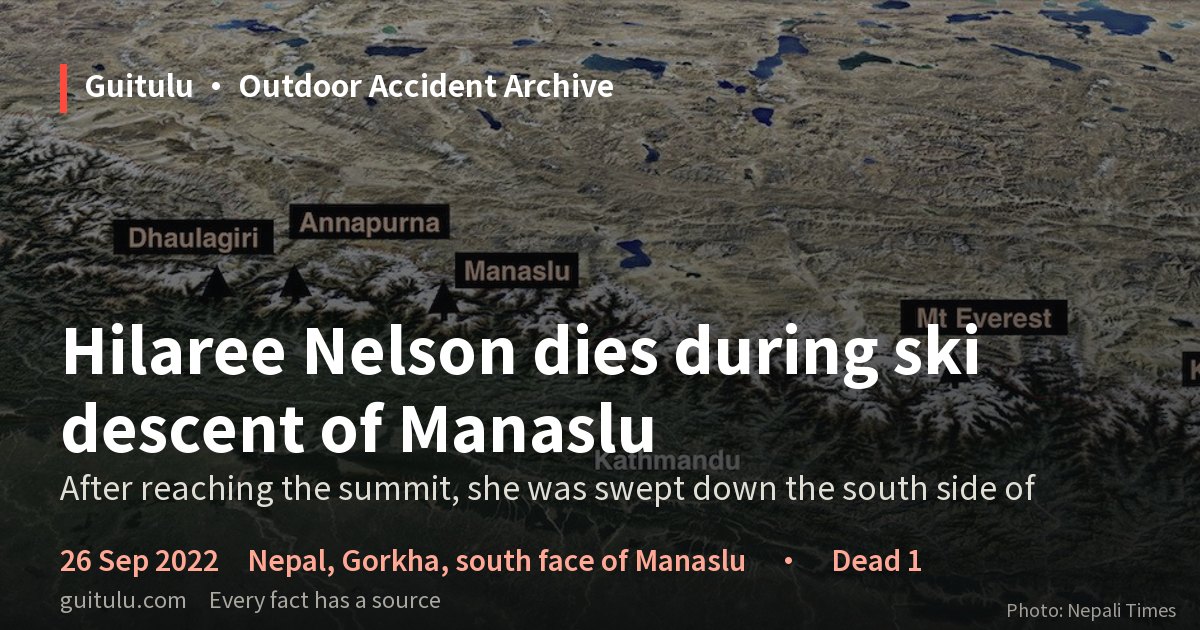
Ski mountaineeringInvolves: Avalanche · Falls and slips2 people (Nelson and her partner Jim Morrison), accompanied by a Sherpa support team
Casualties
Dead 1 Nelson died; on the same day (other reports say the following day), another avalanche on Manaslu killed Nepali guide Anup Rai and injured several people. It was a separate accident
Material
39 facts · 10 sources4 accounts differ and are shown side by side
The number at the end of a paragraph is how many facts it rests on; open it to see each fact and how well it is sourced:
Multiple sourcesSingle source. Conflicting accounts and speculation are kept out of the narrative.
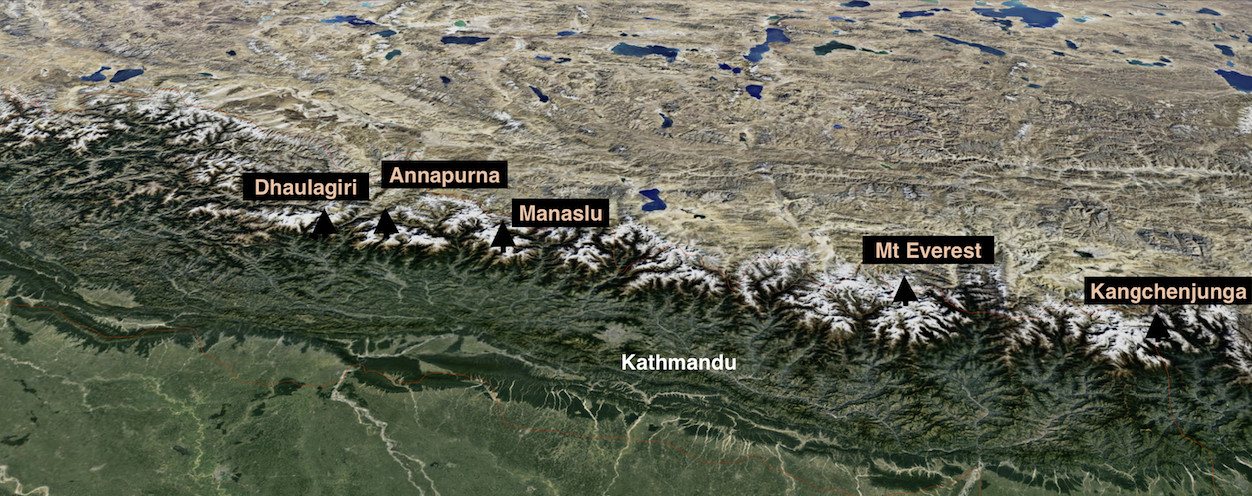
Reported locations along the route (illustrative)Schematic
Scroll down and the map flies to where each part happened. The line is Schematic, Lines connect the locations mentioned in reports in sequence, showing only the approximate direction, not the actual track. Sources for the location coordinates are in places.json.
01
Full route
Locations mentioned in reports are connected in sequence to show the approximate course of events (schematic).
During the descent, Morrison skied first. After he made a few turns, Nelson followed and triggered a small avalanche. F21
Morrison said that the two quickly changed from climbing to skiing in the cold and strong wind, planning to meet the Sherpa team after going around a corner. F20
On Monday, 26 September 2022, Nelson and Morrison reached the true summit of Manaslu. F18
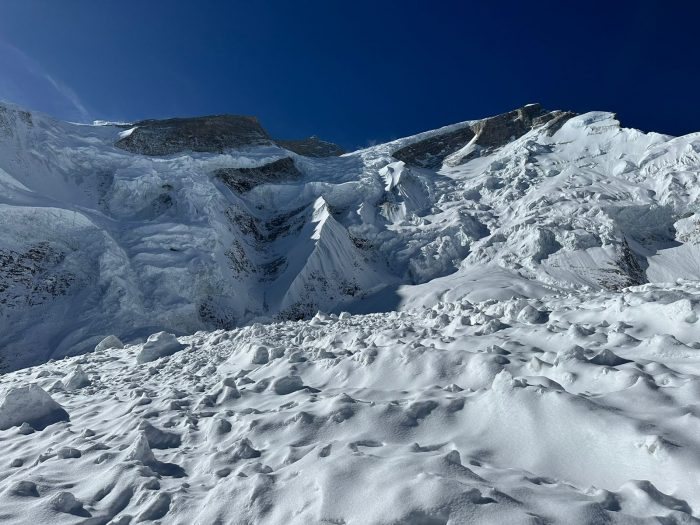
Nelson was knocked down by the avalanche and carried down a narrow snow slope on the south side of the mountain, the opposite side from the climbing route. F22
Morrison said he did everything he could to find Nelson but was unable to descend that face. F25
During an aerial search on 27 September (Tuesday), search and rescue personnel saw what appeared to be skis and clothing, but the weather deteriorated and the helicopter could not fly close enough to confirm. F28
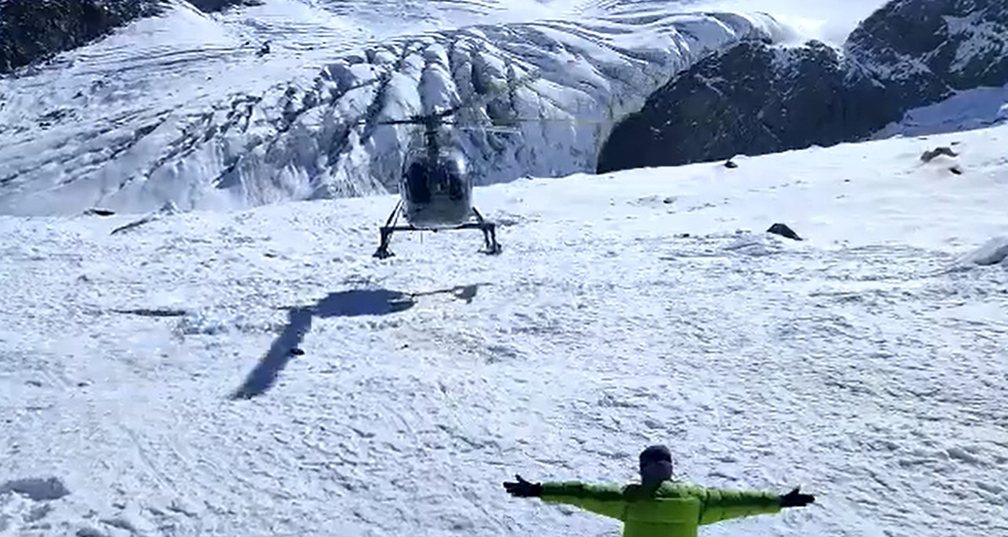
A helicopter took Morrison and Sherpas to an altitude of about 22000 feet (about 6700 metres) to search. F30
After the weather improved on 28 September (Wednesday), a helicopter returned to the same area, and Nelson's body was found and recovered that morning on the south face of Manaslu. F29
Her body was then flown by helicopter to Kathmandu in preparation for an autopsy. F34
Under each fact is a verbatim quote from the original. "Single source" means only one outlet mentioned it; "Accounts differ" means sources contradict each other and this site adopts neither side; "Speculation" is an inference by a reporter or a person involved, not a fact.
“In 2012 she climbed to the summit of both Mount Everest and neighboring Lhotse, the world’s fourth-highest peak, within 24 hours. She was the first woman to do so.”
In 2018, Nelson returned to Lhotse and completed the first ski descent of the peak.
Quotes from the original 3
“Six years later, she returned to Lhotse and made the first ski descent of the mountain, which earned her the National Geographic Adventurer of the Year award.”
In a social media post a few days before the incident, Nelson wrote that she had not felt as “sure-footed” on Manaslu as she had on past adventures into the high Himalayas.
Quotes from the original 3
“I haven't felt as sure-footed on Manaslu as I have on past adventure into the thin atmosphere of the high Himalaya”
According to Nepali Times, According to reports, large amounts of fresh snow had accumulated on dangerous overhanging snow formations along the summit ridge that year, and climbers who summited in early September said the slopes were unstable.
Quotes from the original 2
“Conditions on Manaslu this year were dangerous because of a lot of new snow piled on top of the precarious overhangs on the summit ridge.”
Also on Manaslu, another avalanche occurred at a lower altitude between Camp 3 and Camp 4, killing Nepali guide Anup Rai and injuring several others. It was a separate incident from Nelson's accident.
Quotes from the original 3
“a powerful avalanche occurred between Camps III and IV of Manaslu, killing Anup Rai, a mountain guide, police said. Several others were injured.”
Accounts differ on the date of the avalanche that killed Anup Rai: most reports said it occurred on 26 September, the same Monday as Nelson's accident; Nepali Times said it occurred a day later.
Quotes from the original 3
“In a separate event on Monday, a powerful avalanche occurred between Camps III and IV of Manaslu”
According to The Kathmandu Post, According to a Nepal Tourism Board official, the avalanche seriously injured 4 guides and caused minor injuries to another 9 people; the high-altitude support workers caught in the avalanche were carrying supplies to Camp 4 at the time.
Quotes from the original 2
““Four climbing guides have sustained critical injuries,” said Koirala, the official of the tourism department. “Nine others had minor injuries.””
According to The Kathmandu Post, According to reports, Yukta Gurung, a “glacier doctor” at base camp, believed the avalanche was triggered by persistent snowfall: it had snowed for 15 consecutive days beforehand, and the snow was at least five or six feet deep.
Quotes from the original 1
“It had snowed unceasingly for 15 days. The area was covered in at least five to six feet of snow; the piled-up snow ultimately gave way, triggering the avalanche,”
According to Nepali Times, A Nepali Times commentary said the casualties were a reminder of the extreme dangers of climbing the highest peaks; with fixed ropes and experienced teams, many people tended to regard summiting an 8,000-metre peak as routine.
Quotes from the original 2
“These deaths and injuries are a stark reminder of the extreme dangers associated with climbing the world’s highest and deadliest peaks.”
Morrison said that the two quickly changed from climbing to skiing in the cold and strong wind, planning to meet the Sherpa team after going around a corner.
Both details come from the same account by Morrison on Instagram
Quotes from the original 2
“We quickly transitioned from climbing to skiing in cold and wind with a plan to ski around the corner and regroup with our Sherpa team.”
Nelson was knocked down by the avalanche and carried down a narrow snow slope on the south side of the mountain, the opposite side from the climbing route.
From Morrison's account on Instagram
Quotes from the original 3
“She was swept off her feet and carried down a narrow snow slope down the south side (opposite from climbing route)”
Early accounts of the cause of Nelson's fall differed: Morrison said she triggered a small avalanche while skiing and was swept down; the head of the expedition company said the day after the incident that she fell into a crevasse after becoming separated from her partner; Everest Chronicle relayed the expedition company's account, saying she lost a ski a few metres below the summit and then fell down the steep south face.
The early accounts came the day after the incident, before search and rescue had begun; Morrison was the only companion present
Quotes from the original 3
“I skied first, and after a few turns, Hilaree followed and started a small avalanche.”
According to Nepali Times, Morrison reportedly then skied down to base camp to seek help, but bad weather prevented the rescue from beginning until Tuesday morning.
Quotes from the original 1
“Morrison then skied on down to base camp for help, but poor weather conditions delayed the start of a rescue mission until Tuesday morning.”
During an aerial search on 27 September (Tuesday), search and rescue personnel saw what appeared to be skis and clothing, but the weather deteriorated and the helicopter could not fly close enough to confirm.
Quotes from the original 2
“The search and rescue team spotted what looked like ski blades and clothes yesterday, but could not confirm as bad weather prevented them from flying any closer.”
“Yesterday’s aerial searchers had seen a ski and some clothes during their reconnaissance flight, but worsening weather prevented them from completing the task.”
After the weather improved on 28 September (Wednesday), a helicopter returned to the same area, and Nelson's body was found and recovered that morning on the south face of Manaslu.
Quotes from the original 4
“Today, the helicopter took off as soon as the weather cleared and flew directly back to the same area on the south side of the mountain.”
“Morrison and two others were dropped off by a helicopter around 50 metres away from where Nelson was found. It took over an hour to dig Nelson out from the snow”
Accounts of where her body was found differed: a Nepalese liaison officer said about 2000 feet below the summit; the helicopter pilot said about 6200 feet (1900 metres) from the summit; Nepali Times said at an altitude of about 6500 metres; and the Skiing History Association said about 5000 feet below where the avalanche occurred.
The accounts used different measurements (vertical drop or distance, feet or metres)
Quotes from the original 4
“the rescuers found her body about 2,000 feet below the summit.”
Nelson was captain of the team of athletes sponsored by the outdoor brand The North Face, which called her “the most prolific ski mountaineer of her generation”.
Quotes from the original 4
“Hilaree Nelson was captain of The North Face team of sponsored athletes.”
According to The Kathmandu Post, The main summit of Manaslu (the “true summit”) is 6 to 7 metres higher than the foresummit; reaching the foresummit is also usually counted as a successful ascent.
Quotes from the original 1
“even reaching the fore-summit, which is just below the main summit, is accepted as a successful ascent. The main summit is 6-7 metres higher than the fore-summit”
 GuituluGlobal Outdoor Accident Archive