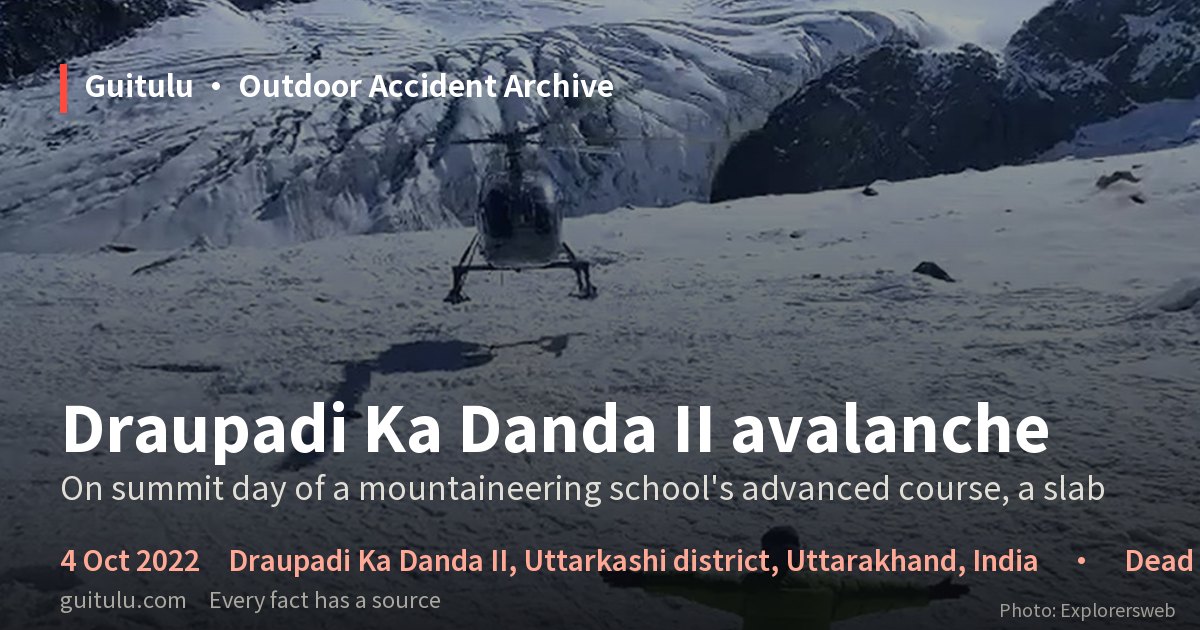
On summit day of a mountaineering school's advanced course, a slab avalanche pushed the entire team toward a crevasse
Search and rescue ended in October 2022; the bodies of 2 trainees were not found. According to a 2023 Outside report, the Uttarakhand government classified the event as a natural disaster, and the authorities did not release an accident investigation report.
Draupadi Ka Danda II, Uttarkashi district, Uttarakhand, IndiaIndia › Uttarakhand · Himalaya78.809°E 30.835°N
Activity
MountaineeringInvolves: Avalanche · Crevasses and glaciersTrainees and instructors on the Nehru Institute of Mountaineering (NIM) advanced mountaineering course
Casualties
Dead 27 Missing 2 According to NIM, of the 29 people buried by the avalanche and reported missing, 27 bodies were recovered (25 trainees and 2 instructors); the bodies of 2 other trainees were not found. Outside counted all 29 as having died. Another 12 people were rescued. According to Outside, those who died were aged 18 to 47.
Material
45 facts · 13 sources3 accounts differ and are shown side by side
The number at the end of a paragraph is how many facts it rests on; open it to see each fact and how well it is sourced:
Multiple sourcesSingle source. Conflicting accounts and speculation are kept out of the narrative.
In September 2022, nearly 60 trainees enrolled in NIM's 172nd advanced mountaineering course. Training took place mainly on the Dokriani Bamak Glacier and DKD2. F01
The previous afternoon, only a small group of trainees and instructors reached Rambo Rock at an altitude of about 16,800 feet and went no higher; NIM had not reached the summit of the mountain since April that year. F05
The avalanche pushed some members of the group into a crevasse. F19
Heavy snow began falling at the scene after the avalanche, and search and rescue was suspended that evening because of bad weather. F24
NIM reported that the avalanche occurred at about 8:45 am on 4 October. F12
At 3:30 am on 4 October, the team set out for the summit. F08
A rescue team from India's High Altitude Warfare School also joined the search and rescue. F31
On 7 October, NIM stated that the death toll had risen to 26 (24 trainees and 2 instructors), with another 3 trainees still missing. F32
Around 8 October, the number of bodies recovered rose to 27, with 2 people still missing. F33
The bodies of the dead were transported from base camp to Uttarkashi in stages and handed over to their families. F35
During the first advanced course after the accident, in April 2023, NIM provided avalanche beacons to almost everyone, added snow shovels, arranged for a rescue team to stand by, and required greater spacing between groups. Because of heavy snowfall, the instructors abandoned the summit attempt after analysing the snowpack. F37
Under each fact is a verbatim quote from the original. "Single source" means only one outlet mentioned it; "Accounts differ" means sources contradict each other and this site adopts neither side; "Speculation" is an inference by a reporter or a person involved, not a fact.
According to Outside, In September 2022, nearly 60 trainees enrolled in NIM's 172nd advanced mountaineering course. Training took place mainly on the Dokriani Bamak Glacier and DKD2.
Quotes from the original 2
“In September 2022, nearly 60 trainees showed up for AMC 172, the monthlong advanced mountaineering course”
According to Outside, The Indian Express reported that the trainees had been attending the course since 14 September and were undergoing high-altitude navigation training when the accident occurred.
Quotes from the original 2
“The Indian Express reported that the climbers had been taking classes in backcountry safety and mountaineering since September 14”
According to Outside, A multi-agency team recovered 27 bodies (25 trainees and 2 instructors) from the crevasse over the following days. The bodies of two other trainees—47-year-old Army Colonel Deepak Vashisht and 29-year-old Navy sailor Vinay Panwar—were not found and remained on the mountain as of reports in 2023.
Quotes from the original 2
“Over the next few days, a multi-agency team removed 27 bodies from the crevasse—25 trainees and two instructors.”
According to Outside, The previous afternoon, only a small group of trainees and instructors reached Rambo Rock at an altitude of about 16,800 feet and went no higher; NIM had not reached the summit of the mountain since April that year.
Quotes from the original 2
“The afternoon before, a small group of students and instructors got as far as Rambo Rock, at 16,800 feet, but did not go any higher.”
Accounts of the total number of people on the mountain vary: PTI reported 41; the state disaster response force said 42 people were trapped, and an early Outside report cited The Indian Express as saying there were 42 in total (including 1 nurse); an in-depth Outside report said there were 46 people on the slope in total, including porters, a nursing assistant and 1 solo climber.
The counts differ in whether medical personnel, porters and a solo climber not affiliated with NIM are included.
Quotes from the original 4
“A 41-member team of mountaineers was returning after climbing the peak”
According to Outside, After reaching Rambo Rock, the team clipped into a fixed rope. Those in front broke trail through snow above their calves, and the final section passed above a deep, narrow crevasse.
Quotes from the original 2
“When the group reached their first landmark, Rambo Rock, at about 16,800 feet, they clipped into a fixed line”
“Those at the front of the pack broke trail through shin-deep snow. As they ascended the final stretch, they passed just uphill of a deep, narrow crevasse.”
According to Outside, Several instructors and physically strong trainees were already near the summit and setting fixed ropes; nearly everyone else was clipped into the fixed rope, waiting on the same slope to climb up.
Quotes from the original 2
“A few instructors and strong students had nearly reached it already and were fixing ropes that would make the final 500 feet easier for the others still en route.”
Accounts differ on whether the team was ascending or descending at the time: NIM, PTI and other reports said the team encountered the avalanche on the way back after reaching the summit; the in-depth Outside report, citing survivors, said most were still climbing and the leaders had just reached the summit snowfield.
Quotes from the original 4
“A 41-member team of mountaineers was returning after climbing the peak when they were hit by the avalanche on Tuesday.”
Accounts of the altitude of the incident differ: Al Jazeera gives about 4880 meters (16,000 feet), Alpine Mag gives 4800 meters, The Tribune gives 17,000 feet, and Outside quotes a survivor as saying 18,000 feet.
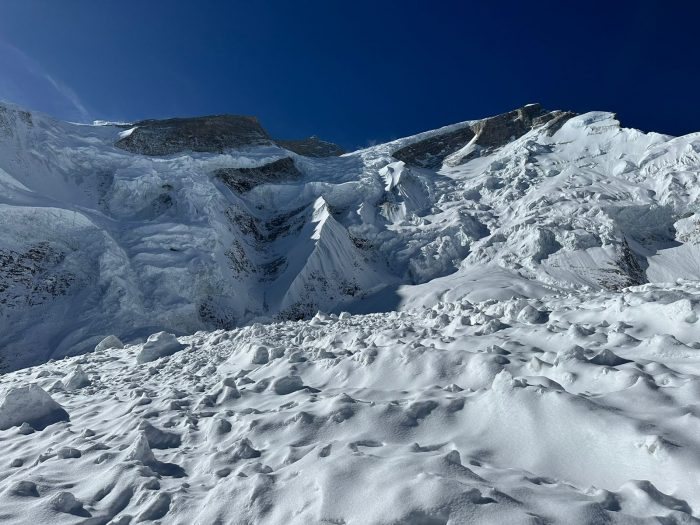
According to Outside, A crack silently crossed the slope, and the entire slope released as a large slab avalanche, sweeping the climbers down the mountain.
Quotes from the original 2
“Behind him, a crack shot silently across the slope and released a large slab avalanche.”
According to Outside, Accounts differ on the depth of the crevasse: an early Outside report quoted a survivor as saying it was about 60 feet; an in-depth Outside report said it was about 80 feet.
Both conflicting accounts come from the same media outlet, or a quotation from the other account could not be verified; several quotations come from different reports by the same outlet and are counted as one source.
According to Outside, Only 5 of the 34 people who fell into the crevasse survived; all the survivors were people whose heads remained above the snow when they reached the bottom.
Quotes from the original 2
“Of the 34 people who fell into the crevasse, only five survived”
According to Outside, A dozen or so trainees and instructors who had not been swept into the crevasse went to its edge, placed ice screws and made anchors. Several descended about 50 feet onto the accumulated snow to search for survivors.
Quotes from the original 2
“The dozen instructors and students who weren’t carried into the crevasse rushed to its edge.”
“The group quickly hammered pickets into the snow, built anchors, and many of them rappelled some 50 feet into the icy cavern to the top of the debris pile to look for survivors.”
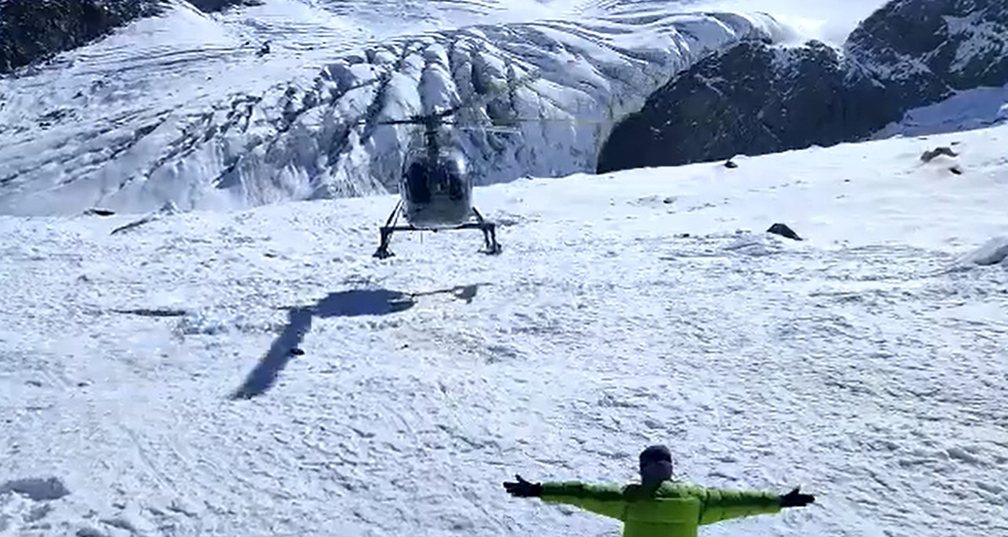
According to Outside, Bad weather prevented the helicopters from landing, and the operation had shifted to searching for bodies before outside rescuers arrived.
Quotes from the original 1
“the bad weather that started soon after the avalanche thwarted any hopes of helicopter landing. Long before aid arrived, the rescue transitioned to a body recovery.”
“Ace mountaineer Savita Kanswal, who had set a national record by climbing Mount Everest and Mount Makalu within a span of 15 days, was among those killed”
A search and rescue team from India's High Altitude Warfare School joined the Indian Air Force and local disaster relief agencies today (machine translation)
According to Outside, The Uttarakhand government classified the avalanche as a natural disaster; as of a July 2023 report, Indian authorities had not released an accident investigation report.
Quotes from the original 2
“In the case of DKD2, Indian authorities have yet to publish any kind of official incident report for the public, nor have they promised one.”
According to Outside, During the first advanced course after the accident, in April 2023, NIM provided avalanche beacons to almost everyone, added snow shovels, arranged for a rescue team to stand by, and required greater spacing between groups. Because of heavy snowfall, the instructors abandoned the summit attempt after analysing the snowpack.
Quotes from the original 3
“almost everyone was equipped with avalanche beacons, there were extra shovels, and a rescue team nearby was made available for immediate search and rescue assistance if needed”
According to Outside, Without knowing the snow conditions above, the instructors put all the trainees in one group and deliberately had them climb close together, placing the entire group on the same dangerous slope at the same time.
Quotes from the original 2
“Despite not knowing conditions at the top, they lumped all the trainees into one group and intentionally climbed close together.”
According to Outside, The instructors probed the snowpack with ice axes while climbing; Doug Chabot, director of Montana's Gallatin Avalanche Center, said this was not a standard method of testing stability, leading them to believe mistakenly that the slope was stable.
Quotes from the original 2
“As they climbed, instructors probed the snow with ice axes to get a sense of what it felt like.”
According to Outside, In the days before the accident, the trainees had only attended a one-hour lecture on avalanches; the basic course also had only a lecture of similar length.
Quotes from the original 1
“A few days before the fatal slide, students received an hourlong lecture about avalanches, and in their basic mountaineering course they received a similar-length lecture.”
 GuituluGlobal Outdoor Accident Archive