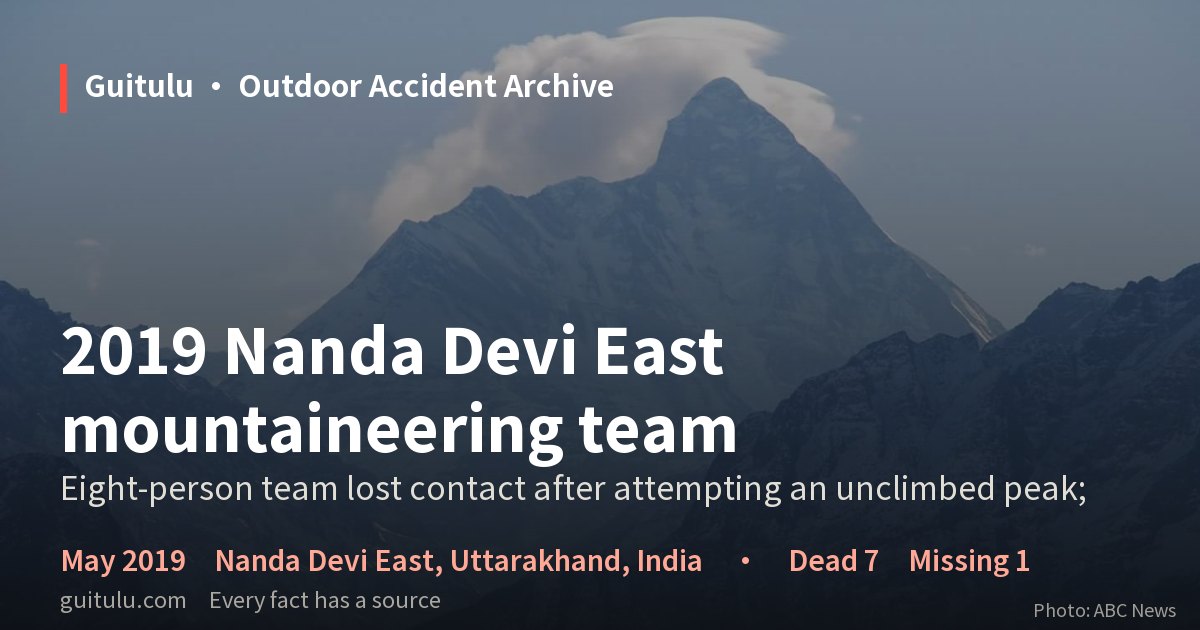
MountaineeringInvolves: AvalancheEight-person mountaineering team led by Martin Moran
Casualties
Dead 7 Missing 1 Seven bodies have been identified; Martin Moran's body remained missing as of October 2022. Officials had previously presumed all eight dead.
Material
21 facts · 20 sources3 accounts differ and are shown side by side
The number at the end of a paragraph is how many facts it rests on; open it to see each fact and how well it is sourced:
Multiple sourcesSingle source. Conflicting accounts and speculation are kept out of the narrative.
Reported locations along the route (illustrative)Schematic
Scroll down and the map flies to where each part happened. The line is Schematic, Connects the locations mentioned in reports in sequence, showing only the approximate direction, not the actual track.
01
Full route
Places mentioned in reports are connected in sequence to show the approximate route (schematic).
After the team failed to return, the alarm was raised on 31 May, and local officials learned that eight people were missing. F07
An avalanche occurred in the area where the team was operating, but during the early search the Indian Mountaineering Foundation said it could not determine whether the missing people had been caught in it. F12
On 3 June, an Indian Air Force helicopter found five bodies while searching for the missing climbers. F13
On 23 June, search and rescue personnel found seven bodies under the snow; their identities had yet to be formally confirmed at the time. F15
Identification of the seven bodies was completed on 6 July, confirming that Martin Moran's body had not been found. F16
According to reports as of October 2022, the body of one climber had still not been found. F17
Under each fact is a verbatim quote from the original. "Single source" means only one outlet mentioned it; "Accounts differ" means sources contradict each other and this site adopts neither side; "Speculation" is an inference by a reporter or a person involved, not a fact.
“Eight mountain climbers from the same expedition group, including two Americans, have gone missing in the Indian Himalayan Mountains, triggering a desperate search-and-rescue effort.”
“The eight missing climbers include two Americans -- Anthony Sudekum and Ronald Beimel -- as well as four people from the U.K., one from Australia and one from India”
“Veteran British mountaineer Martin Moran led the team of four Britons, two Americans, an Australian and an Indian on the expedition on Nanda Devi East.”
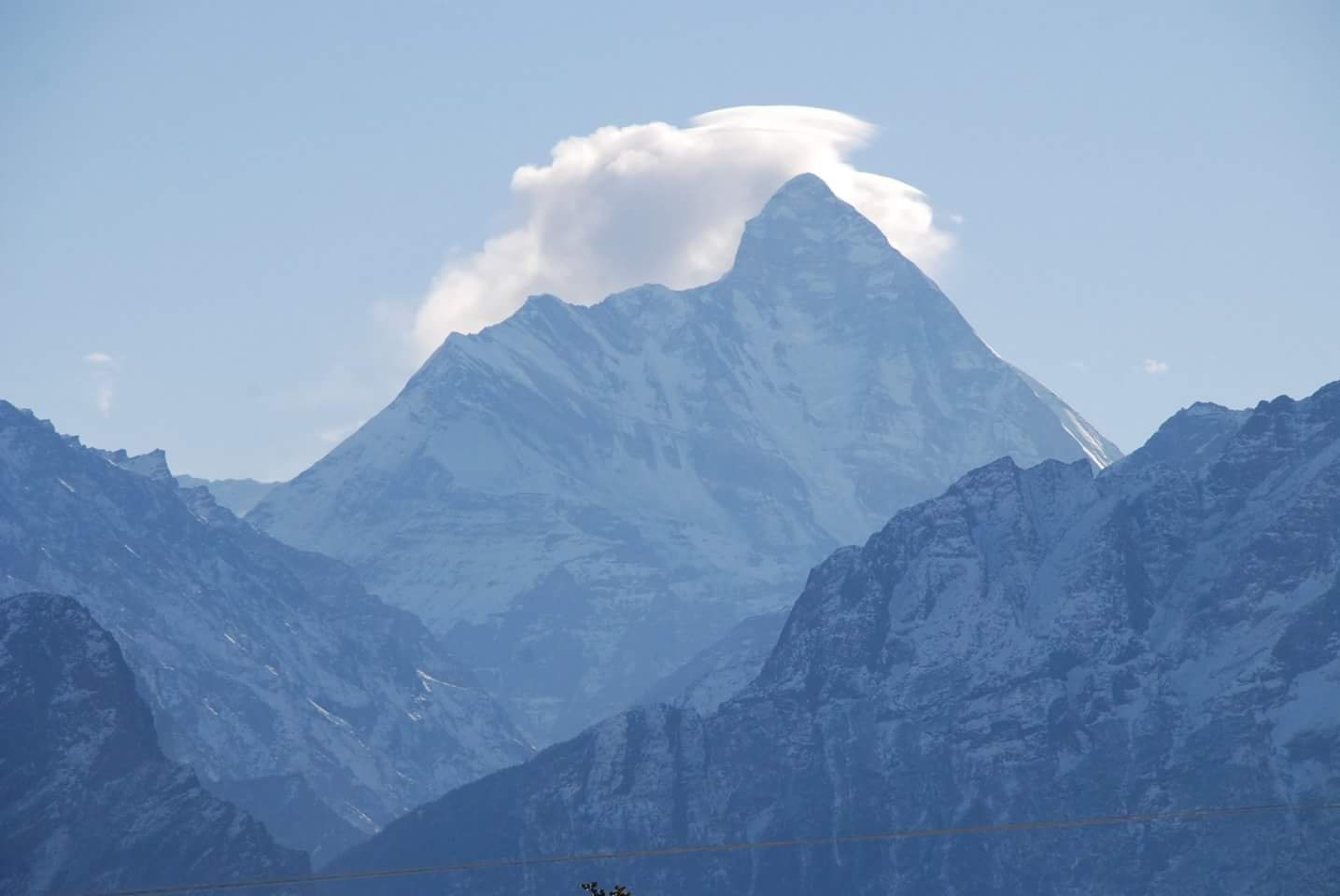
The eight people led by Moran planned to climb a previously unclimbed 6477-metre peak near Nanda Devi East.
Several foreign media reports used an Associated Press dispatch.
Quotes from the original 8
“on 25 May the expedition’s deputy leader, Mark Thomas, returned to camp with three others, with their fellow climbers due to make a summit attempt on an unclimbed peak at 6,477 metres (21,250ft).”
“The Moran family explained how the group “had set out to attempt an unclimbed, unnamed summit, Peak 6477m, and the last contact intimated that all was well”.”
Accounts differ on the date the team was due to return to base camp: ABC reported 26 May; The New Indian Express and The Indian Express reported 25 May; and ITV quoted Moran's company as saying the team had not returned as expected on 31 May.
Sources give different dates for the scheduled return to camp.
Quotes from the original 6
“When they failed to return to base camp last Sunday, mountaineers searched a higher camp and found the group's tents empty.”
“Eight Mountaineers had set out on an expedition of the 7,434-metre-high peak from Munsiyari village on May 13 but went missing on May 25, the day they were supposed to reach their base camp.”
“The mountaineers had left Munsyari on May 13 to scale the peak in Pithoragarh district, but did not return to the base camp on the appointed date of May 25.”
“Mr Moran’s Scotland-based company said contact with the team was lost on May 26 following an avalanche, and they failed to return to base camp as expected on May 31.”
“The eight were part of a larger contingent of 12 climbers who began their ascent on 13 May from the village of Munsiyari in northern India, near the western Nepal border.”
“Eight Mountaineers had set out on an expedition of the 7,434-metre-high peak from Munsiyari village on May 13 but went missing on May 25, the day they were supposed to reach their base camp.”
“The mountaineers had left Munsyari on May 13 to scale the peak in Pithoragarh district, but did not return to the base camp on the appointed date of May 25.”
Accounts differ on the time of the last contact: ABC News said Moran Mountain last communicated with the team on 24 May; The Indian Express, CBS and other outlets reported that contact with the team was lost on 26 May after an avalanche.
The parties involved in the reported communications and the times contact was lost may differ.
Quotes from the original 7
“They had last been in contact with the other eight in the group on May 24.”
“The group of climbers, believed to comprise four Britons, two Americans, one Australian and an Indian liaison officer, vanished in the Nanda Devi region on 26 May following an avalanche.”
“But they said that it is “not entirely clear” what happened next, and an alarm was raised on the morning of May 31 after the group failed to return to base camp.”
India sent search and rescue personnel to look for the missing people, but bad weather and terrain hampered the operation.
Quotes from the original 9
“India has sent a search team to look for them, but the rescuers are traveling on foot and are expected to take three days to reach their last known camp.”
“A rescue team was sent to the Nanda Devi base camp, including personnel from the State Disaster Relief Fund, Indo Tibetan Border police force and a team of doctors, according to Prasad.”
“Two groups of 24 rescuers – including police and disaster response personnel – have been mobilised for the search. The first group will need at least three days to walk to the avalanche site”
Because of bad weather and high-altitude conditions, the bodies could not be brought back immediately, and a ground recovery operation was subsequently launched.
Quotes from the original 7
“The bodies were seen in the middle of an avalanche and due to its remote location and height it is difficult to recover them.”
“Last week, military helicopters tried several times to drop mountaineers down to where the bodies had been spotted at an altitude of about 5,000 metres (16,400ft), but high winds made it impossible to get close enough.”
“Ground expeditions by the Indian paramilitary forces and the Indian Mountaineering Foundation were launched after helicopter missions failed to reach the area.”
“Bodies were spotted 500 metres below where the team was hit, and a recovery mission began in early June but was hampered by harsh weather and technical problems.”
“the bodies were first brought to Munsiyari by Cheetah helicopters from camp one located at a height of 15,600 feet and then to Naini Saini airport in Pithoragarh by another IAF chopper.”
“In one of the most difficult high-altitude operation named ‘Daredevils’, which lasted about 20 days, the Indo-Tibetan Border Police (ITBP) and Indian Air Force (IAF)”
“The team subsequently shifted the bodies to a camp at an altitude of 19,000 feet and then further down to one at 15,000 feet, from where the bodies were air lifted.”
“In all 12 mountaineers had gone for the expedition to climb India’s second highest mountain. Four had split from the group and they were rescued from the base camp area on June 2.”
An avalanche occurred in the area where the team was operating, but during the early search the Indian Mountaineering Foundation said it could not determine whether the missing people had been caught in it.
Quotes from the original 6
“Local mountaineers report there was a heavy avalanche on the group's proposed route.”
“He confirmed there had been a number of avalanches in the Nanda Devi peak region and said prints had been spotted leading into the site of an avalanche.”
“Rescuers onboard an Indian Air Force helicopter spotted the bodies of five of the eight mountaineers missing since May 25, near an unnamed peak adjoining Nanda Devi East peak in Uttarakhand”
“Pittorgarh District Magistrate V.K. Jogdande told CBS News that a paramilitary force reached the location after at least five bodies were spotted by helicopters earlier this month.”
“Government officials were consulting the Indian army and Indo-Tibetan Border Police on how to retrieve the bodies, which were seen at an altitude of 16,404 feet.”
On 23 June, search and rescue personnel found seven bodies under the snow; their identities had yet to be formally confirmed at the time.
Quotes from the original 8
“A 10-member ITBP team of climbers dug out the seven bodies, including a woman mountaineer, which were buried under the snow on the western ridge of the peak towards the Pindari glacier, said Deputy Inspector General (Kumaon range) A P S Nimbadia.”
“Indian paramilitary soldiers have reached the bodies of seven people from an eight-member team of international climbers believed to have been killed on a notoriously dangerous Himalayan mountain, an official said Sunday.”
“According to Jogdande, the bodies were found under snow and are now being kept in a temporary camp set up to allow rescuers to bring them down one by one over the course of the next few days.”
“आईटीबीपी के द्वितीय कमान अधिकारी और एवरेस्ट विजेता रतन सिंह सोनाल के नेतृत्व में 18 सदस्यीय हिमवीरों की टीम ने 23 जून को सात पर्वतारोहियों के शवों को बरामद कर लिया।”
The missing people included Martin Moran, John McLaren, Rupert Whewell and Richard Payne from Britain; Anthony Sudekum and Ronald Beimel from the United States; and Indian guide Chetan Pandey.
Quotes from the original 3
“The other climbers were John Mclaren, Rupert Whewell and Richard Payne from the United Kingdom, Anthony Sudekum and Ronald Beimel from the United States and Indian guide Chetan Pandey.”
“Veteran British mountaineer Martin Moran led a team who included John McLaren, Rupert Whewell and University of York lecturer Richard Payne from the UK;”
“The eight were part of a larger contingent of 12 climbers who began their ascent on 13 May from the village of Munsiyari in northern India, near the western Nepal border.”
“In all 12 mountaineers had gone for the expedition to climb India’s second highest mountain. Four had split from the group and they were rescued from the base camp area on June 2.”
 GuituluGlobal Outdoor Accident Archive