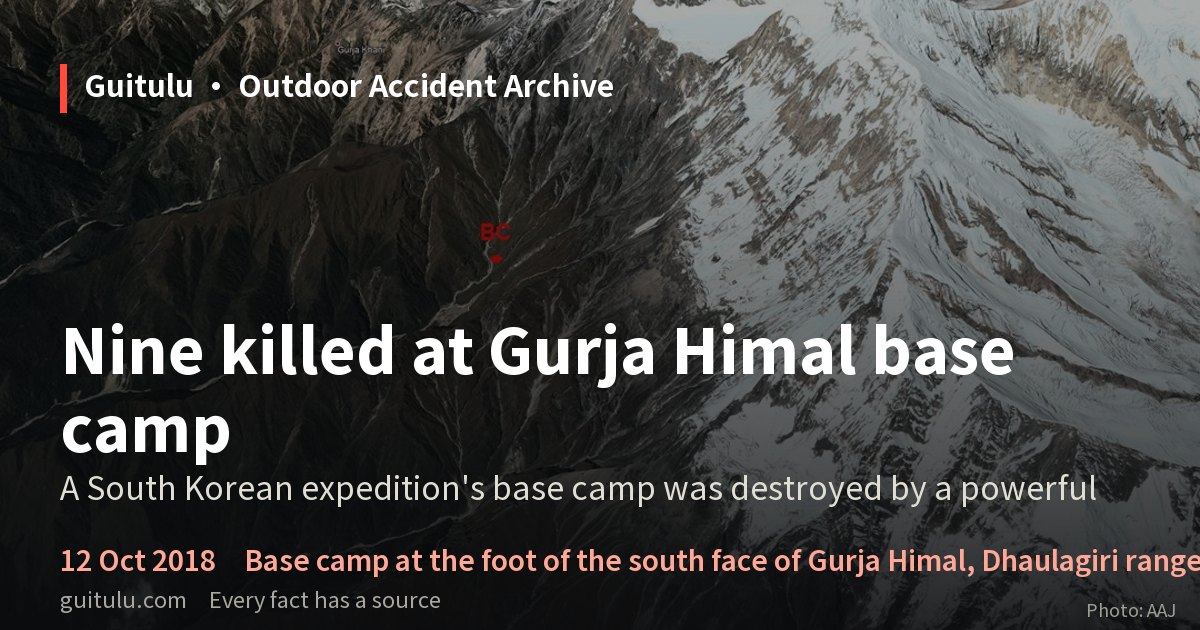
A South Korean expedition's base camp was destroyed by a powerful wind that remains unexplained
The time and cause of the incident remain undetermined: an air blast is more widely accepted by experts, though strong winds, an avalanche and a landslide have also been suggested
A distant view of the Dhaulagiri range from Poon Hill, with Gurja Himal at the far left of the photographPhoto source: Mark Horrell · Manish Dangol / Wikimedia Commons
The number at the end of a paragraph is how many facts it rests on; open it to see each fact and how well it is sourced:
Multiple sourcesSingle source. Conflicting accounts and speculation are kept out of the narrative.
Reported locations along the route (schematic)Schematic
Scroll down and the map flies to where each part happened. The line is Schematic, Lines connect the locations mentioned in reports in sequence, showing only the approximate direction, not the actual track.
01
Full route
The locations mentioned in reports are connected in sequence to show the approximate course of events (schematic).
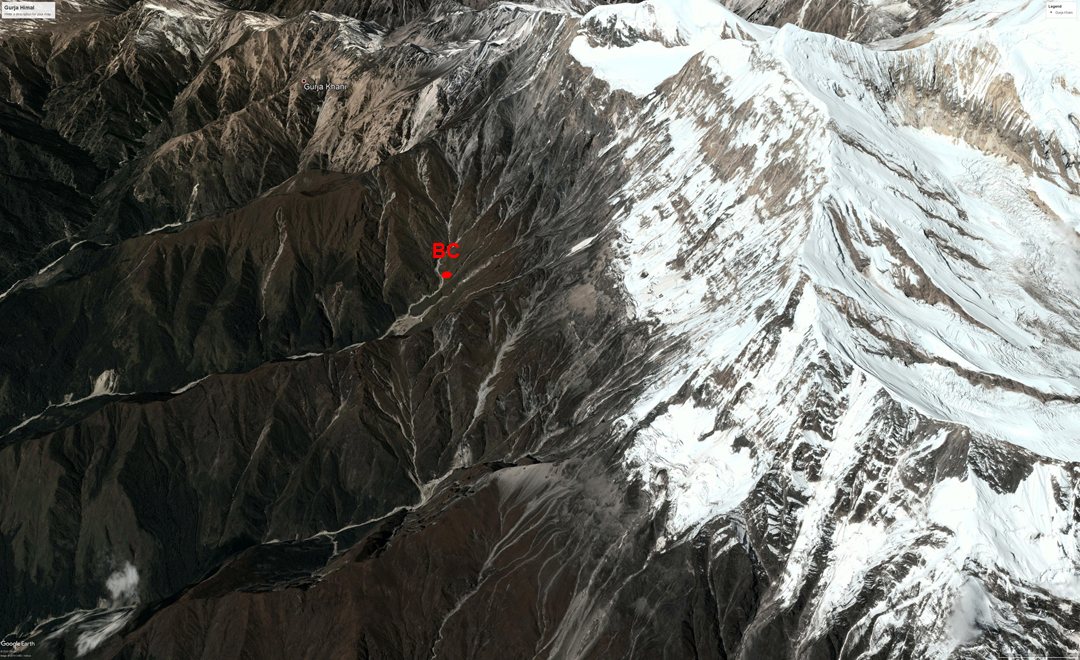
Kim Chang-ho visited the area in 2017 to scout it and personally selected the base camp site, close to the foot of the rock face. F03
The '2018 Koreanway Gurja Himal Expedition' led by Kim Chang-ho planned to climb the south face of Gurja Himal and establish a new route. It set out on 28 September. F04
The team had been camped at base camp since early October, waiting for good weather to climb. F05
After the storm struck, the base camp was completely destroyed and the tents were scattered by the wind. F07
After being unable to contact the team for nearly 24 hours, the organizer, Trekking Camp Nepal, sent people from the village and deployed a helicopter to search. F08
The first helicopter pilot to arrive reported that all the camp's tents had been blown away. The helicopter was unable to recover the bodies that day because the frozen ground was unstable and the weather was poor. F10
Early reports said 7 people had died and 2 were missing; all 9 were later confirmed dead. F11
On 14 October (Sunday), all 9 bodies were recovered from the site by helicopter. F14
The bodies of the 5 South Korean victims were scheduled to be flown home from Kathmandu on the evening of 16 October. F15
Under each fact is a verbatim quote from the original. "Single source" means only one outlet mentioned it; "Accounts differ" means sources contradict each other and this site adopts neither side; "Speculation" is an inference by a reporter or a person involved, not a fact.
Kim Chang-ho was a South Korean mountaineer. In 2013, he completed all 14 8000-meter peaks, becoming the first South Korean to do so without supplemental oxygen and completing them in the shortest time.
Quotes from the original 2
“Chang-ho was the first Korean to climb all 14 8000’ers without oxygen, and was also the fastest person to complete that daunting list.”
The '2018 Koreanway Gurja Himal Expedition' led by Kim Chang-ho planned to climb the south face of Gurja Himal and establish a new route. It set out on 28 September.
Accounts differ on when the incident occurred: most reports say the evening of 12 October (Friday), while an American Alpine Club review places it between the evening of 10 October and 11 October, and the Nepali news outlet Setopati says 10 October.
The accounts conflict, so no conclusion is drawn; the page uses 12 October, the date given in most reports
After being unable to contact the team for nearly 24 hours, the organizer, Trekking Camp Nepal, sent people from the village and deployed a helicopter to search.
Quotes from the original 3
“we sent people from the village and a helicopter to search for them”
The initial account from South Korea's Ministry of Foreign Affairs and its embassy in Nepal was that the team members were swept away by strong winds at base camp and fell down a steep slope to their deaths.
Initial official account; other explanations followed
Quotes from the original 2
“swept off by strong winds at the base camp during their climb to Mount Gurja”
The first helicopter pilot to arrive reported that all the camp's tents had been blown away. The helicopter was unable to recover the bodies that day because the frozen ground was unstable and the weather was poor.
Quotes from the original 2
“icy and unstable conditions meant they were unable to retrieve any of the bodies”
According to AFP and other reports, this was the deadliest mountaineering accident in Nepal since the 2015 Everest base camp avalanche, in which 18 people died.
The Japan Times separately described it as Nepal's deadliest mountaineering accident in two years; the accounts are not entirely consistent.
Quotes from the original 2
“The storm is the deadliest incident to hit Nepal’s mountaineering industry since 18 people were killed at the Mount Everest base camp in 2015”
According to Outdoor Journal, The head of Global Rescue said that such extreme winds do not normally occur at such a high altitude, and that base camps are usually located there for safety.
Account from a single organization
Quotes from the original 1
“base camps are normally chosen because they are safe places”
Gurja Himal was first climbed by a Japanese team in 1969. According to the Himalayan Database, about 30 people have reached the summit since then, most recently in 1996.
Quotes from the original 3
“Gurja was first summited in 1969 by a Japanese team but no one has stood on its summit for 22 years, according to the Himalayan Database.”
The south face of Gurja Himal rises nearly 4000 meters from the valley and has never been climbed. Deep, narrow gullies and watercourses lie at the bottom of the face.
Quotes from the original 2
“an imposing and unclimbed south face that rises almost 4,000m vertically from the valley below”
Reports differ on the altitude of base camp: most give it as about 3500 meters, while the American Alpine Club's American Alpine Journal records it as 3800 meters.
Both 3500 meters and 3800 meters are reported; no conclusion is drawn
Quotes from the original 2
“They were at the base camp located at 3,500 meters at the time of the storm.”
According to Munhwa Ilbo, According to an account cited by the Associated Press, the base camp was at least a day's walk from even the nearest village.
According to reports, the fifth South Korean victim, Jung Joon-mo, was an accompanying trekker who joined later and was not among the four climbers listed on the climbing permit.
Quotes from the original 3
“The fifth Korean was a trekker, who joined the group, according to hiking officials.”
According to AAJ, The guide who had stayed in the village waited for the team to return and, unable to contact base camp, walked to a point several kilometers from the camp, where he saw a body in the distance; the next day, people found scattered clothing and equipment below the camp.
Single source
Quotes from the original 1
“the guide walked up to within a few kilometers of camp, from where he spotted a body”
The initial landslide explanation was questioned: a scientist at the US National Snow and Ice Data Center considered a landslide unlikely, and a blogger also noted that rescue video from the site showed no signs of burial.
Quotes from the original 2
“seems unlikely to me because it was likely frozen in place”
According to Outdoor Journal, A Nepali police spokesperson considered an avalanche unlikely because the bodies were not buried; but an expert at the US National Snow and Ice Data Center said that the blast from a dry powder-snow avalanche could likewise destroy a camp without leaving much snow.
A single media outlet relaying the views of experts
Quotes from the original 2
“it was unlikely that an avalanche had struck the team, because the bodies were not buried”
Speculation: a widely accepted explanation among experts is that a serac or avalanche high on the mountain generated a powerful blast of air that rushed down the gully toward base camp, but this has not been confirmed.
Quotes from the original 4
“the supposition is that the wind blast from a large serac avalanche high on the face was funneled through these canyons”
Speculation: some have suggested that a storm produced tornado-force winds that blew down the valley toward the camp; South Korean mountaineer Heo Young-ho also thought this was more like a sudden tornado-like gust.
Quotes from the original 2
“there is speculation that the storm whipped up tornado-strength wind that was funneled up the valley”
According to Nepali Times, According to local villagers, they had advised the expedition to set up base camp lower down, at about 3000 meters, reportedly to avoid angering the local mountain god; this is only the villagers' account, not an investigation finding.
Only the villagers' account, incorporating folk beliefs; it cannot be regarded as the cause of the accident.
Quotes from the original 1
“say they told the expedition to establish their Base Camp lower at 3,000m”
 GuituluGlobal Outdoor Accident Archive