GuituluGlobal Outdoor Accident Archive 中文
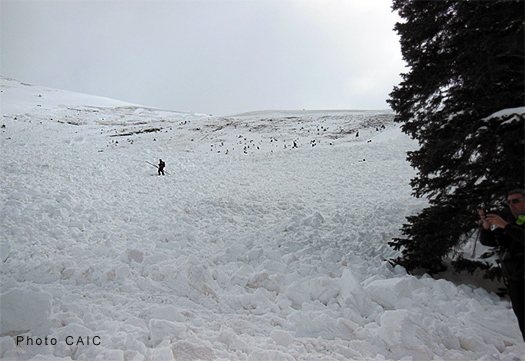
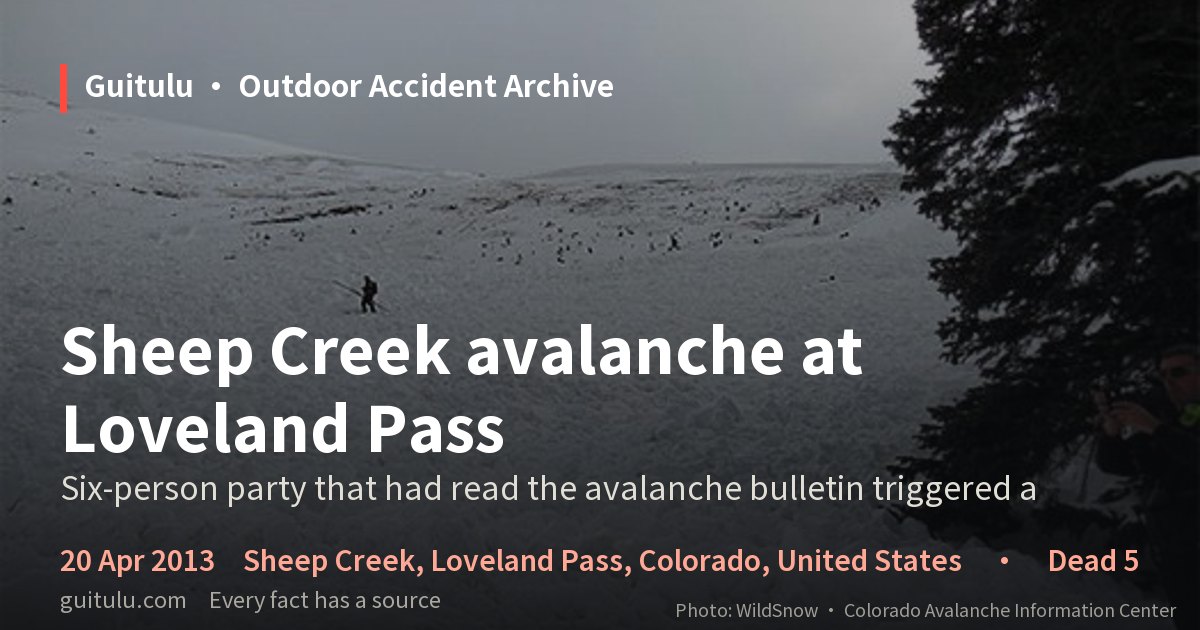
Sheep Creek avalanche debris area after the accident

Archive / Other

Sheep Creek avalanche at Loveland Pass

Six-person party that had read the avalanche bulletin triggered a deep slab at the bottom of a slope; five died

The Colorado Avalanche Information Center (CAIC) published its final investigation report on 24 April 2013

Photo: WildSnow · Colorado Avalanche Information Center

Date
Spring
Place
Sheep Creek, Loveland Pass, Colorado, United StatesUnited States › Colorado · Rocky Mountains-105.858°E 39.678°N
Activity
SkiingInvolves: Avalanche6 people (4 on splitboards, 1 on an approach snowboard, 1 skier)
Casualties
Dead 5 All 6 were caught in the avalanche; 5 died and 1 was rescued after being partially buried for about 4 hours
Material
50 facts · 9 sources1 account differs and are shown side by side

01What happened

On 19–20 April 2013, the Rocky Mountain High Backcountry Bash was held in the Loveland area of Colorado. Organized by Joe Timlin, the event aimed to promote backcountry snowboarding and avalanche safety. According to reports, shallow snow and low temperatures early the previous winter had left a pronounced depth hoar weak layer in the Front Range mountains, and heavy snowfall in April had triggered a cycle of deep slab avalanches. Two days before the accident, an avalanche of the same type killed one person near Vail Pass. The CAIC forecast that day stated that avalanches triggered in the wrong place would be very large, destructive and dangerous.Facts it rests onF02Multiple sourcesThe Rocky Mountain High Backcountry Gathering was scheduled for 19–20 April 2013 and was organized by Joe Timlin.F03Multiple sourcesThe gathering aimed to promote backcountry snowboarding and avalanche safety. Its publicity included backcountry riding and demonstrations of avalanche equipment and safety.F01Single sourceFrom November to December 2012, shallow snow and low temperatures formed a pronounced deep hoar weak layer in the Front Range mountains, including the Loveland Pass area.F05Single sourceHeavy, rapid snowfall in April triggered a cycle of deep slab avalanches in the Front Range and Vail–Summit forecast zones.F09Multiple sourcesTwo days before the incident, on Thursday, a similar avalanche killed a snowboarder near Vail Pass.F11Multiple sourcesCAIC's forecast that day warned of this type of deep persistent slab avalanche and possible trigger points. It said that if someone found the wrong spot, the resulting avalanche would be very large, destructive, and dangerous.

Sheep Creek avalanche debris area after the accidentPhoto source: WildSnow · Colorado Avalanche Information Center

On the morning of 20 April, a party of 6 (4 on splitboards, 1 on an approach snowboard and 1 on skis) left the Loveland Ski Area parking lot shortly before 10:00 and headed along Highway 6 toward Loveland Pass, intending to take a short tour of about 1 hour in the Sheep Creek drainage. Before setting out, they read the avalanche bulletin together and discussed the deep persistent slab problem. They planned to enter the old summer road at Scotty's Corner, cross the Sheep Creek gully, then ascend the northwest slope of Mount Sniktau, crossing below a north-facing slope they considered threatening in the runout zone well below the starting zone.Facts it rests onF14Multiple sourcesThe group involved consisted of 6 people: 4 on splitboards, 1 on an approach snowboard, and 1 skier.F15Multiple sourcesThe 6 left the Loveland Ski Area parking lot shortly before 10:00 and traveled along Highway 6 to Loveland Pass, planning a short tour of about 1 hour in the Sheep Creek drainage.F16Multiple sourcesBefore setting out, the whole group read the CAIC avalanche bulletin together and discussed the deep persistent slab problem.F17Multiple sourcesThey planned to enter the old summer road at the uppermost switchback, Scotty's Corner, cross the Sheep Creek gully, then climb several hundred feet to the northwest slope of Mount Sniktau.F18Multiple sourcesThey identified the north-facing slopes as a threat and planned to cross them in the runout zone, far below the starting zones, to reach terrain they considered safer.

Approximate extent of the Sheep Creek avalanche marked on a topographic map (annotated by WildSnow)Photo source: WildSnow · WildSnow

As they crossed below the north-facing slope, they spaced themselves about 50 feet apart. The first two had reached the grove of trees they were heading for, with the other four close behind, when the group felt a widespread collapse and heard a "whumpf" sound. Within seconds, they all ran toward the trees. According to the CAIC report, at about 10:15 a.m., the hard slab avalanche, triggered by party members at the bottom of the slope, engulfed the entire party from above. The avalanche was about 800 feet wide and pushed the whole group into the Sheep Creek gully, completely burying 5 people.Facts it rests onF19Multiple sourcesAs they crossed below the north-facing slopes, they spaced themselves about 50 feet apart.F20Multiple sourcesWhen the first two had reached the small grove of trees, with the other four close behind, they felt a large area collapse and heard a “whumpf” sound.F21Multiple sourcesIt took a few seconds for the fracture to propagate uphill and the deep slab to release; during those seconds, everyone ran toward the stand of trees.F23Single sourceAccording to the CAIC report, at about 10:15 a.m., the avalanche engulfed the entire group from above.F25Multiple sourcesThis was a hard slab avalanche, triggered by one or more members of the group at the bottom of the slope.F27Multiple sourcesThe avalanche was about 800 feet (about 244 meters) wide.F24Multiple sourcesThe avalanche pushed the entire group into the Sheep Creek gully. All five others were completely buried; only the survivor was not.

View south from the Sheep Creek parking area, with the 2013 avalanche slope and access trail markedPhoto source: WildSnow · WildSnow

The sole survivor was partially buried, with his left forearm exposed. He cleared the snow from his face so he could breathe, but the other party members were buried and there was no one else nearby; no one could hear him. At about 12:15, two CAIC highway avalanche forecasters saw the avalanche from Interstate 70. They went to the scene and searched with beacons but received no signals, so they returned to Loveland Ski Area to make inquiries. Several people then went to the scene. The survivor had been trapped for about 4 hours before rescuers reached him.Facts it rests onF29Multiple sourcesThe sole survivor was partially buried, coming to rest in an upright, semi-seated position, with his left forearm exposed and his face close to the snow surface. He used his exposed arm to clear snow from his face so he could breathe.F30Multiple sourcesThe other group members were buried, and there was no one else nearby; no one could hear the survivor.F32Multiple sourcesTwo CAIC highway avalanche forecasters spotted the avalanche at about 12:15 while driving on Interstate 70.F33Multiple sourcesThe two forecasters arrived at the site about half an hour later and received no signals during a beacon search.F34Multiple sourcesThe forecasters drove back to Loveland Ski Area to ask whether any gathering participants were trapped, after which several people headed to the site.F31Multiple sourcesThe survivor was trapped in this position for about 4 hours, until rescuers arrived.

View west from the safe area, with red dots marking the estimated route of the group involved in the accidentPhoto source: WildSnow · WildSnow

The other 5 people died, including one who was buried 10 to 12 feet deep. At least two members of the party were carrying avalanche airbags, but neither deployed them. It was Colorado's deadliest avalanche accident since 1962. CAIC published its full investigation report on 24 April, concluding that although the accident was tragic, it could have been avoided.Facts it rests onF06Multiple sourcesClear Creek County police identified the people who died as Christopher Peters (32), Joseph Timlin (32), Ryan Novack (33), Ian Lamphere (36), and Rick Gaukel (33).F37Multiple sourcesOne of those killed was buried at a depth of 10 to 12 feet.F38Multiple sourcesAt least two members of the group carried avalanche airbags, but neither deployed them; another person carried an Avalung breathing device, which, according to the report, apparently could not be used.F40Multiple sourcesThis was Colorado's deadliest avalanche since 1962.F45Multiple sourcesCAIC released its full investigation report on the accident on 24 April 2013.F44Multiple sourcesCAIC said that the accident, although tragic, was avoidable.

The number at the end of a paragraph is how many facts it rests on; open it to see each fact and how well it is sourced: Multiple sourcesSingle source. Conflicting accounts and speculation are kept out of the narrative.

ImgScene photos all from news coverage; copyright belongs to the original authors

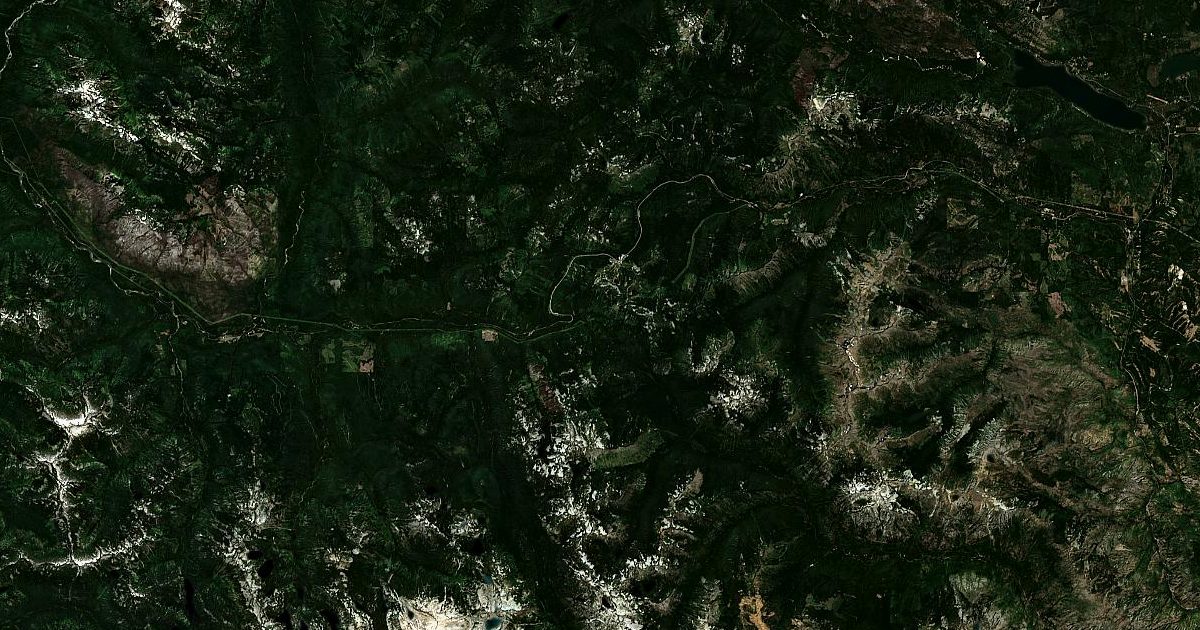
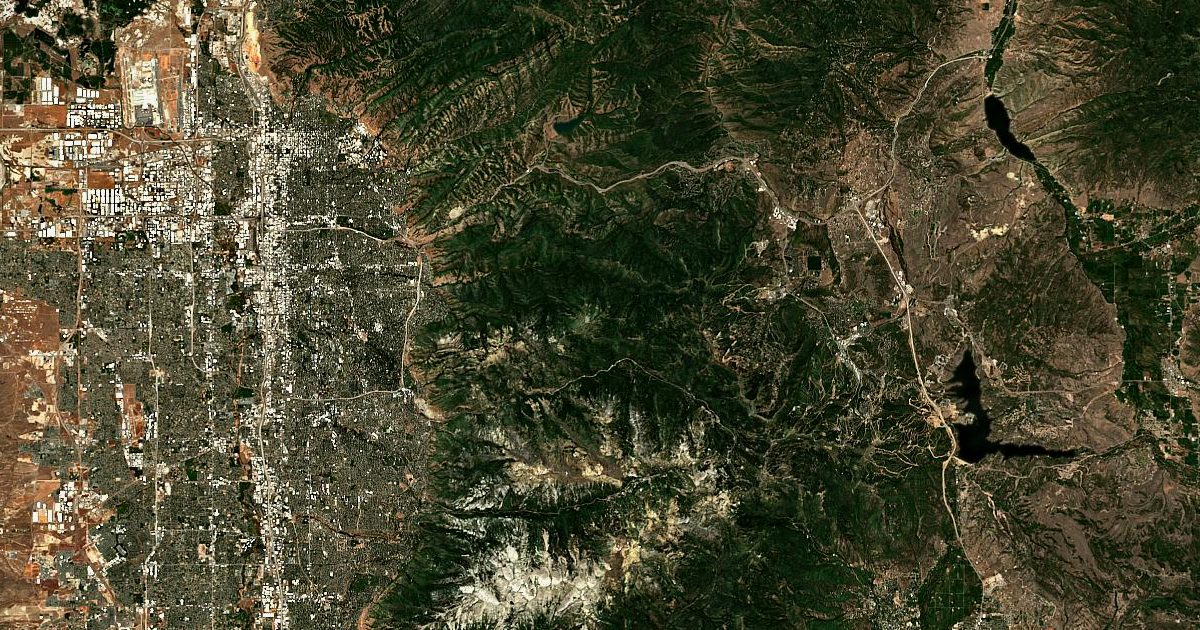
Satellite imagery Sentinel-2 cloudless 2024 © EOX · Terrain AWS Terrain Tiles · Position is schematic, geocoded from place names · Place coordinates not individually verified

Route review

5 scenes to understand what happened

Scroll down and the map flies to where each part happened.

01

The accident area

The reports do not identify enough waypoints, so the map shows only the approximate location and terrain of the accident area.

03

Choosing the route

They read the avalanche bulletin together and planned to cross the Sheep Creek gully and use the runout zone to bypass the north-facing slope on their way to the northwest slope of Mount Sniktau.Facts it rests onF16Multiple sourcesBefore setting out, the whole group read the CAIC avalanche bulletin together and discussed the deep persistent slab problem.F17Multiple sourcesThey planned to enter the old summer road at the uppermost switchback, Scotty's Corner, cross the Sheep Creek gully, then climb several hundred feet to the northwest slope of Mount Sniktau.F18Multiple sourcesThey identified the north-facing slopes as a threat and planned to cross them in the runout zone, far below the starting zones, to reach terrain they considered safer.

04

Triggered at the bottom of the slope

The party crossed below the slope about 50 feet apart. Seconds after they heard a "whumpf" sound, a hard slab avalanche pushed the entire group into the Sheep Creek gully.Facts it rests onF19Multiple sourcesAs they crossed below the north-facing slopes, they spaced themselves about 50 feet apart.F20Multiple sourcesWhen the first two had reached the small grove of trees, with the other four close behind, they felt a large area collapse and heard a “whumpf” sound.F24Multiple sourcesThe avalanche pushed the entire group into the Sheep Creek gully. All five others were completely buried; only the survivor was not.

05

A four-hour wait

The survivor was partially buried, and no one heard him. At about 12:15, a forecaster saw the avalanche from the interstate and returned to the ski area to ask about it, after which people came to the scene.Facts it rests onF29Multiple sourcesThe sole survivor was partially buried, coming to rest in an upright, semi-seated position, with his left forearm exposed and his face close to the snow surface. He used his exposed arm to clear snow from his face so he could breathe.F30Multiple sourcesThe other group members were buried, and there was no one else nearby; no one could hear the survivor.F32Multiple sourcesTwo CAIC highway avalanche forecasters spotted the avalanche at about 12:15 while driving on Interstate 70.F34Multiple sourcesThe forecasters drove back to Loveland Ski Area to ask whether any gathering participants were trapped, after which several people headed to the site.

02Timeline

  1. On Sunday, 14 April 2013, a strong cold front brought a significant period of snowfall. F08

  2. Two days before the incident, on Thursday, a similar avalanche killed a snowboarder near Vail Pass. F09

  3. The forecasters drove back to Loveland Ski Area to ask whether any gathering participants were trapped, after which several people headed to the site. F34

  4. Before setting out, the whole group read the CAIC avalanche bulletin together and discussed the deep persistent slab problem. F16

  5. The 6 left the Loveland Ski Area parking lot shortly before 10:00 and traveled along Highway 6 to Loveland Pass, planning a short tour of about 1 hour in the Sheep Creek drainage. F15

  6. According to the CAIC report, at about 10:15 a.m., the avalanche engulfed the entire group from above. F23

  7. The avalanche pushed the entire group into the Sheep Creek gully. All five others were completely buried; only the survivor was not. F24

  8. When the first two had reached the small grove of trees, with the other four close behind, they felt a large area collapse and heard a “whumpf” sound. F20

  9. On the morning of 20 April, gathering participants met in the Loveland Ski Area parking lot. Several small groups set out between 9:00 and 10:00 for short backcountry tours. F13

  10. According to the CAIC report, the first two rescuers, including a Loveland ski patroller, arrived at the site at about 13:45 and began a beacon search. F35

  11. Two CAIC highway avalanche forecasters spotted the avalanche at about 12:15 while driving on Interstate 70. F32

  12. CAIC released its full investigation report on the accident on 24 April 2013. F45

03Lessons

Avalanche and high altitude

Spacing cannot stop a deep slab

The party spaced themselves about 50 feet apart as they crossed below the slope. CAIC considered this method of travel ineffective against an avalanche of such magnitude. The CAIC report stated that the only effective way to deal with deep persistent slab avalanches is to avoid areas where a deep slab could release and, if the risk is considered acceptable, to expose only one party member to the danger at a time.Facts it rests onF19Multiple sourcesAs they crossed below the north-facing slopes, they spaced themselves about 50 feet apart.F41Multiple sourcesCAIC concluded that, to reach a safer location, they had to pass through a dangerous area first, and that travel techniques used to reduce risk were ineffective against an avalanche of this size.F43Single sourceThe CAIC report stated that the only effective travel technique for dealing with deep persistent slab avalanches is to avoid areas where a deep slab could be released; if the risk is considered acceptable, only one member of the group should be exposed to the danger at a time; spacing out often does not reduce the risk to the whole group.

Avalanche and high altitude

Slope bottoms and 'islands of safety' are also within reach

They deliberately crossed below the north-facing slope in the runout zone, well below the starting zone. The party was indeed far below the starting zone when the avalanche released, but it was triggered by party members at the bottom of the slope. The CAIC report stated that at least 3 party members had reached a previously selected 'island of safety' but were still caught and buried.Facts it rests onF18Multiple sourcesThey identified the north-facing slopes as a threat and planned to cross them in the runout zone, far below the starting zones, to reach terrain they considered safer.F22Single sourceWhen the avalanche released, the group was far below the steepest part of the slope (the starting zone).F25Multiple sourcesThis was a hard slab avalanche, triggered by one or more members of the group at the bottom of the slope.F42Single sourceThe CAIC report said that at least 3 members of the group had reached a previously selected “island of safety”, but were still caught and buried by the avalanche.

Rescue and self-rescue

When everyone is buried, no one can call for help

The avalanche caught all 6 people and completely buried 5; no one could hear the survivor. Only after two forecasters saw the avalanche from the interstate and returned to the ski area to make inquiries did people go to the scene. The survivor was trapped for about 4 hours as a result.Facts it rests onF24Multiple sourcesThe avalanche pushed the entire group into the Sheep Creek gully. All five others were completely buried; only the survivor was not.F30Multiple sourcesThe other group members were buried, and there was no one else nearby; no one could hear the survivor.F32Multiple sourcesTwo CAIC highway avalanche forecasters spotted the avalanche at about 12:15 while driving on Interstate 70.F34Multiple sourcesThe forecasters drove back to Loveland Ski Area to ask whether any gathering participants were trapped, after which several people headed to the site.F31Multiple sourcesThe survivor was trapped in this position for about 4 hours, until rescuers arrived.

Avalanche and high altitude

Change the route after understanding the bulletin

Before setting out, they read the avalanche bulletin together and discussed the deep persistent slab problem. The forecast that day stated that avalanches triggered in the wrong place would be very large, destructive and dangerous. CAIC later concluded that the accident could have been avoided.Facts it rests onF16Multiple sourcesBefore setting out, the whole group read the CAIC avalanche bulletin together and discussed the deep persistent slab problem.F11Multiple sourcesCAIC's forecast that day warned of this type of deep persistent slab avalanche and possible trigger points. It said that if someone found the wrong spot, the resulting avalanche would be very large, destructive, and dangerous.F44Multiple sourcesCAIC said that the accident, although tragic, was avoidable.

04Fact list 50 facts

Under each fact is a verbatim quote from the original. "Single source" means only one outlet mentioned it; "Accounts differ" means sources contradict each other and this site adopts neither side; "Speculation" is an inference by a reporter or a person involved, not a fact.

  1. F01Single sourceBackground

    According to Westword, From November to December 2012, shallow snow and low temperatures formed a pronounced deep hoar weak layer in the Front Range mountains, including the Loveland Pass area.

    Quotes from the original 1

    “A shallow snowpack in November and December of 2012 and cool temperatures formed a pronounced weak layer of depth hoar across much of the Front Range, including the Loveland Pass area.”

    Westword · 2013-04-25
  2. F02Multiple sourcesBackground

    The Rocky Mountain High Backcountry Gathering was scheduled for 19–20 April 2013 and was organized by Joe Timlin.

    Quotes from the original 2

    “Timlin was the man behind the Rocky Mountain High Backcountry gathering, slated for April 19 and 20.”

    Westword · 2013-04-22

    “the event’s organizer, Joseph Timlin, was among the dead”

    Coyote Gulch · 2013-04-24
  3. F03Multiple sourcesBackground

    The gathering aimed to promote backcountry snowboarding and avalanche safety. Its publicity included backcountry riding and demonstrations of avalanche equipment and safety.

    Quotes from the original 2

    “The event was organized to promote backcountry snowboarding and avalanche safety.”

    Westword · 2013-04-25

    “The event was promoted by a Colorado snowboarding magazine as a day for backcountry riding but also avalanche gear and safety demonstrations.”

    AP · 2013-04-24
  4. F04Single sourceBackground

    According to Westword, In the week before the incident, Loveland Ski Area, 1.7 miles west of the incident site, received about 3.5 feet of snow in total.

    Quotes from the original 1

    “Snowfall totals for the week prior to the accident were around 3.5 feet at Loveland Ski Area 1.7 miles west of the accident site”

    Westword · 2013-04-25
  5. F05Single sourceBackground

    According to Westword, Heavy, rapid snowfall in April triggered a cycle of deep slab avalanches in the Front Range and Vail–Summit forecast zones.

    Quotes from the original 1

    “The rapid, heavy load from the April storms initiated a deep-slab avalanche cycle in the Front Range and Vail-Summit forecast zones.”

    Westword · 2013-04-25
  6. F06Multiple sourcesAftermath

    Clear Creek County police identified the people who died as Christopher Peters (32), Joseph Timlin (32), Ryan Novack (33), Ian Lamphere (36), and Rick Gaukel (33).

    Quotes from the original 2

    “The Clear Creek County sheriff identified the victims as Christopher Peters, 32, of Lakewood; Joseph Timlin, 32, of Gypsum; Ryan Novack, 33, of Boulder; Ian Lamphere, 36, of Crested Butte; and Rick Gaukel, 33, of Estes Park.”

    AP · 2013-04-22

    “The victims are Ryan Novack, 33, of Boulder; Christopher Peters, 32, of Lakewood; Rick Gaukel, 33, of Estes Park; Ian Lamphere, 36, of Crested Butte; and Timlin, 32, of Gypsum.”

    Coyote Gulch · 2013-04-24
  7. F07Single sourceAftermath

    According to AP, Friends identified the survivor as Jerome Boulay, and the sheriff said he did not need to be taken to hospital.

    Quotes from the original 1

    “The sixth person, identified by friends as Jerome Boulay, didn’t need to be taken to a hospital, said Sheriff Don Kreuger.”

    AP · 2013-04-22
  8. F08Single sourceBackground

    According to Westword, On Sunday, 14 April 2013, a strong cold front brought a significant period of snowfall.

    Quotes from the original 1

    “A significant storm cycle started on Sunday, April 14 with the arrival of a strong cold front.”

    Westword · 2013-04-25
  9. F09Multiple sourcesBackground

    Two days before the incident, on Thursday, a similar avalanche killed a snowboarder near Vail Pass.

    Quotes from the original 2

    “It’s also the same type of avalanche that killed a snowboarder Thursday near Vail Pass.”

    AP · 2013-04-22

    “This included a fatal accident in the Vail Pass area (Figure 16)”

    Westword · 2013-04-25
  10. F10Accounts differBackground

    Accounts differ on whether the trip was connected to fundraising for CAIC: Westword and Clear Creek Courant said the gathering was an event to raise funds for the Colorado Avalanche Information Center (CAIC); AP quoted CAIC director Ethan Greene as saying that the day's trip to Sheep Creek was not part of any event raising funds for the center.

    Quotes from the original 3

    “The event was a fundraiser for the Colorado Avalanche Information Center.”

    Westword · 2013-04-22

    “An event benefiting the Colorado Avalanche Information Center turned deadly on Saturday”

    Coyote Gulch · 2013-04-24

    “Saturday’s outing in the Sheep Creek area wasn’t part of any fundraiser for the center.”

    AP · 2013-04-22
  11. F11Multiple sourcesBackground

    CAIC's forecast that day warned of this type of deep persistent slab avalanche and possible trigger points. It said that if someone found the wrong spot, the resulting avalanche would be very large, destructive, and dangerous.

    Quotes from the original 2

    “If you find the wrong spot, the resulting avalanche will be very large, destructive, and dangerous.”

    Westword · 2013-04-25

    “Colorado Avalanche Information Center forecasters had alerted people about the potential for such avalanches Saturday, warning of likely trigger points.”

    AP · 2013-04-24
  12. F12Single sourceBackground

    According to WildSnow, According to WildSnow, the avalanche danger rating that day was “considerable”.

    Quotes from the original 1

    “avalanche danger for the day was rated considerable”

    WildSnow · 2013-04-22
  13. F13Single sourceMovement

    According to Westword, On the morning of 20 April, gathering participants met in the Loveland Ski Area parking lot. Several small groups set out between 9:00 and 10:00 for short backcountry tours.

    Quotes from the original 1

    “Several smaller groups departed the ski area parking lot between 9 and 10am for some short backcountry tours”

    Westword · 2013-04-25
  14. F14Multiple sourcesBackground

    The group involved consisted of 6 people: 4 on splitboards, 1 on an approach snowboard, and 1 skier.

    Quotes from the original 2

    “A smaller group of 6 (4 snowboarders on splitboards, 1 on approach skis, and 1 skier)”

    Westword · 2013-04-25

    “a group of six backcountry tourers, some on skis and some on snowboards, and some on splitboards”

    Aspen Public Radio · 2013-04-24
  15. F15Multiple sourcesMovement

    The 6 left the Loveland Ski Area parking lot shortly before 10:00 and traveled along Highway 6 to Loveland Pass, planning a short tour of about 1 hour in the Sheep Creek drainage.

    The original report published by Westword and the AP report both came from the CAIC investigation report

    Quotes from the original 2

    “departed the parking lot shortly before 10am and headed up towards Loveland Pass on U.S. Highway 6, intending to do a short (~1 hour) tour in the Sheep Creek drainage.”

    Westword · 2013-04-25

    “had left the parking lot of Loveland Ski Area, which wasn't affiliated with the backcountry gathering, for a one-hour tour.”

    AP · 2013-04-24
  16. F16Multiple sourcesPlan

    Before setting out, the whole group read the CAIC avalanche bulletin together and discussed the deep persistent slab problem.

    The original report published by Westword and the AP report both came from the CAIC investigation report

    Quotes from the original 2

    “The group read the CAIC avalanche bulletin together, and discussed the deep persistent slab problem.”

    Westword · 2013-04-25

    “They read the center's avalanche bulletin together, were aware of the deep persistent slab problem”

    AP · 2013-04-24
  17. F17Multiple sourcesPlan

    They planned to enter the old summer road at the uppermost switchback, Scotty's Corner, cross the Sheep Creek gully, then climb several hundred feet to the northwest slope of Mount Sniktau.

    The original report published by Westword and the AP report both came from the CAIC investigation report

    Quotes from the original 2

    “they decided that they would head in from the upper-most switchback (Scotty’s Corner) on the old summer road, cross the Sheep Creek drainage gully, and ascend a few hundred vertical feet onto northwest-facing slopes of Mount Sniktau.”

    Westword · 2013-04-25

    “they planned to climb a few hundred vertical feet onto northwest-facing slopes”

    AP · 2013-04-24
  18. F18Multiple sourcesPlan

    They identified the north-facing slopes as a threat and planned to cross them in the runout zone, far below the starting zones, to reach terrain they considered safer.

    The original report published by Westword and the AP report both came from the CAIC investigation report

    Quotes from the original 2

    “They aimed to avoid the more north-facing slopes which they recognized as a threat, by crossing well below the start zone, in the runout zone, to reach what they deemed safer terrain.”

    Westword · 2013-04-25

    “aimed to avoid threatening north-facing slopes”

    AP · 2013-04-24
  19. F19Multiple sourcesMovement

    As they crossed below the north-facing slopes, they spaced themselves about 50 feet apart.

    The original report published by Westword and the AP report both came from the CAIC investigation report

    Quotes from the original 2

    “They decided to spread out with approximately 50 feet between people as they crossed below the north-facing slopes”

    Westword · 2013-04-25

    “They decided to reduce the risk by leaving 50 feet between each person as they trekked.”

    AP · 2013-04-24
  20. F20Multiple sourcesEvent

    When the first two had reached the small grove of trees, with the other four close behind, they felt a large area collapse and heard a “whumpf” sound.

    Both the original report published by Westword and the Associated Press reporting came from the CAIC investigation report.

    Quotes from the original 2

    “The first two members in the group had reached the small stand of trees, with the other 4 group members close behind, when they felt a large collapse and heard a whumpf.”

    Westword · 2013-04-25

    “The group was heading for a stand of trees when they felt a large collapse and heard a "whumpf," the report said.”

    AP · 2013-04-24
  21. F21Multiple sourcesEvent

    It took a few seconds for the fracture to propagate uphill and the deep slab to release; during those seconds, everyone ran toward the stand of trees.

    Both the original report published by Westword and the Associated Press reporting came from the CAIC investigation report.

    Quotes from the original 2

    “In those several seconds, they all ran for the far end of the slope and towards the small stand of trees.”

    Westword · 2013-04-25

    “In the seconds it took for the crack in the snow to move uphill and release the deep slab, the group ran toward the trees.”

    AP · 2013-04-24
  22. F22Single sourceFound at scene

    According to Elevation Outdoors, When the avalanche released, the group was far below the steepest part of the slope (the starting zone).

    Quotes from the original 1

    “well below the steepest portion (start zone) when the avalanche released.”

    Elevation Outdoors · 2013-04-24
  23. F23Single sourceEvent

    According to Westword, According to the CAIC report, at about 10:15 a.m., the avalanche engulfed the entire group from above.

    Quotes from the original 1

    “The avalanche was quite large and engulfed the entire group from above at approximately 10:15am.”

    Westword · 2013-04-25
  24. F24Multiple sourcesEvent

    The avalanche pushed the entire group into the Sheep Creek gully. All five others were completely buried; only the survivor was not.

    Both the original report published by Westword and the Associated Press reporting came from the CAIC investigation report.

    Quotes from the original 2

    “The avalanche pushed all group members between 5 and 20 feet into the Sheep Creek gully. Five of the six members of the group were completely buried.”

    Westword · 2013-04-25

    “Everyone but Boulay was completely buried as the group was swept into the Sheep Creek gully.”

    AP · 2013-04-24
  25. F25Multiple sourcesFound at scene

    This was a hard slab avalanche, triggered by one or more members of the group at the bottom of the slope.

    Quotes from the original 2

    “The avalanche was a hard slab, triggered by one or more party members at the bottom of the slope.”

    Westword · 2013-04-25

    “That turned out not to be enough for the large avalanche they triggered.”

    AP · 2013-04-24
  26. F26Multiple sourcesFound at scene

    CAIC classified the avalanche as a deep persistent slab avalanche.

    Quotes from the original 2

    “The center has said the avalanche was a deep persistent slab avalanche”

    AP · 2013-04-24

    “It is rare that we have as clear of evidence of a deep-persistent avalanche problem as we did the week leading up to this accident.”

    Westword · 2013-04-25
  27. F27Multiple sourcesFound at scene

    The avalanche was about 800 feet (about 244 meters) wide.

    Quotes from the original 2

    “The slide was 800 feet (244m) wide, and ran 600 vertical feet (180m)”

    Westword · 2013-04-25

    “800-foot-wide”

    AP · 2013-04-24
  28. F28Single sourceFound at scene

    According to Westword, According to the CAIC report, the avalanche crown depth ranged from less than 1 foot to more than 12 feet, averaging about 5 feet.

    Quotes from the original 1

    “The crown face ranged from less than 1 foot (25cm) to over 12 feet (380cm) deep, with an average crown height of 5 feet (155cm).”

    Westword · 2013-04-25
  29. F29Multiple sourcesEvent

    The sole survivor was partially buried, coming to rest in an upright, semi-seated position, with his left forearm exposed and his face close to the snow surface. He used his exposed arm to clear snow from his face so he could breathe.

    Both the original report published by Westword and the Associated Press reporting came from the CAIC investigation report.

    Quotes from the original 2

    “The survivor came to rest in an upright semi-seated position with his lower left arm free, and his face very near the surface.”

    Westword · 2013-04-25

    “Boulay was buried except for his lower left arm, which he used to clear snow from his face.”

    AP · 2013-04-24
  30. F30Multiple sourcesEvent

    The other group members were buried, and there was no one else nearby; no one could hear the survivor.

    Both the original report published by Westword and the Associated Press reporting came from the CAIC investigation report.

    Quotes from the original 2

    “as there was no one left unburied to hear him and no other people in the area”

    Westword · 2013-04-25

    “There was no one around to hear him, the report said.”

    AP · 2013-04-24
  31. F31Multiple sourcesEvent

    The survivor was trapped in this position for about 4 hours, until rescuers arrived.

    Both the original report published by Westword and the Associated Press reporting came from the CAIC investigation report.

    Quotes from the original 3

    “The survivor was stranded in this position for approximately 4 hours before rescuers arrived at the scene.”

    Westword · 2013-04-25

    “he remained stuck for four hours until rescuers arrived”

    AP · 2013-04-24

    “remained stuck in the snow for approximately four hours”

    Elevation Outdoors · 2013-04-24
  32. F32Multiple sourcesEvent

    Two CAIC highway avalanche forecasters spotted the avalanche at about 12:15 while driving on Interstate 70.

    Both the original report published by Westword and the Associated Press reporting came from the CAIC investigation report.

    Quotes from the original 2

    “They noticed the avalanche around 12:15pm from the Interstate 70 as they were driving back from Berthoud Pass.”

    Westword · 2013-04-25

    “Two Colorado Avalanche Information Center highway avalanche forecasters spotted the slide around 12:15 p.m. from Interstate 70.”

    AP · 2013-04-24
  33. F33Multiple sourcesEvent

    The two forecasters arrived at the site about half an hour later and received no signals during a beacon search.

    Both the original report published by Westword and the Associated Press reporting came from the CAIC investigation report.

    Quotes from the original 2

    “They turned their beacons to search mode, but did not detect any signals.”

    Westword · 2013-04-25

    “When they got to the scene about 30 minutes later, their avalanche beacons detected no signals.”

    AP · 2013-04-24
  34. F34Multiple sourcesEvent

    The forecasters drove back to Loveland Ski Area to ask whether any gathering participants were trapped, after which several people headed to the site.

    Both the original report published by Westword and the Associated Press reporting came from the CAIC investigation report.

    Quotes from the original 2

    “The CAIC forecasters then drove back down to the Loveland ski area arriving around 1:30pm”

    Westword · 2013-04-25

    “After forecasters drove back to the ski area to ask others at the backcountry gathering whether anyone might be trapped, several people rushed to the scene.”

    AP · 2013-04-24
  35. F35Single sourceEvent

    According to Westword, According to the CAIC report, the first two rescuers, including a Loveland ski patroller, arrived at the site at about 13:45 and began a beacon search.

    Quotes from the original 1

    “The first two responders (including a Loveland ski patrol member) arrived at the avalanche site around 1:45pm and initiated a beacon search.”

    Westword · 2013-04-25
  36. F36Single sourceEvent

    According to Westword, According to the CAIC report, a rescuer followed a beacon signal to the partially buried survivor, who confirmed that two other people were buried beside him.

    Quotes from the original 2

    “following a beacon signal, came upon the partially-buried survivor.”

    Westword · 2013-04-25

    “The survivor confirmed that two people were buried right next to him.”

    Westword · 2013-04-25
  37. F37Multiple sourcesFound at scene

    One of those killed was buried at a depth of 10 to 12 feet.

    Both the original report published by Westword and the Associated Press reporting came from the CAIC investigation report.

    Quotes from the original 2

    “One of them was buried 10 to 12 feet deep and beyond the reach of probe poles.”

    Westword · 2013-04-25

    “one was buried under 10 to 12 feet of snow.”

    AP · 2013-04-24
  38. F38Multiple sourcesFound at scene

    At least two members of the group carried avalanche airbags, but neither deployed them; another person carried an Avalung breathing device, which, according to the report, apparently could not be used.

    Both the original report published by Westword and the Associated Press reporting came from the CAIC investigation report.

    Quotes from the original 2

    “At least 2 members of the group were wearing avalanche airbags, but neither were deployed.”

    Westword · 2013-04-25

    “At least two had avalanche airbags, and some had Avalung breathing devices but apparently were unable to use them, the report said.”

    AP · 2013-04-24
  39. F39Single sourceFound at scene

    According to AP, The entire group carried avalanche equipment, including avalanche beacons.

    Several quotations come from different reports by the same media outlet and are counted as one source

    Quotes from the original 2

    “All had avalanche beacons, used to locate people buried under the snow.”

    AP · 2013-04-22

    “All had proper avalanche equipment.”

    AP · 2013-04-24
  40. F40Multiple sourcesPost-incident analysis

    This was Colorado's deadliest avalanche since 1962.

    Quotes from the original 3

    “Saturday’s was the deadliest in the state since 1962”

    AP · 2013-04-22

    “Greene says the accident killed the most people in an avalanche in Colorado since 1962.”

    Aspen Public Radio · 2013-04-24

    “This is the worst avalanche accident in our state since 1962 (Twin Lakes event)”

    WildSnow · 2013-04-22
  41. F41Multiple sourcesPost-incident analysis

    CAIC concluded that, to reach a safer location, they had to pass through a dangerous area first, and that travel techniques used to reduce risk were ineffective against an avalanche of this size.

    The original report published by Westword and the AP report both came from the CAIC investigation report

    Quotes from the original 2

    “Unfortunately, the travel technique employed to mitigate the risk was not effective for the size of the avalanche that released.”

    Westword · 2013-04-25

    “But to get to that safer spot, they had to cross a dangerous area, Greene said.”

    AP · 2013-04-24
  42. F42Single sourcePost-incident analysis

    According to Westword, The CAIC report said that at least 3 members of the group had reached a previously selected “island of safety”, but were still caught and buried by the avalanche.

    Quotes from the original 1

    “At least 3 members of the group reached the “island of safety” they had identified, only to be subsequently caught and buried in the avalanche.”

    Westword · 2013-04-25
  43. F43Single sourcePost-incident analysis

    According to Westword, The CAIC report stated that the only effective travel technique for dealing with deep persistent slab avalanches is to avoid areas where a deep slab could be released; if the risk is considered acceptable, only one member of the group should be exposed to the danger at a time; spacing out often does not reduce the risk to the whole group.

    Quotes from the original 2

    “The only effective travel technique for this avalanche problem is to avoid areas where deep slabs might release, or if the risk is deemed acceptable, expose a single group member to the danger.”

    Westword · 2013-04-25

    “Spreading out often does not mitigate the risk to the group because these avalanches are always large and destructive.”

    Westword · 2013-04-25
  44. F44Multiple sourcesPost-incident analysis

    CAIC said that the accident, although tragic, was avoidable.

    The original CAIC press release and the AP account both came from CAIC

    Quotes from the original 2

    “Even though this is a very tragic accident, it was avoidable.”

    Elevation Outdoors · 2013-04-24

    “The avalanche was tragic but avoidable, the center said.”

    AP · 2013-04-24
  45. F45Multiple sourcesAftermath

    CAIC released its full investigation report on the accident on 24 April 2013.

    Quotes from the original 2

    “The Colorado Avalanche Information Center (CAIC) released its full-length report on the Sheep Creek avalanche accident today, April 24.”

    Elevation Outdoors · 2013-04-24

    “Boulder, CO – April 24, 2013, The Colorado Avalanche Information Center (CAIC) has published the results of their investigation”

    Coyote Gulch · 2013-04-24
  46. F46Single sourceParticipant's view

    According to AP, CAIC director Ethan Greene said that no one is immune to being caught in an avalanche, regardless of how much experience they have or how fit they are.

    Quotes from the original 1

    “Nobody's immune from getting caught in avalanches. It doesn't matter how long you've been doing this, how athletic you are.”

    AP · 2013-04-24
  47. F47Single sourceAftermath

    According to Aspen Public Radio, Greene said that CAIC was considering how to make avalanche forecast information easier to access, understand and use.

    Quotes from the original 1

    “Are there ways that we could present it better, you know are there ways to make it easier for people to get, digest, apply.”

    Aspen Public Radio · 2013-04-24
  48. F48Single sourceParticipant's view

    According to WildSnow, After visiting the site, WildSnow founder Louis Dawson concluded that a group of 6 was too large to make careful decisions together and that the members had not spaced themselves noticeably apart.

    Quotes from the original 1

    “A 6 person group is too big for fine-grained contributory decision making, and the individuals were not spread apart to any significant degree.”

    WildSnow · 2013-04-26
  49. F49Multiple sourcesBackground

    Sheep Creek, where the accident occurred, is near Loveland Pass, below the north-facing side of Mount Sniktau (elevation 13,234 feet); CAIC recorded the accident site at an elevation of approximately 11,800 feet.

    Quotes from the original 2

    “near Loveland Pass known as Sheep Creek, under a northerly facing flank of Mount Sniktau (13,234 feet)”

    WildSnow · 2013-04-22

    “Site Elevation: 11800 ft”

    Westword · 2013-04-25
  50. F50Single sourceBackground

    According to Westword, Rick Gaukel, one of those killed, was a wilderness first responder and an instructor certified by the American Mountain Guides Association.

    Quotes from the original 1

    “he was a Wilderness First Responder and an instructor certified by the American Mountain Guides Association.”

    Westword · 2013-04-22