GuituluGlobal Outdoor Accident Archive 中文
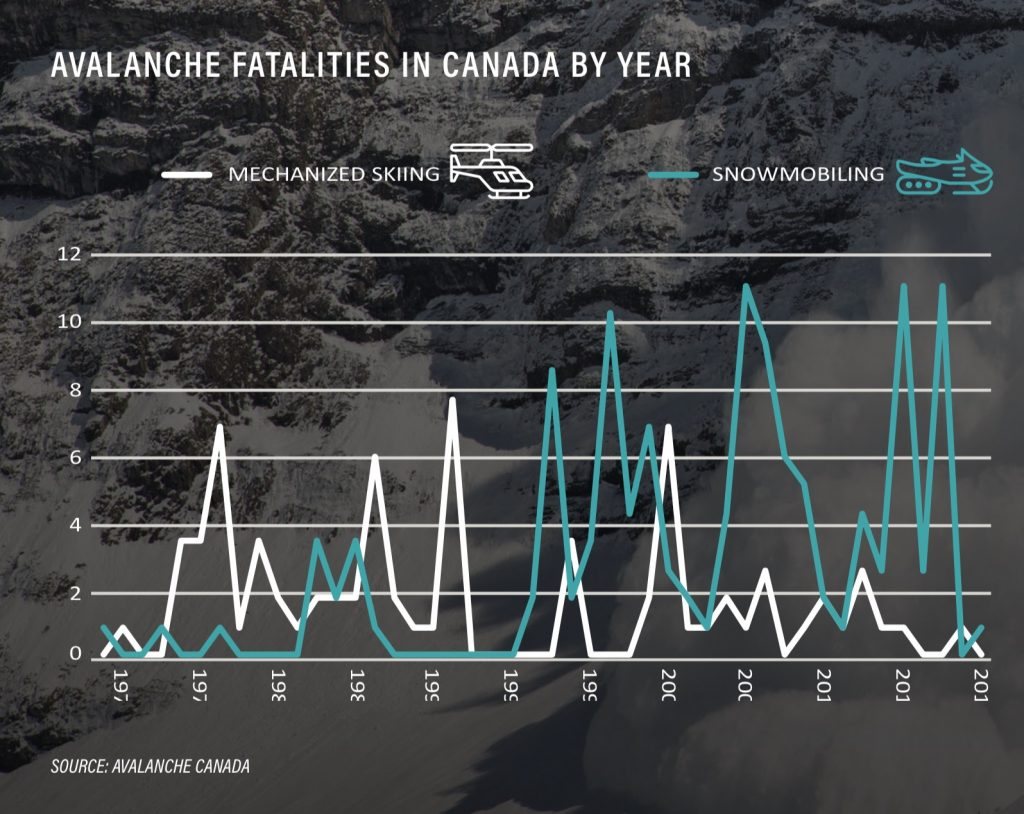
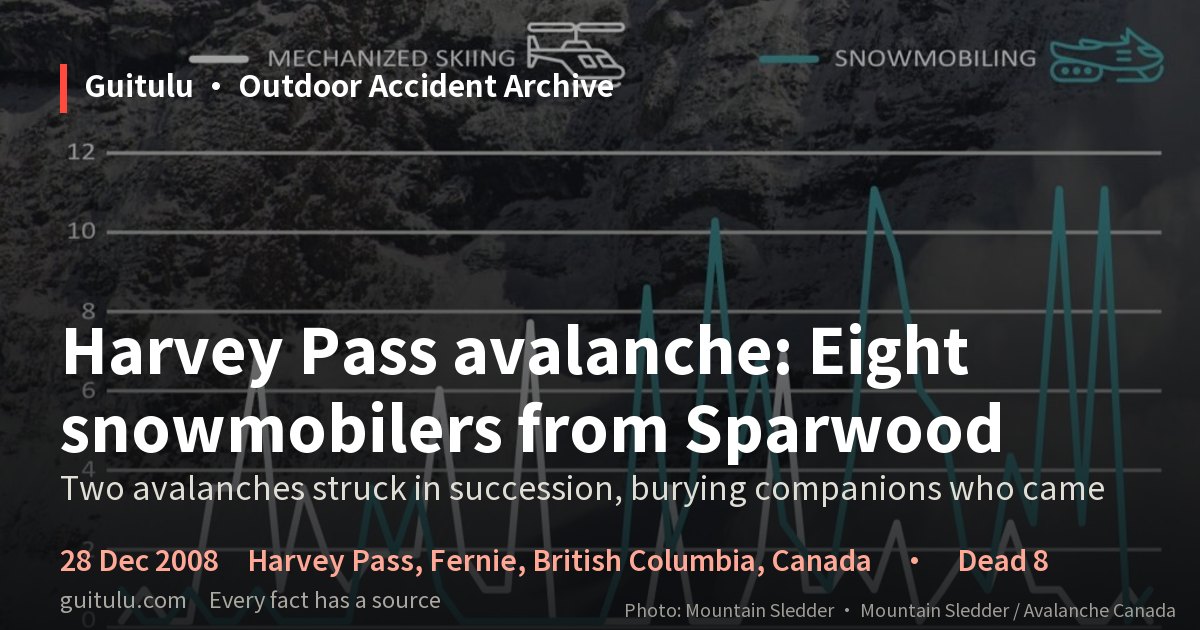
Annual avalanche deaths in Canada: mechanized skiing compared with snowmobiling (data source: Avalanche Canada)

Archive / Other

Harvey Pass avalanche: Eight snowmobilers from Sparwood killed

Two avalanches struck in succession, burying companions who came to help; only 3 of 11 survived

Coroner ruled the deaths accidental and made no recommendations; snowmobile avalanche deaths in the same season prompted a provincial coroner's death review panel

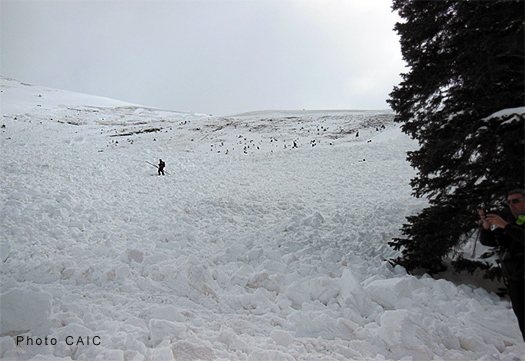
Photo: Mountain Sledder · Mountain Sledder / Avalanche Canada

Date
Winter
Place
Harvey Pass, Fernie, British Columbia, CanadaCanada › British Columbia · Rocky Mountains-114.700°E 49.283°N
Activity
SnowmobilingInvolves: Avalanche11 men from Sparwood, in groups of 7 and 4
Casualties
Dead 8 Injured 38 killed; 3 survivors sustained minor injuries
Material
44 facts · 12 sources4 accounts differ and are shown side by side

01What happened

On 28 December 2008, 11 men from Sparwood, a coal-mining town in British Columbia, went into the mountains in two groups to ride snowmobiles. Several reportedly worked in coal mines. According to a first-anniversary report, the group of 7 had planned to go near Golden, but changed their destination to the Harvey Creek area while having coffee in Fernie because of poor road conditions; the other group of 4 had decided to go there the previous evening. Heavy snow had fallen in the area in the days before the incident, with one report saying about 30 centimetres had fallen in the previous 24 hours.Facts it rests onF02Multiple sourcesThere were 11 participants, all male snowmobilers from the nearby town of Sparwood.F39Single sourceAccording to the mayor of Sparwood, most of the men worked in coal mines and were snowmobiling enthusiasts who loved the outdoors.F03Single sourceThe 11 went into the mountains in two groups. The group of 7 had originally planned to ride near Golden, but because of poor road conditions, they changed their destination to the Harvey Creek area while stopped for coffee in Fernie.F01Single sourceThe other group of 4 decided on the evening before departure to go to Harvey Creek; the coroner found no evidence that they had checked the Canadian Avalanche Centre's latest information before leaving.F04Multiple sourcesThere was heavy snowfall in the Fernie area from the day before the accident through the day of the accident: one report said about 30 centimetres had fallen in the previous 24 hours, while another said about 70 centimetres of new snow had fallen in the mountains around Fernie over several days.

Annual avalanche deaths in Canada: mechanized skiing compared with snowmobiling (data source: Avalanche Canada)Photo source: Mountain Sledder · Mountain Sledder / Avalanche Canada

According to reports, heavy snow was falling in the mountains at the time, and low clouds obscured the peaks. Michael Steele, 20, of the group of 7, became stuck in the snow while going uphill. A survivor later told the coroner that he heard a cracking sound as Steele turned his snowmobile around. After the first avalanche, the second group of 4 heard shouts and came to help dig. As they were digging for a buried person at a depth of about 3 metres, a second avalanche buried everyone at the scene.Facts it rests onF08Single sourceHeavy snow was falling in the mountains at the time, and low clouds obscured the peaks.F09Single sourceAccording to a survivor's statement in the coroner's investigation, 20-year-old Michael Steele, a member of the group of 7, became stuck in the snow while riding uphill. As he turned his snowmobile around, a survivor heard a cracking sound.F12Multiple sourcesThe second group of 4 heard shouts and came to help dig out their buried companions.F13Multiple sourcesAccording to a police statement, they found a buried person and were digging for him at a depth of about 3 metres when a second avalanche buried everyone at the scene.

Two people freed themselves after about 20 minutes, then used an avalanche beacon to locate and dig out a third. The three saw huge cornices around the snow bowl where they were and, fearing a third avalanche, decided to leave on foot. Another avalanche occurred at the site afterward. According to reports, at about 2:30 p.m. the provincial emergency agency received an automatic distress signal from a device carried by a rider. A helicopter picked up two survivors, while the Fernie search and rescue team helped evacuate the third; all three had minor injuries. Search and rescue was postponed until the next day because of avalanche danger and darkness.Facts it rests onF14Multiple sourcesTwo buried people freed themselves after about 20 minutes, then used an avalanche beacon to locate a third buried person and dug for another 20 minutes or so to rescue him.F16Multiple sourcesThe three survivors judged that the large snow bowl they were in was surrounded by huge cornices that could collapse at any moment. Fearing a third avalanche, they decided to walk out.F17Multiple sourcesAnother avalanche occurred at the site shortly after the three left.F18Single sourceThe Provincial Emergency Program office received an automatic distress signal from a communications device carried by a rider at about 2:30 p.m. Mountain Time.F20Multiple sourcesA helicopter picked up two survivors, and the third was transported by ground with assistance from Fernie Search and Rescue. All three sustained minor injuries and were taken to hospital; two were discharged that day, and one was kept in hospital for observation.F21Multiple sourcesBecause of the evident avalanche danger and fading daylight, search and rescue that evening was postponed until the following morning.

After daybreak on 29 December, rescuers reportedly used explosives to stabilise the snow slope before search and rescue personnel reached the site by helicopter and snowmobile. Seven people who had died were found that afternoon. According to the search and rescue team leader, three were found almost immediately because they were wearing avalanche beacons, while the other four were found using probes. On 30 December, the eighth person who had died, 28-year-old Daniel Bjarnason, was found after survivor Jeff Adams helped locate him.Facts it rests onF23Single sourceAt daybreak on 29 December, rescuers flew over the avalanche area and dropped hand-held avalanche bombs to stabilize the snow slope; 15 trained volunteer search and rescue workers travelled there by helicopter and snowmobile, assisted by two RCMP avalanche search and rescue dogs.F25Multiple sourcesAt around 1 p.m. on 29 December, search and rescue personnel first found 3 of those killed, then another 3. The seventh was found shortly before the search was suspended at 3:30 p.m. because of avalanche risk.F27Single sourceAccording to Thomas, 3 of them were found almost immediately because they were wearing avalanche beacons; the other 4 were found using probes.F31Multiple sourcesOn 30 December, survivor Jeff Adams helped the search and rescue team determine where the eighth person had been when the avalanche began, and the search was concentrated in that area.F32Multiple sourcesOn the afternoon of 30 December, the eighth person killed, 28-year-old Daniel Bjarnason, was found.F33Multiple sourcesThe 8 people killed were Daniel Bjarnason (28), Kurtis Kabel (28), Warren Roszell (33), Rodney Kane Rusnak (30), Thomas Talarico (32), Bryan Wilson (26), Leonard Steer (45) and his son Michael.

According to reports, the coroner ruled the deaths accidental, made no recommendations for improvements, and found that the group of 7 could not access avalanche warnings when they changed their route. That winter, 19 snowmobilers died in avalanches, nearly half of them on this day. According to reports, the Canadian Avalanche Centre subsequently redesigned its avalanche bulletins, and the British Columbia Coroners Service established a death review panel. Its report was released in January 2010.Facts it rests onF35Single sourceCoroner Brenda Downey ruled the deaths accidental and made no recommendations for improvements.F40Single sourceThe coroner determined that the group of 7 could not obtain avalanche warning information when they decided to go to the Harvey Creek area instead.F36Multiple sourcesIn the winter of 2008–09, 26 people died in avalanches, 19 of them snowmobilers; nearly half died at Harvey Pass on that day.F37Single sourceThe Canadian Avalanche Centre then quickly redesigned its avalanche bulletins and conducted outreach aimed at snowmobilers.F38Single sourceThe Harvey Pass accident and the large number of snowmobilers killed that season prompted the British Columbia Coroners Service to establish a death review panel the following autumn; its report was released in January 2010, and the Canadian Avalanche Centre subsequently received a three-year federal grant.

The number at the end of a paragraph is how many facts it rests on; open it to see each fact and how well it is sourced: Multiple sourcesSingle source. Conflicting accounts and speculation are kept out of the narrative.

  • Reported locations along the way (illustrative)Schematic

Satellite imagery Sentinel-2 cloudless 2024 © EOX · Terrain AWS Terrain Tiles · Orange line is schematic · Place coordinates not individually verified

Route review

6 scenes to understand what happened

Scroll down and the map flies to where each part happened. The line is Schematic, Connects the locations mentioned in reports in sequence, showing only the approximate direction, not the actual route. See places.json for the sources of the location coordinates.

01

Full route

Places mentioned in reports are connected in sequence to show the approximate course of events (schematic).

02

Change of route at short notice

According to reports, the group of 7 set out from Sparwood and, because of poor road conditions, changed their destination to the Harvey Creek area while having coffee in Fernie; the other group of 4 had decided on this destination the previous evening.Facts it rests onF03Single sourceThe 11 went into the mountains in two groups. The group of 7 had originally planned to ride near Golden, but because of poor road conditions, they changed their destination to the Harvey Creek area while stopped for coffee in Fernie.F01Single sourceThe other group of 4 decided on the evening before departure to go to Harvey Creek; the coroner found no evidence that they had checked the Canadian Avalanche Centre's latest information before leaving.

03

Heavy snow in the mountains

Heavy snow fell in the days before the incident. According to reports, the avalanche centre's warning that day described conditions in the area as “very touchy”; heavy snow was still falling in the mountains, and low clouds obscured the peaks.Facts it rests onF04Multiple sourcesThere was heavy snowfall in the Fernie area from the day before the accident through the day of the accident: one report said about 30 centimetres had fallen in the previous 24 hours, while another said about 70 centimetres of new snow had fallen in the mountains around Fernie over several days.F05Single sourceThe Canadian Avalanche Centre issued a warning on the day of the accident, saying conditions in the area were “very touchy” because 27 inches of new snow had fallen on a weak snowpack.F08Single sourceHeavy snow was falling in the mountains at the time, and low clouds obscured the peaks.

04

Two avalanches

After the first avalanche, the second group of 4 heard the calls and came to dig. As they were digging for a buried person at a depth of about 3 metres, the second avalanche buried everyone.Facts it rests onF12Multiple sourcesThe second group of 4 heard shouts and came to help dig out their buried companions.F13Multiple sourcesAccording to a police statement, they found a buried person and were digging for him at a depth of about 3 metres when a second avalanche buried everyone at the scene.

05

Three survivors leave

Two people freed themselves and used a beacon to rescue a third. Fearing a third avalanche, the three walked out and were subsequently picked up by helicopter and a search and rescue team.Facts it rests onF14Multiple sourcesTwo buried people freed themselves after about 20 minutes, then used an avalanche beacon to locate a third buried person and dug for another 20 minutes or so to rescue him.F16Multiple sourcesThe three survivors judged that the large snow bowl they were in was surrounded by huge cornices that could collapse at any moment. Fearing a third avalanche, they decided to walk out.F20Multiple sourcesA helicopter picked up two survivors, and the third was transported by ground with assistance from Fernie Search and Rescue. All three sustained minor injuries and were taken to hospital; two were discharged that day, and one was kept in hospital for observation.

06

Three-day search

Seven victims were found on 29 December, and the eighth, Daniel Bjarnason, was found on the afternoon of 30 December.Facts it rests onF25Multiple sourcesAt around 1 p.m. on 29 December, search and rescue personnel first found 3 of those killed, then another 3. The seventh was found shortly before the search was suspended at 3:30 p.m. because of avalanche risk.F32Multiple sourcesOn the afternoon of 30 December, the eighth person killed, 28-year-old Daniel Bjarnason, was found.

02Timeline

  1. The other group of 4 decided on the evening before departure to go to Harvey Creek; the coroner found no evidence that they had checked the Canadian Avalanche Centre's latest information before leaving. F01

  2. The Canadian Avalanche Centre issued a warning on the day of the accident, saying conditions in the area were “very touchy” because 27 inches of new snow had fallen on a weak snowpack. F05

  3. Because of the evident avalanche danger and fading daylight, search and rescue that evening was postponed until the following morning. F21

  4. According to a survivor's statement in the coroner's investigation, 20-year-old Michael Steele, a member of the group of 7, became stuck in the snow while riding uphill. As he turned his snowmobile around, a survivor heard a cracking sound. F09

  5. According to a police statement, they found a buried person and were digging for him at a depth of about 3 metres when a second avalanche buried everyone at the scene. F13

  6. The Provincial Emergency Program office received an automatic distress signal from a communications device carried by a rider at about 2:30 p.m. Mountain Time. F18

  7. The three survivors judged that the large snow bowl they were in was surrounded by huge cornices that could collapse at any moment. Fearing a third avalanche, they decided to walk out. F16

  8. The 11 went into the mountains in two groups. The group of 7 had originally planned to ride near Golden, but because of poor road conditions, they changed their destination to the Harvey Creek area while stopped for coffee in Fernie. F03

  9. A helicopter picked up two survivors, and the third was transported by ground with assistance from Fernie Search and Rescue. All three sustained minor injuries and were taken to hospital; two were discharged that day, and one was kept in hospital for observation. F20

  10. At daybreak on 29 December, rescuers flew over the avalanche area and dropped hand-held avalanche bombs to stabilize the snow slope; 15 trained volunteer search and rescue workers travelled there by helicopter and snowmobile, assisted by two RCMP avalanche search and rescue dogs. F23

  11. At around 1 p.m. on 29 December, search and rescue personnel first found 3 of those killed, then another 3. The seventh was found shortly before the search was suspended at 3:30 p.m. because of avalanche risk. F25

  12. A candlelight vigil was held in Sparwood on the evening of 29 December, attended by hundreds of people; memorial events were held at two churches in the town on the evening of 30 December. F29

  13. On the afternoon of 30 December, the eighth person killed, 28-year-old Daniel Bjarnason, was found. F32

  14. The Harvey Pass accident and the large number of snowmobilers killed that season prompted the British Columbia Coroners Service to establish a death review panel the following autumn; its report was released in January 2010, and the Canadian Avalanche Centre subsequently received a three-year federal grant. F38

03Lessons

Avalanche and high altitude

Check avalanche bulletins even when changing routes at short notice

According to the coroner's findings, the group of 7 could not access avalanche warnings when they changed their destination to Harvey Creek at short notice in Fernie; there was also no evidence that the other group of 4 had checked the avalanche centre's latest information before setting out. According to reports, the avalanche centre's warning that day described conditions in the area as “very touchy”.Facts it rests onF40Single sourceThe coroner determined that the group of 7 could not obtain avalanche warning information when they decided to go to the Harvey Creek area instead.F01Single sourceThe other group of 4 decided on the evening before departure to go to Harvey Creek; the coroner found no evidence that they had checked the Canadian Avalanche Centre's latest information before leaving.F05Single sourceThe Canadian Avalanche Centre issued a warning on the day of the accident, saying conditions in the area were “very touchy” because 27 inches of new snow had fallen on a weak snowpack.

Weather and retreat

Snowpack overloaded after sustained heavy snowfall

Heavy snow had fallen around Fernie in the days before the incident. An avalanche centre forecaster said that a large amount of new snow combined with a period of warming had overloaded the snowpack. Heavy snow was still falling in the mountains at the time, and low clouds obscured the peaks.Facts it rests onF04Multiple sourcesThere was heavy snowfall in the Fernie area from the day before the accident through the day of the accident: one report said about 30 centimetres had fallen in the previous 24 hours, while another said about 70 centimetres of new snow had fallen in the mountains around Fernie over several days.F06Single sourceCanadian Avalanche Centre forecaster James Floyer said that heavy new snow and a period of warming combined to overload the snowpack; the centre's warning that afternoon said soft slabs were forming at all elevations in the Fernie and Lizard Range area.F08Single sourceHeavy snow was falling in the mountains at the time, and low clouds obscured the peaks.

Rescue and self-rescue

Rescue site remained in the avalanche path

When the second group of 4 came to help dig, a second avalanche buried everyone at the scene. After freeing themselves, the three survivors saw huge cornices around the snow bowl and left because they feared a third avalanche. Another avalanche did occur at the site afterward.Facts it rests onF12Multiple sourcesThe second group of 4 heard shouts and came to help dig out their buried companions.F13Multiple sourcesAccording to a police statement, they found a buried person and were digging for him at a depth of about 3 metres when a second avalanche buried everyone at the scene.F16Multiple sourcesThe three survivors judged that the large snow bowl they were in was surrounded by huge cornices that could collapse at any moment. Fearing a third avalanche, they decided to walk out.F17Multiple sourcesAnother avalanche occurred at the site shortly after the three left.

Rescue and self-rescue

Beacons determine how quickly buried people are found

The two survivors who freed themselves used an avalanche beacon to locate and dig out a third person. According to the search and rescue team leader, 3 of the victims were found almost immediately because their beacons were transmitting signals; the other 4 could only be found gradually using probes.Facts it rests onF14Multiple sourcesTwo buried people freed themselves after about 20 minutes, then used an avalanche beacon to locate a third buried person and dug for another 20 minutes or so to rescue him.F27Single sourceAccording to Thomas, 3 of them were found almost immediately because they were wearing avalanche beacons; the other 4 were found using probes.

04Fact list 44 facts

Under each fact is a verbatim quote from the original. "Single source" means only one outlet mentioned it; "Accounts differ" means sources contradict each other and this site adopts neither side; "Speculation" is an inference by a reporter or a person involved, not a fact.

  1. F01Single sourceFound at scene

    According to The Globe and Mail, The other group of 4 decided on the evening before departure to go to Harvey Creek; the coroner found no evidence that they had checked the Canadian Avalanche Centre's latest information before leaving.

    Quotes from the original 1

    “The four snowmobilers had decided to go to Harvey Creek on the evening before their trip. The coroner did not find any evidence they had checked the Canadian Avalanche Centre for an update before setting out.”

    The Globe and Mail ·
  2. F02Multiple sourcesBackground

    There were 11 participants, all male snowmobilers from the nearby town of Sparwood.

    Quotes from the original 3

    “said all 11 riders involved are males from the nearby town of Sparwood”

    CBC ·

    “All 11 snowmobilers involved are men from the nearby town of Sparwood.”

    CTV ·

    “All 11 men came from the nearby coal-mining town of Sparwood, population 4,000, and knew each other, Mayor David Wilks said.”

    AP · 2008-12-30
  3. F03Single sourcePlan

    According to The Globe and Mail, The 11 went into the mountains in two groups. The group of 7 had originally planned to ride near Golden, but because of poor road conditions, they changed their destination to the Harvey Creek area while stopped for coffee in Fernie.

    Quotes from the original 2

    “The 11 men had come to the valley in two separate groups. Seven had set out from Sparwood to ride the mountains near Golden, B.C., but road conditions were poor.”

    The Globe and Mail ·

    “They changed their plans during a coffee stop at Fernie.”

    The Globe and Mail ·
  4. F04Multiple sourcesBackground

    There was heavy snowfall in the Fernie area from the day before the accident through the day of the accident: one report said about 30 centimetres had fallen in the previous 24 hours, while another said about 70 centimetres of new snow had fallen in the mountains around Fernie over several days.

    The two media reports covered different periods.

    Quotes from the original 2

    “About 30 centimetres of snow had fallen in the area over the past 24 hours - an amount equal to the snow that fell on Saturday”

    The Globe and Mail ·

    “Approximately 70 cm of new snow has fallen in the mountains surrounding Fernie over the past few days.”

    CTV ·
  5. F05Single sourceBackground

    According to AP, The Canadian Avalanche Centre issued a warning on the day of the accident, saying conditions in the area were “very touchy” because 27 inches of new snow had fallen on a weak snowpack.

    Quotes from the original 1

    “the Canadian Avalanche Center had issued an alert Sunday saying conditions in the region of the deadly slides were “very touchy” because of 27 inches of new snow combined with a weak snowpack.”

    AP · 2008-12-30
  6. F06Single sourcePost-incident analysis

    According to CBC, Canadian Avalanche Centre forecaster James Floyer said that heavy new snow and a period of warming combined to overload the snowpack; the centre's warning that afternoon said soft slabs were forming at all elevations in the Fernie and Lizard Range area.

    Quotes from the original 2

    “James Floyer, an avalanche forecaster at the centre, noted there has been significant new snowfall and a warming period, which have combined to overload the snowpack.”

    CBC ·

    “Mountain conditions, especially around Fernie and the Lizard ranges, have changed and we're now seeing avalanches starting to affect this region. Soft slabs are building at all elevations”

    CBC ·
  7. F07Single sourceParticipant's view

    According to The Globe and Mail, Paul Kramer, president of the Fernie Snowmobile Association, believed most snowmobilers would avoid going out in such weather.

    Quotes from the original 1

    “Most snowmobilers would have avoided going on a day like yesterday, Mr. Kramer said.”

    The Globe and Mail ·
  8. F08Single sourceEvent

    According to The Globe and Mail, Heavy snow was falling in the mountains at the time, and low clouds obscured the peaks.

    Quotes from the original 1

    “It was snowing heavily in the back country, with low clouds blocking out the top of the mountain.”

    The Globe and Mail ·
  9. F09Single sourceEvent

    According to The Globe and Mail, According to a survivor's statement in the coroner's investigation, 20-year-old Michael Steele, a member of the group of 7, became stuck in the snow while riding uphill. As he turned his snowmobile around, a survivor heard a cracking sound.

    Quotes from the original 1

    “One of the group, Michael Stier, 20, started up a hill and became stuck in the snow. A survivor later told the coroner that he heard a crack as Mr. Stier was turning his sled.”

    The Globe and Mail ·
  10. F10Accounts differEvent

    Accounts differ on how many people were buried in the first avalanche: a police statement said some members of the group of 7 were buried; AP said all 7 were buried while resting at the foot of the mountain; The Globe and Mail said all 7 were buried and that everyone except Steele freed themselves or was pulled out; and a National Geographic column said 3 people were buried initially.

    Quotes from the original 4

    “The first avalanche caught part of a group of seven snowmobilers in the Harvey Pass area”

    CBC ·

    “The first avalanche Sunday buried seven of the snowmobilers while they were resting at the foot of a hill.”

    AP · 2008-12-30

    “A wall of snow crashing from the mountain top buried all seven members of the group. Everyone but Mr. Stier managed to either dig themselves out or be pulled out.”

    The Globe and Mail ·

    “Two other riders came to his rescue, but all three were caught and buried in a slide.”

    National Geographic ·
  11. F11SpeculationSpeculation

    The mayor of Sparwood speculated that a cornice at the top of the mountain may have broken off and triggered the first avalanche.

    Quotes from the original 1

    “"It appears a cornice let loose — an overhang on the top of the mountain — and buried them," he said.”

    AP · 2008-12-30
  12. F12Multiple sourcesEvent

    The second group of 4 heard shouts and came to help dig out their buried companions.

    Both the CBC and CTV accounts came from a police statement.

    Quotes from the original 3

    “A second group of four riders heard their cries and came to help members of the first group dig out their fellow riders.”

    CBC ·

    “The other four snowmobilers heard their shouts, hurried over and started digging when they were hit by a second avalanche.”

    AP · 2008-12-30

    “A second group of four snowmobilers heard yelling from the area and came to the aid of members from the first group”

    CTV ·
  13. F13Multiple sourcesEvent

    According to a police statement, they found a buried person and were digging for him at a depth of about 3 metres when a second avalanche buried everyone at the scene.

    Both the CBC and CTV accounts came from a police statement.

    Quotes from the original 3

    “They located one rider, but as they were digging him out at a depth of about three metres, a second avalanche buried the entire group”

    CBC ·

    “as they were digging him out from a depth of about three meters a second avalanche came down and buried the entire group”

    CTV ·

    “While the two groups were searching for Mr. Stier, a second avalanche buried all the men.”

    The Globe and Mail ·
  14. F14Multiple sourcesEvent

    Two buried people freed themselves after about 20 minutes, then used an avalanche beacon to locate a third buried person and dug for another 20 minutes or so to rescue him.

    Both the CBC and CTV accounts came from a police statement.

    Quotes from the original 3

    “Two of the buried riders managed to rescue themselves in about 20 minutes and then used their avalanche beacons to locate a third buried rider, whom they rescued after another 20 minutes of digging.”

    CBC ·

    “Two of the buried riders managed to self-rescue within about 20 minutes. These two used their avalanche beacons to locate a third buried victim who they rescued after an additional 20 minutes of digging.”

    CTV ·

    “Two men dug themselves out and pulled a third man free.”

    AP · 2008-12-30
  15. F15Single sourceEvent

    According to The Globe and Mail, According to a report on the first anniversary, survivor Jeff Adams first dug himself out, then rescued Jeremy Rusnak, and the two together pulled Drake out; Adams said he was buried twice that day.

    Quotes from the original 2

    “Mr. Adams, who was with the group of seven, managed to dig himself out and then rescued Jeremy Rusnak. Together, they managed to pull Mr. Drake out.”

    The Globe and Mail ·

    “I was buried twice that day.”

    The Globe and Mail ·
  16. F16Multiple sourcesEvent

    The three survivors judged that the large snow bowl they were in was surrounded by huge cornices that could collapse at any moment. Fearing a third avalanche, they decided to walk out.

    Both the CBC and CTV accounts came from a police statement.

    Quotes from the original 3

    “The three survivors assessed their surroundings in a large bowl with massive cornices ready to come down. Based on the risk of a third avalanche, they began walking out.”

    CBC ·

    “They were located in a large bowl with massive cornices ready to come down. Based on their risk assessment of the possibility of a third avalanche, they began walking out.”

    CTV ·

    “left the area when they feared another avalanche would hit.”

    AP · 2008-12-30
  17. F17Multiple sourcesEvent

    Another avalanche occurred at the site shortly after the three left.

    Some sources have low credibility.

    Quotes from the original 2

    “It did soon after they hurried away.”

    AP · 2008-12-30

    “looked back to see a fourth slide fall on the site.”

    National Geographic ·
  18. F18Single sourceEvent

    According to CTV, The Provincial Emergency Program office received an automatic distress signal from a communications device carried by a rider at about 2:30 p.m. Mountain Time.

    Quotes from the original 1

    “The Provincial Emergency Program was notified about the event at approximately 2:30 PM (Mountain Time) when automated distress calls were received from communications devices worn by the snowmobilers.”

    CTV ·
  19. F19Accounts differEvent

    Accounts differ on when the avalanche occurred: the Associated Press and The Globe and Mail said Sunday afternoon; a CBC report said Sunday morning.

    Quotes from the original 3

    “Eleven men, most of them in their 20s, were swept away when back-to-back avalanches hit Sunday afternoon.”

    AP · 2008-12-30

    “Area officials say the avalanche occurred yesterday afternoon between Fernie and Sparwood”

    The Globe and Mail ·

    “the area where the men were trapped in the avalanches Sunday morning”

    CBC ·
  20. F20Multiple sourcesEvent

    A helicopter picked up two survivors, and the third was transported by ground with assistance from Fernie Search and Rescue. All three sustained minor injuries and were taken to hospital; two were discharged that day, and one was kept in hospital for observation.

    Quotes from the original 3

    “A helicopter sent to the scene picked up two of the three known survivors, while Fernie Search and Rescue personnel rescued the third, the statement said. All three sustained minor injuries.”

    CBC ·

    “Two have been discharged already, while the third is in stable condition and was kept overnight for observation.”

    CTV ·

    “of the three rescued people taken to hospital in Fernie, two have been discharged and the other is in stable condition.”

    The Globe and Mail ·
  21. F21Multiple sourcesEvent

    Because of the evident avalanche danger and fading daylight, search and rescue that evening was postponed until the following morning.

    The Globe and Mail quotes CTV here.

    Quotes from the original 2

    “Due to the obvious avalanche hazard and growing darkness, the search for survivors had to be postponed until Monday morning.”

    CTV ·

    “CTV reported the search for the missing snowmobilers had been called off until morning.”

    The Globe and Mail ·
  22. F22Multiple sourcesBackground

    The Canadian Avalanche Centre described the avalanche danger level in the area as “high”.

    Quotes from the original 2

    “The Canadian Avalanche Centre is describing the avalanche hazard in this area as "high".”

    CTV ·

    “The Canadian Avalanche Centre said the avalanche risk is still high in the area.”

    CBC ·
  23. F23Single sourceEvent

    According to CTV, At daybreak on 29 December, rescuers flew over the avalanche area and dropped hand-held avalanche bombs to stabilize the snow slope; 15 trained volunteer search and rescue workers travelled there by helicopter and snowmobile, assisted by two RCMP avalanche search and rescue dogs.

    Quotes from the original 2

    “Rescuers flew over the avalanche zone in the Harvey Pass area near Fernie at first light and dropped handheld avalanche bombs onto the slope to stabilize it and prevent further avalanches.”

    CTV ·

    “Currently 15 trained volunteer searchers are en-route to the site by helicopter and snow cat to look for survivors.”

    CTV ·
  24. F24Multiple sourcesEvent

    About 50 people took part in the search, including RCMP officers and local volunteers, with two trained search and rescue dogs; the Associated Press said search and rescue was postponed until later on Monday because of the threat of another avalanche.

    Quotes from the original 2

    “Some 50 people, including RCMP officers and local volunteers, and two specially trained sniffer dogs have been combing the area”

    CBC ·

    “Search efforts — which involved several dozen rescue officials and volunteers as well as search dogs — had been delayed until later Monday by the threat of more avalanches.”

    AP · 2008-12-30
  25. F25Multiple sourcesEvent

    At around 1 p.m. on 29 December, search and rescue personnel first found 3 of those killed, then another 3. The seventh was found shortly before the search was suspended at 3:30 p.m. because of avalanche risk.

    The two CBC reports are from the same outlet.

    Quotes from the original 3

    “Search crews first located three bodies at about 1 p.m., and then three more bodies a little later, police said. The seventh body was found shortly before Monday's search was called off at 3:30 p.m.”

    CBC ·

    “crews located three bodies at about 1 p.m. Monday afternoon and three more bodies a short time later, police said.”

    CBC ·

    “Search teams recovered the bodies of seven snowmobilers Monday”

    AP · 2008-12-30
  26. F26Single sourceFound at scene

    According to CBC, According to Fernie Search and Rescue leader Chris Thomas, those killed were spread across an area of about 120 metres; the deepest was buried under 3.5 metres of snow, and the others were about 1 metre deep.

    Quotes from the original 2

    “The deepest was found under 3.5 metres of snow, the others about a metre beneath the surface, said Chris Thomas, president of Fernie Search and Rescue.”

    CBC ·

    “They were spread out over about 120 metres”

    CBC ·
  27. F27Single sourceFound at scene

    According to CBC, According to Thomas, 3 of them were found almost immediately because they were wearing avalanche beacons; the other 4 were found using probes.

    Quotes from the original 2

    “three were located almost immediately because they were wearing special avalanche transceivers that send out an electronic signal, Thomas said.”

    CBC ·

    “"The other four were found by probe strikes”

    CBC ·
  28. F28SpeculationSpeculation

    Thomas speculated that the other 4 people's beacons may not have been turned on, or may have been in receive mode and not transmitting because they were searching for their companions.

    Quotes from the original 1

    “their transceivers were not on or they were, likely, in receive mode as opposed to transmit mode because they were looking for additional people," Thomas said.”

    CBC ·
  29. F29Single sourceAftermath

    According to CBC, A candlelight vigil was held in Sparwood on the evening of 29 December, attended by hundreds of people; memorial events were held at two churches in the town on the evening of 30 December.

    Several quotations come from different reports by the same outlet and are counted as one source.

    Quotes from the original 2

    “Wilks was one of several hundred people to attend a candlelight vigil held in Sparwood Monday night”

    CBC ·

    “Two church services were held Tuesday night in Sparwood, B.C.”

    CBC ·
  30. F30Multiple sourcesFound at scene

    Randy Roberts, the father-in-law of one of those killed, said everyone had shovels and emergency transmitters.

    Quotes from the original 2

    “All had shovels and emergency transmitters designed to help locate them in case of an avalanche.”

    AP · 2008-12-30

    “They all had their packs, their shovels”

    CBC ·
  31. F31Multiple sourcesEvent

    On 30 December, survivor Jeff Adams helped the search and rescue team determine where the eighth person had been when the avalanche began, and the search was concentrated in that area.

    Quotes from the original 2

    “One of those was Jeff Adams, who helped search crews pinpoint where the eighth man might be buried in the snow.”

    CBC ·

    “One survivor, Jeff Adams, went out with the search team Tuesday”

    AP · 2008-12-30
  32. F32Multiple sourcesEvent

    On the afternoon of 30 December, the eighth person killed, 28-year-old Daniel Bjarnason, was found.

    Quotes from the original 2

    “The eighth and final body — identified as Daniel Bjarnason, 28 — was found Tuesday afternoon.”

    CBC ·

    “The eighth and final body was found today from a group of snowmobilers buried by weekend avalanches”

    AP · 2008-12-30
  33. F33Multiple sourcesAftermath

    The 8 people killed were Daniel Bjarnason (28), Kurtis Kabel (28), Warren Roszell (33), Rodney Kane Rusnak (30), Thomas Talarico (32), Bryan Wilson (26), Leonard Steer (45) and his son Michael.

    Quotes from the original 2

    “The avalanches killed Daniel Bjarnason, 28; Kurt Kabel, 28; Warren Rothel, 33; Rodney Kane Rusnak, 30; Thomas Talarico, 32; Blayne Wilson, 26; Leonard Stier, 45, and his son Michael.”

    The Globe and Mail ·

    “Also Tuesday, RCMP released the names of the seven men whose bodies were found Monday.”

    CBC ·
  34. F34Single sourceParticipant's view

    According to CBC, The mayor of Sparwood believed that the riders had done nothing wrong and that what happened was a series of events beyond their control.

    Quotes from the original 1

    “"They did nothing wrong here," Wilks said, speaking to CBC Newsworld. "A series of events occurred that were uncontrollable by them.”

    CBC ·
  35. F35Single sourceFound at scene

    According to The Globe and Mail, Coroner Brenda Downey ruled the deaths accidental and made no recommendations for improvements.

    Quotes from the original 1

    “Coroner Brenda Downey concluded the deaths were accidental and made no recommendations for changes.”

    The Globe and Mail ·
  36. F36Multiple sourcesPost-incident analysis

    In the winter of 2008–09, 26 people died in avalanches, 19 of them snowmobilers; nearly half died at Harvey Pass on that day.

    Quotes from the original 2

    “26 people died in avalanches that season. 19 were sledders, and nearly half of them were killed in a single day: the notorious Harvey Pass accident”

    Mountain Sledder ·

    “With 19 snowmobiling fatalities in the back country during the winter season”

    The Globe and Mail ·
  37. F37Single sourceAftermath

    According to The Globe and Mail, The Canadian Avalanche Centre then quickly redesigned its avalanche bulletins and conducted outreach aimed at snowmobilers.

    Quotes from the original 1

    “the Canadian Avalanche Centre moved quickly to revamp its avalanche advisory and reach out to at-risk sledders.”

    The Globe and Mail ·
  38. F38Single sourceAftermath

    According to Mountain Sledder, The Harvey Pass accident and the large number of snowmobilers killed that season prompted the British Columbia Coroners Service to establish a death review panel the following autumn; its report was released in January 2010, and the Canadian Avalanche Centre subsequently received a three-year federal grant.

    Quotes from the original 2

    “The magnitude of Harvey Pass and the shocking number of snowmobiling fatalities over that winter spurred the BC Coroner’s Office to strike a Death Review Panel the next fall”

    Mountain Sledder ·

    “The report came out in January of 2010, and its recommendations provided Avalanche Canada with a road map for this growing issue. Avalanche Canada received a three-year federal grant”

    Mountain Sledder ·
  39. F39Single sourceBackground

    According to CBC, According to the mayor of Sparwood, most of the men worked in coal mines and were snowmobiling enthusiasts who loved the outdoors.

    Quotes from the original 1

    “Most of them worked in the coal mines. They were avid outdoorsmen; they loved snowmobiling, they loved life.”

    CBC ·
  40. F40Single sourceFound at scene

    According to The Globe and Mail, The coroner determined that the group of 7 could not obtain avalanche warning information when they decided to go to the Harvey Creek area instead.

    Quotes from the original 1

    “They did not have access to avalanche warnings when they decided to go over to the Harvey Creek area, the coroner concluded.”

    The Globe and Mail ·
  41. F41Accounts differBackground

    Accounts differ on the location of the accident: an RCMP statement placed it in the Harvey Pass area, about 40 kilometres south of Fernie, a popular local backcountry snowmobiling location; the publisher of the Fernie Free Press placed it in the Harvey Creek area, about 20 kilometres east of Fernie.

    Quotes from the original 3

    “the Harvey Pass area, a popular back-country snowmobile destination about 40 kilometres south of Fernie”

    CBC ·

    “a popular backcountry snowmobile destination located about 40 km south of Fernie”

    CTV ·

    “the avalanches occurred "about 20 kilometres east of Fernie, in the Harvey Creek area."”

    CBC ·
  42. F42Accounts differFound at scene

    Accounts differ on the devices the riders wore: an RCMP statement said everyone buried in the second avalanche was wearing an avalanche beacon; a National Geographic column said authorities later stated that it was a SPOT satellite distress beacon.

    Quotes from the original 3

    “a second avalanche buried the entire group, all of whom were wearing avalanche beacons.”

    CBC ·

    “All of the snowmobilers were wearing avalanche beacons.”

    CTV ·

    “Early reports said the snowmobilers wore avalanche transceivers, but authorities later said they were SPOT satellite emergency beacons.”

    National Geographic ·
  43. F43Single sourceAftermath

    According to Global News, More than 2000 people reportedly attended the public funeral.

    Quotes from the original 1

    “More than 2,000 people attended the public funeral.”

    Global News ·
  44. F44Single sourceAftermath

    According to SnoRiders West, At a snowmobile safety forum later held in Fernie, attendees observed a moment of silence for the riders killed in December 2008.

    Quotes from the original 1

    “A moment of silence was marked at the Sledhead Think Tank to pay tribute to the men who lost their lives in a tragic avalanche near Sparwood, B.C., in December 2008.”

    SnoRiders West ·