The number at the end of a paragraph is how many facts it rests on; open it to see each fact and how well it is sourced:
Multiple sourcesSingle source. Conflicting accounts and speculation are kept out of the narrative.
The team established a base camp below the mountain in May. F05
After Rosen returned to Colorado, the other three left the liaison officer on 15 May to establish an advanced base camp. They cached equipment and food about five hours away, then returned to base camp. F07
On 20 May, the three left base camp for advanced base camp; the plan was for Copp and Dash to attempt the summit while Johnson remained at camp. F08
Search and rescue personnel found the first body at about 4000 meters between base camp and advanced base camp; it was later identified as Copp. A second body, about 300 meters away, was identified as Johnson. F10
The three did not return on time and missed their return flight on 3 June, after which Rosen alerted the relevant authorities. F16
The Sichuan Mountaineering Association quickly organized four climbers to begin searching on 4 June, with about twenty Chinese soldiers providing ground support. F17
The search and rescue encountered strong winds, snowstorms and avalanche risk; a spokesperson for the Sichuan Mountaineering Association said conditions were extremely difficult. F19
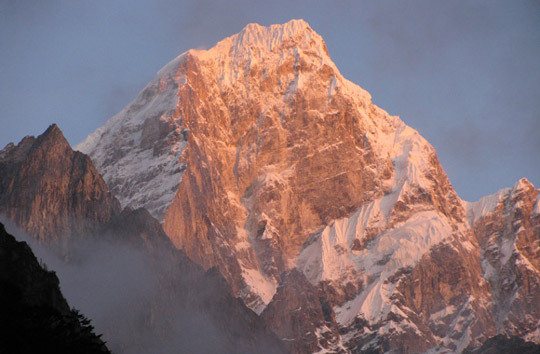
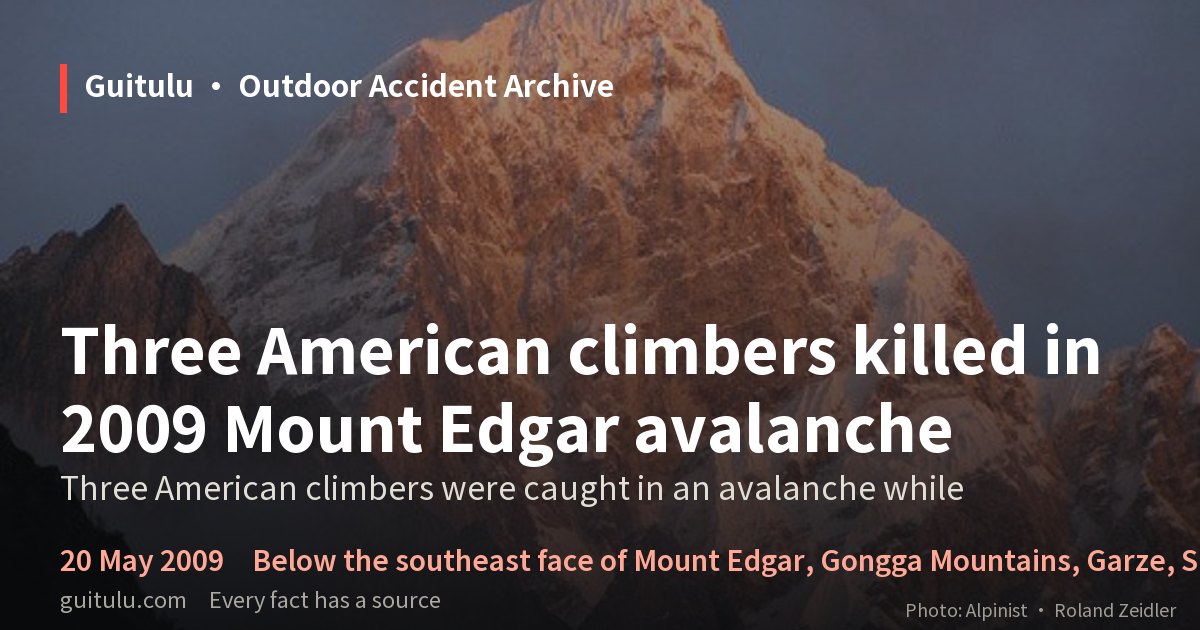
On 11 June, two bodies were recovered from avalanche debris in a broad gully below the southeast face of Mount Edgar; when found, the bodies were partly exposed from fresh avalanche debris. F21
Search and rescue personnel believed that frequent rockfall and almost daily avalanches made continued searching extremely dangerous. On 12 June, the American and Chinese search and rescue teams ended the search for Dash, believing he had died. F22
Under each fact is a verbatim quote from the original. "Single source" means only one outlet mentioned it; "Accounts differ" means sources contradict each other and this site adopts neither side; "Speculation" is an inference by a reporter or a person involved, not a fact.
According to BMC, The two had originally received a Mugs Stump Award in the United States and planned to climb an unclimbed peak in eastern Tibet, but later changed their objective to Mount Edgar, possibly because of access permit issues.
Quotes from the original 1
“possibly due to political access problems, changed their objective to the impressive E Gongga”
In late May 2009, Copp, Dash and Johnson from Colorado were killed in an avalanche below the southeast face of Mount Edgar; Dash's body was not found, and search and rescue personnel believed he had died.
Alpinist described the avalanche as a possibility, while the American Alpine Club stated directly that they were killed in an avalanche.
Quotes from the original 2
“In late May Colorado residents Jonny Copp, Micah Dash, and Wade Johnson lost their lives in an avalanche below the southeast face of Mt. Edgar”
According to AAC, Rosen and Johnson of Sender Films accompanied the team and had planned to film part of the trip for a National Geographic television series.
The American Alpine Club and British Mountaineering Council reports on this subject were written by the same author; only the American Alpine Club report is used here.
Quotes from the original 1
“With Nick Rosen of Sender Films, who with Johnson hoped to document part of the expedition for a National Geographic TV series”
According to AAC, The team established a base camp below the mountain in May.
The American Alpine Club and British Mountaineering Council reports on this subject were written by the same author; only the American Alpine Club report is used here.
Quotes from the original 1
“the three established base camp below the mountain in May”
According to AAC, After Rosen returned to Colorado, the other three left the liaison officer on 15 May to establish an advanced base camp. They cached equipment and food about five hours away, then returned to base camp.
The American Alpine Club and British Mountaineering Council reports on this subject were written by the same author; only the American Alpine Club report is used here.
Quotes from the original 1
“on May 15 the remaining three left their liaison officer to establish an advanced base camp”
According to AAC, On 20 May, the three left base camp for advanced base camp; the plan was for Copp and Dash to attempt the summit while Johnson remained at camp.
Quotes from the original 2
“On the 20th Copp, Dash, and Johnson moved up toward advanced base.”
According to AAC, Search and rescue personnel found the first body at about 4000 meters between base camp and advanced base camp; it was later identified as Copp. A second body, about 300 meters away, was identified as Johnson.
Quotes from the original 1
“The rescuers were able to identify the first body as Copp and the second as Johnson.”
Reports differ on the specific dates the bodies were found: the American Alpine Club and a search and rescue statement said Copp's body was found on 5 June and Johnson's on 7 June; the British Mountaineering Council said a body was first found on 6 June; Alpinist said Copp's body was identified on 7 June and Johnson's found the following day; AP said Copp's body was found on Saturday and Johnson's on Monday.
The reports use different starting dates and reporting time frames; the specific dates are subject to further review.
Quotes from the original 3
“On June 5 two Sichuan Mountaineering Association (SMA) climbers, Li Zong Li and Guo Jie, discovered Copp’s body at 4,000 meters”
According to AAC, Four experienced American climbers close to the three men (Eric DeCaria, Nick Martino, Steve Su, Pete Takeda) arranged flights and visas and traveled to China to assist with the search and rescue.
Quotes from the original 1
“four experienced American mountaineers, Eric DeCaria, Nick Martino, Steve Su, and Pete Takeda, who were close friends of the three climbers”
Friends raised funds for the search and rescue and coordinated information in Boulder; the search and rescue organizers said they hoped to conduct the operation as independently as possible.
Quotes from the original 2
“Climbers in Colorado spent their savings to expedite visas and buy plane tickets.”
According to Alpinist, The Sichuan Mountaineering Association quickly organized four climbers to begin searching on 4 June, with about twenty Chinese soldiers providing ground support.
Quotes from the original 2
“The Sichuan Mountaineering Association quickly rallied four Chinese climbers to begin a search on June 4.”
According to BMC, Two Chinese climbers searching on 6 June found a body at about 4000 meters. Visibility was poor and an avalanche blocked the way ahead, so they could only photograph the body for identification and could not move it.
This date conflicts with the discovery dates in other reports; see the related conflicting facts.
Quotes from the original 2
“Visibility was reported to have been very limited and the way ahead blocked by avalanche.”
According to Deseret News, The search and rescue encountered strong winds, snowstorms and avalanche risk; a spokesperson for the Sichuan Mountaineering Association said conditions were extremely difficult.
Quotes from the original 1
“Our search team has encountered extremely challenging conditions today with the intense winds, potential for avalanches and heavy snowfall”
According to Deseret News, According to a spokesperson for the Sichuan Mountaineering Association, Copp and Johnson's deaths were the first fatalities on Mount Gongga since 2001.
Quotes from the original 1
“The deaths of Copp, 35, and Johnson were the first on Mount Gongga since 2001”
According to Climbing, On 11 June, two bodies were recovered from avalanche debris in a broad gully below the southeast face of Mount Edgar; when found, the bodies were partly exposed from fresh avalanche debris.
Quotes from the original 2
“were removed from a broad gulley among avalanche debris on the southeast face of Mount Edgar”
According to Climbing, Search and rescue personnel believed that frequent rockfall and almost daily avalanches made continued searching extremely dangerous. On 12 June, the American and Chinese search and rescue teams ended the search for Dash, believing he had died.
Quotes from the original 2
“frequent rock fall and near-daily avalanches made further efforts extremely dangerous”
According to Climbing, Search and rescue personnel said the extensive search area, fresh avalanche debris and approaching rainy season further reduced the likelihood of finding Dash.
Quotes from the original 1
“The vast search area and deposition of new avalanche debris further diminished the probability of locating Dash’s body.”
According to AAC, The southeast face of Mount Edgar had long been discussed as an objective in the climbing community, and photographs by Japanese explorer Tamotsu Nakamura made it widely known.
Quotes from the original 1
“The face was a much talked about objective, which has received wide publicity due to photos published by prolific Japanese explorer Tamotsu Nakamura.”
Reported elevations for Mount Edgar differ: the American Alpine Club, Alpinist and the British Mountaineering Council give 6618 metres, while Backpacker and others give 22368 feet.
 GuituluGlobal Outdoor Accident Archive