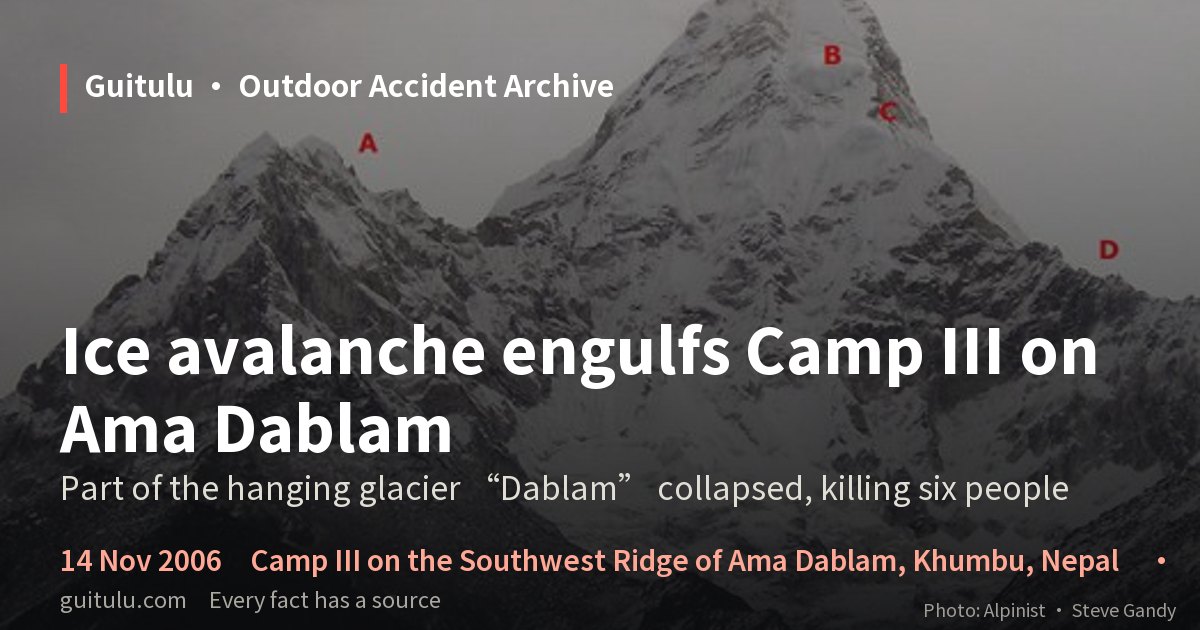
Part of the hanging glacier “Dablam” collapsed, killing six people staying overnight at Camp III
Six people died; a helicopter search found no signs of life after the incident, and reports said the search for bodies might have to wait until the following spring.
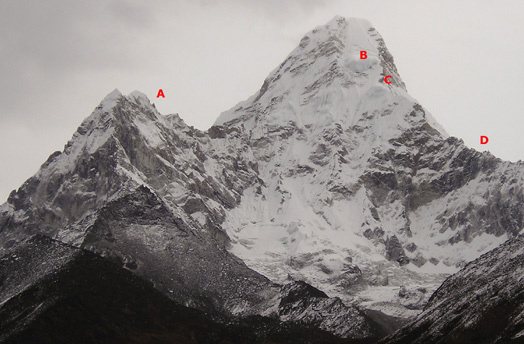
Ama Dablam seen from the west about a week before the accident, with letters marking the Northwest Ridge, the Dablam ice tower, the location of Camp III and the Southwest RidgePhoto source: Alpinist · Steve Gandy
Ama Dablam photographed from Kyangjuma after the accident, marking the Dablam, the initial collapse area of the ice tower, the former site of Camp III and the main avalanche pathPhoto source: Tim Mosedale · Tim Mosedale
The number at the end of a paragraph is how many facts it rests on; open it to see each fact and how well it is sourced:
Multiple sourcesSingle source. Conflicting accounts and speculation are kept out of the narrative.
The subsequent helicopter search found no signs of life and saw scattered debris about 500 metres below the camp. F05
The Himalayan Rescue Association considered survivors unlikely and believed the search for the bodies would have to wait until spring. F06
On 11 November, Williams and Mingma Nuru left Base Camp for Camp I. F07
After that, their teammate Clive Roberts descended because of a recurring chest infection, while Stephen Gandy and Pembu Sherpa continued up to Camp II. F08
On 13 November, the 41-year-old Swedish team leader wrote on his personal website that they had climbed for five hours from Camp II to Camp III and planned to begin their summit attempt at 4 a.m. Nepal time the following day. F09
Early on 14 November, Gandy and Pembu were awakened at Camp II by a sound like an avalanche or ice avalanche; at the time, they thought the sound had come from farther east, not from Ama Dablam. F12
At 4:30 p.m., people at Base Camp saw another avalanche strike the site of Camp III. F20
Gandy retreated to a safer position and radioed a distress message to Base Camp, then returned to Camp II before dusk. F19
At 9:45 a.m., Gandy and Pembu set out from Camp II for Camp III, unaware that something had happened above them. F15
There was no response from Camp III during the routine morning radio call. F14
At about 1:15 p.m., as the two were approaching Camp III, another avalanche came down, and they were shielded by the shoulder on which Camp III stood. F16
The campsite, about 30 metres square, was covered with large blocks of ice and snow, and there was no sign on the surface that Camp III had ever existed. F18
In 2007, Sherpas refused to camp below the ice tower; there were 56 teams on the standard route that autumn, some skipping Camp III and others placing it lower down or on the right, as far as possible from the avalanche path. F27
On the night of 17 November 2008, another part of the Dablam broke off, and several subsequent collapses reduced it by nearly half. F28
Under each fact is a verbatim quote from the original. "Single source" means only one outlet mentioned it; "Accounts differ" means sources contradict each other and this site adopts neither side; "Speculation" is an inference by a reporter or a person involved, not a fact.
According to Sveriges Radio, The missing 41-year-old Swede was the leader of a Swedish climbing team that had been in the area since 25 October, with Island Peak as its first objective.
Swedish Radio stated that this information about his identity came from the Nepalese authorities.
Quotes from the original 1
“ledare för en svensk expedition som funnits på plats i området sedan den 25 oktober. Gruppens första mål var Island Peak.”
The six people who died were British climber Duncan Williams and his Sherpa Mingma Nuru, Swedish climbers Daniel Carlsson and Mikael Forsberg, and their two Sherpas, Danurbu and Tashi Dorje.
The Sherpas' names are spelled slightly differently in different reports (Danuru, Danurbu, Da Nurbu).
Quotes from the original 3
“the British mountaineer Duncan Williams and his Sherpa Mingma Nuru, together with two Swedish climbers, Daniel Carlsson and Mikael Forsberg, plus their two Sherpas, Danuru and Tashi Dorje”
There had been intermittent snowfall on the mountain during the 10 days before the incident, but not much snow had fallen; Gandy felt that the ridge was quite solid as he climbed to Camp III.
Both articles are based on Gandy's own account.
Quotes from the original 4
“In the 10 days prior to the accident there had been intermittent but certainly not heavy snowfall on the mountain”
According to AAJ, After that, their teammate Clive Roberts descended because of a recurring chest infection, while Stephen Gandy and Pembu Sherpa continued up to Camp II.
Quotes from the original 1
“but later Clive descended due to difficulties with a recurring chest infection. Pembu and I continued to Camp 2 without incident.”
According to Sveriges Radio, On 13 November, the 41-year-old Swedish team leader wrote on his personal website that they had climbed for five hours from Camp II to Camp III and planned to begin their summit attempt at 4 a.m. Nepal time the following day.
Quotes from the original 2
“41-åringen skrev på sin hemsida den 13 november att de efter fem timmars klättring mellan läger två och läger tre”
Accounts differ on the time of the incident: the British Foreign Office, Gandy and Tim Mosedale said it was on 14 November, and people at Base Camp recorded the first loud noise at 4:15 a.m.; a Nepalese tourism department spokesperson said the avalanche hit the camp around midnight; Nepali Times, meanwhile, wrote that it was at about 5:30 a.m. on 13 November.
Quotes from the original 6
“We are aware of an avalanche on November 14 at Camp Three of Ama Dablam mountain”
Early on 14 November, Gandy and Pembu were awakened at Camp II by a sound like an avalanche or ice avalanche; at the time, they thought the sound had come from farther east, not from Ama Dablam.
Both articles are based on Gandy's own account.
Quotes from the original 3
“Early on the morning of the 14th Pembu and I were woken by what sounded like an avalanche or serac fall.”
More avalanches followed the first loud noise: Gandy said there was a second about 15 minutes later, while Mosedale said there were two more over the following approximately 20 minutes.
Quotes from the original 2
“Approximately 15 minutes later there was a second.”
The campsite, about 30 metres square, was covered with large blocks of ice and snow, and there was no sign on the surface that Camp III had ever existed.
Both accounts come from Gandy himself.
Quotes from the original 3
“Snow and blocks of ice weighing roughly 250-350kg covered the ca 30m by 30m area”
According to Sveriges Radio, The Swedish Foreign Ministry said the two were reported missing by a third Swedish team member, who had been forced to abandon the climb because of altitude sickness.
Quotes from the original 1
“Det är en tredje svensk som anmält dem saknade. Han drabbades av höjdsjuka och tvingades avbryta klättringen.”
According to BBC, The organiser, Adventure Peaks, said four Sherpas were searching at the site and another ten would join them, but conditions were extremely dangerous.
Quotes from the original 1
“He said four Sherpas were trying to search the area and would be joined by another 10, but conditions were very dangerous.”
According to Jagged Globe, The Jagged Globe team learned of the ice avalanche at Camp III while approaching the mountain; they later established Camp III at about 6200 metres, at the start of Mushroom Ridge.
Quotes from the original 2
“Sadly along the way we learnt of the Camp 3 serac collapse on Ama Dablam.”
According to Berg Adventures, After the accident, the Berg Adventures team decided not to climb below the Dablam that season, out of respect for the Sherpas and their beliefs.
Quotes from the original 1
“With respect for our climbing Sherpas and the religion that guides them we would not climb under the Dablam this season.”
According to AAJ, In 2007, Sherpas refused to camp below the ice tower; there were 56 teams on the standard route that autumn, some skipping Camp III and others placing it lower down or on the right, as far as possible from the avalanche path.
Camp III sits on a shoulder of the ridge. Above it, the steep ridge passes a huge wall of ice towers on the left side of the West Face, the hanging glacier known as the “Dablam”.
Quotes from the original 2
“Camp 3 is situated on a shoulder, above which a steep section of ridge leads past a large serac barrier, the Dablam, which is situated out left on the west face.”
Accounts differ on the altitude of Camp III: Nepali Times and AAJ give about 6300 metres; Sveriges Radio, citing the website of the team leader who died, and Montagna.tv give 6400 metres.
Quotes from the original 4
“They were placed at Camp Three (dot on Before photo), at 6,300m”
According to Sveriges Radio, The Swedish team was climbing on the southwest face, which was considered the safest side in terms of avalanches and rockfall.
Quotes from the original 1
“valt att bestiga bergets sydvästra sida som anses vara säkrast när det gäller laviner och stenras”
According to Sveriges Radio, A male member of the Swedish team from Gothenburg had given up the climb several days earlier, leaving only the 41-year-old and the 27-year-old to continue.
Quotes from the original 2
“För tre dagar sedan valde en manlig deltagare från Göteborg att avbryta sin klättring.”
Gandy believed the initial avalanche was caused by the collapse of part of the Dablam, which changed the structure of the ice tower and diverted subsequent avalanches descending from the slopes above to the right and towards the camp; it remains unclear why the first ice avalanche struck Camp III rather than descending its usual path down the West Face.
Both accounts come from Gandy himself.
Quotes from the original 6
“I believe that the initial avalanche was caused by part of the Dablam collapsing.”
People present afterwards believed there was no way to escape an ice avalanche of this kind: the Nepali Times writer believed that even those at Camp II might not have escaped, while Mosedale believed no one would have had a chance of survival wherever the tents had been pitched.
Quotes from the original 2
“this was an accident from which there was no escape, possibly even if the climbers had been at Camp Two”
Gandy and Mosedale both rejected criticism that the camp was too crowded and the tents were pitched too far to the left, saying that the camp was not crowded and its location was as safe as in previous years.
Quotes from the original 2
“However, I can confirm that the site was definitely not overcrowded, nor were tents situated too far to the left.”
According to Alpinist, The accident raised the death toll on Ama Dablam from 11 to 17; there had been only one previous avalanche fatality, caused by a partial collapse of the Dablam in 1979.
Quotes from the original 2
“This incident has raised the number of deaths on Ama Dablam from 11 to 17”
 GuituluGlobal Outdoor Accident Archive