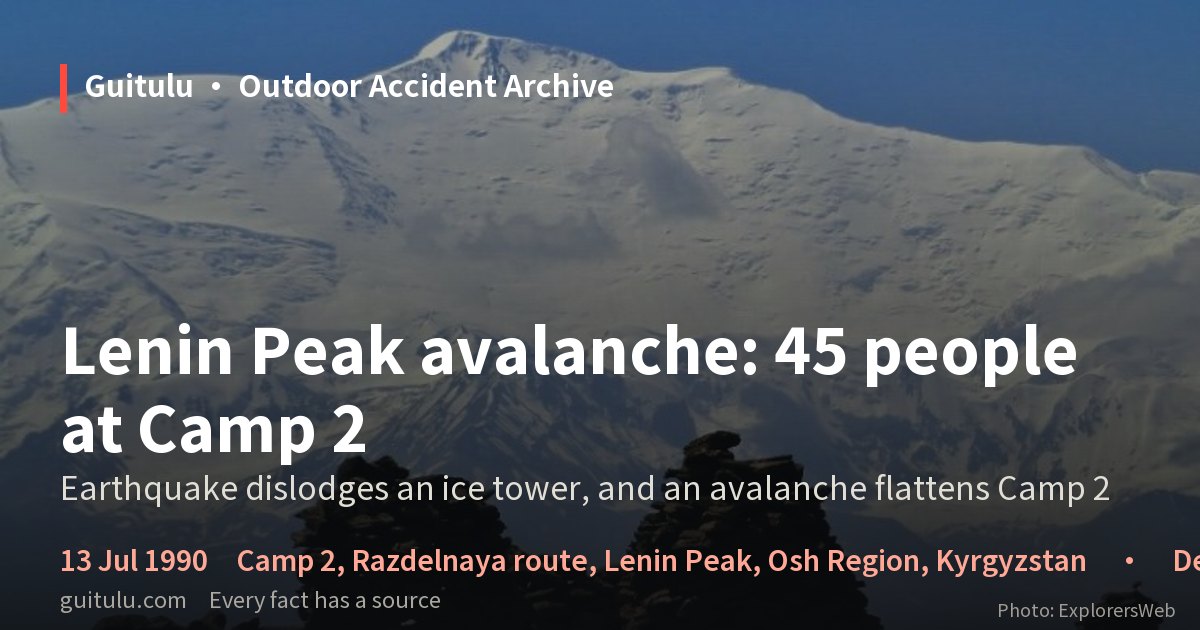
MountaineeringInvolves: AvalancheA Leningrad mountaineering club team and climbers from Czechoslovakia, Israel, Switzerland, Spain and other countries; 45 people in the camp that night
Casualties
Dead 43 Injured 2Of the 45 people in the camp, 43 died and 2 survived with injuries; only a few bodies were found afterward, while the others gradually emerged as the glacier melted over subsequent years
Material
45 facts · 7 sources9 accounts differ and are shown side by side
The number at the end of a paragraph is how many facts it rests on; open it to see each fact and how well it is sourced:
Multiple sourcesSingle source. Conflicting accounts and speculation are kept out of the narrative.
Before the accident, there had been sustained snowfall and cold weather on Lenin Peak, affecting the climbers' plans. F03
After the accident, Camp 2 was moved to a higher location. F10
After the accident, Soviet authorities deployed helicopters and other equipment for a prolonged search and rescue operation, but found no other survivors. F07
There were 45 climbers in the camp when the avalanche occurred, of whom 43 died. F13
The two were lightly dressed. They found a small amount of clothing and items including mats in the remains of the camp, and used them to get through the night. F26
A six-person British team led by Mark Miller survived because they had camped some distance from the main camp. F27
By 13 July the weather had improved, and dozens of people climbed to Camp 2. F12
The earthquake dislodged a serac, triggering a massive avalanche that swept through Camp 2; Guinness World Records and ExplorersWeb say the serac came from neighbouring Chapaev Peak. F15
An earthquake occurred at around 9:30 pm local time on 13 July, followed by an avalanche that rushed towards Camp 2. F14
The avalanche engulfed all of Camp 2 within seconds. F19
After coming to a stop, Koren found Brozman trapped in the snow nearby and dug him out. F25
Koren encountered rescuers during the descent. Rescuers subsequently found Brozman as well, and both were rescued and brought down the mountain. F32
The next day, the two attempted to descend on their own. Brozman, exhausted, stopped to wait, while Koren continued down alone. F31
Under each fact is a verbatim quote from the original. "Single source" means only one outlet mentioned it; "Accounts differ" means sources contradict each other and this site adopts neither side; "Speculation" is an inference by a reporter or a person involved, not a fact.
The Leningrad mountaineering club team on Lenin Peak in the summer of 1990 was led by Leonid Troshchinenko.
Quotes from the original 3
“В числе кандидатов находились члены Ленинградского альпинистского клуба во главе с опытнейшим Леонидом Трощиненко, одним из сильнейших спортсменов СССР.”
The Leningrad climbers' expedition was connected to a later Himalayan expedition: Argumenty i Fakty said the climb was a selection event for the Soviet Himalayan expedition team, while Esquire Singapore said they were training to climb Cho Oyu.
Quotes from the original 2
“В июле 1990 года на пике Ленина должен был состояться отбор участников в очередную советскую экспедицию в Гималаи.”
Initial accounts differed on the death toll: TASS reported that 43 people died, while Soviet national mountaineering team coach Shatayev said 40 had died and 3 had survived; Rambler said another account put the team at 43 people, with 40 buried.
Early counts may have differed because registration was incomplete.
Quotes from the original 2
“Tass said 43 people died in the accident Friday but Vladimir Shataev, coach of the Soviet national mountaineering team, cited 40 deaths and three survivors.”
Accounts differ on the nationalities of those who died: Shatayev listed 23 from Leningrad, 3 from Dushanbe, 1 from Chimkent, 6 from Czechoslovakia, 4 from Israel, 2 from Switzerland and 1 from Spain; the AAJ report listed 23 from the Leningrad mountaineering club, 4 other Soviet citizens, 2 from Switzerland, 1 from Spain, 6 from Czechoslovakia, 3 from Israel and 1 from Italy; Esquire Singapore listed 26 from the Soviet Union, 6 from Czechoslovakia, 4 from Israel, 3 from Germany, 2 from Switzerland and 1 each from Spain and Italy.
Early lists were incomplete, and sources used different counting criteria.
Quotes from the original 3
“23 Soviets from Leningrad, three from the Tadzhik capital of Dushanbe, one from the Kazakh city of Chimkent, six foreign visitors from Czechoslovakia, four from Israel, two from Switzerland and one from Spain”
“The dead included 23 members of the Leningrad Climbing Club led by Leonid Troshchinenko, 4 other Soviets, 2 Swiss, 1 Spaniard, 6 Czechoslovaks, 3 Israelis and 1 Italian.”
“They included 26 from the Soviet Union, six from Czechoslovakia, four from Israel, three from Germany, two from Switzerland, and one each from Spain and Italy.”
Accounts differ on the injuries of the two survivors: Guinness World Records and ExplorersWeb say that one broke an arm and the other a leg; Esquire Singapore says Koren had no broken bones, while Brozman could not move his right leg and may have fractured his spine.
Quotes from the original 4
“the two men escaped with a broken arm and leg respectively”
After the accident, Soviet authorities deployed helicopters and other equipment for a prolonged search and rescue operation, but found no other survivors.
Quotes from the original 4
“with the Soviet government sending helicopters and other equipment to aid the seach, but no other survivors were found”
Accounts differ on the number of bodies found during the search and rescue operation: Guinness World Records says only 4 were found; Argumenty i Fakty says 4 were found on the first day and none thereafter; ExplorersWeb says only 1 was found initially; Rambler says only a few were found.
According to Deseret News, Soviet national mountaineering team coach Shatayev said there had never been such a tragedy in the history of Soviet mountaineering.
Quotes from the original 1
“There has never been a tragedy like this in the history of Soviet mountaineering”
The earthquake dislodged a serac, triggering a massive avalanche that swept through Camp 2; Guinness World Records and ExplorersWeb say the serac came from neighbouring Chapaev Peak.
Quotes from the original 3
“a minor earthquake dislodged a serac (a building-sized column of glacial ice) from the slopes of neighbouring Chapaev Peak”
Accounts differ on the strength of the earthquake: ExplorersWeb says it was magnitude 6.4; Guinness World Records calls it a minor earthquake; Rambler says it was a “seven-point (семибалльного)” earthquake.
The sources may have used different magnitude or intensity scales.
Accounts differ on the size of the avalanche: Argumenty i Fakty and Rambler say its front was about 1.5 kilometres wide; the author of the Esquire Singapore article says it was nearly 1000 feet wide and about 1 mile long, while survivor Koren says it was about 300 metres wide.
Quotes from the original 4
“По фронту ширина сошедшей снежной массы составляла около полутора километров, а вверх по склону — около километра.”
The two were lightly dressed. They found a small amount of clothing and items including mats in the remains of the camp, and used them to get through the night.
Quotes from the original 2
“a fleece jacket for Miro, a foam sleeping pad, and, amazingly, a lightweight emergency blanket”
According to Esquire Singapore, After the avalanche, the British team leader organised a group of four people, including the team doctor and two Czechoslovak climbers, to go to Camp 2 to search for survivors; according to the team doctor, the avalanche debris had already become as hard as stone.
Quotes from the original 2
“So Mark assembled a team of four, including Mike—our doctor—and two Czechoslovaks, and rushed toward Camp 2 to look for survivors.”
Soviet mountaineer Vladimir Balyberdin escaped because he had left the camp before the avalanche, but accounts differ on where he went: the AAJ report says he made a last-minute decision to go up to Camp 3 with a friend; Argumenty i Fakty says he descended to a lower camp with his friend Boris Sitnik about two hours before the incident; Rambler says the two went up above the camp.
Quotes from the original 3
“Vladimir Balyberdin, saved his life deciding at the last minute to move with some friends to Camp III.”
The standard route on Lenin Peak is not technically difficult, and it is often regarded as a relatively easy 7000-metre peak, but the high altitude, changeable weather and avalanche risk make it far from easy.
Quotes from the original 3
“the mountain’s reputation as the easiest 7,000m peak is misleading because of its high altitude, unpredictable weather, and avalanche risk.”
Accounts differ on the altitude of Camp 2: Guinness World Records and ExplorersWeb say about 5300 metres, Deseret News says about 17400 feet, and Rambler says 5200 metres.
The differences may reflect different methods of estimation.
Quotes from the original 4
“descended from the 5,300-m-high (17,388-ft) camp”
Accounts differ on the year the remains began to emerge: ExplorersWeb says they appeared at an altitude of 4200 metres in 2004, with more appearing in 2008; Esquire Singapore says 2007; Guinness World Records says 2008; and Rambler says efforts to collect the remains began in 2009.
Quotes from the original 4
“In 2004, because of glacial melt, human remains surfaced at 4,200m, with more emerging in 2008.”
The author of the Esquire Singapore article speculated that the earthquake most likely dislodged a serac, which fell onto a slope with snow accumulated over many years and fresh snow on top, triggering the huge avalanche.
Quotes from the original 1
“The shaking likely dislodged a serac that fell on a slope loaded with layer upon layer of snow that had accumulated over the years, plus the fresh snowfall, triggering the monstrous avalanche.”
 GuituluGlobal Outdoor Accident Archive