GuituluGlobal Outdoor Accident Archive 中文
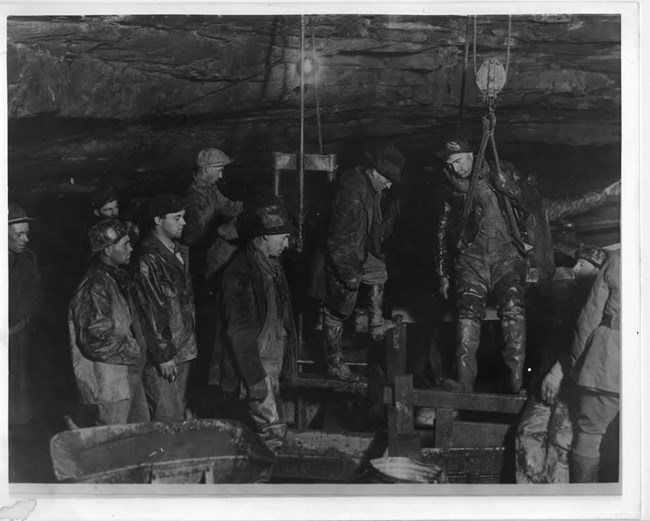
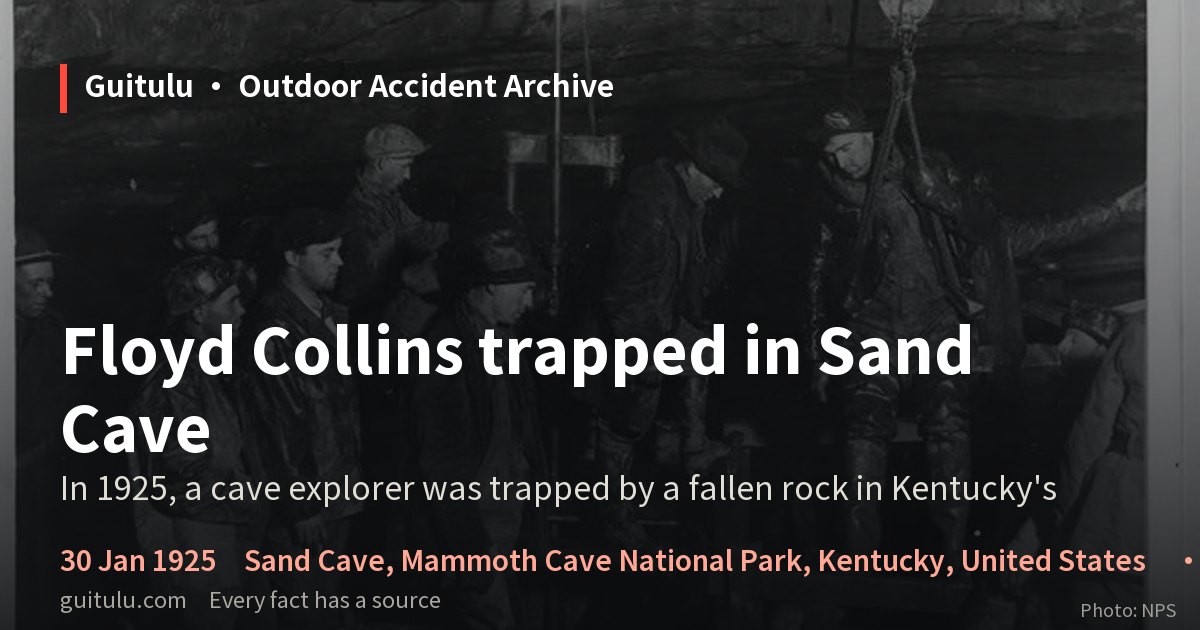
The Sand Cave rescue site in 1925, with rescuers gathered beside the shaft

Archive / Diving and caving

Floyd Collins trapped in Sand Cave

In 1925, a cave explorer was trapped by a fallen rock in Kentucky's Sand Cave; a 17-day rescue effort failed

Closed: A military court of inquiry found that he was indeed trapped; a coroner's jury ruled that the cause of death was exposure resulting from accidental entrapment

Photo: NPS

Date
Winter
Place
Sand Cave, Mammoth Cave National Park, Kentucky, United StatesUnited States › Kentucky · Mammoth Cave National Park-86.123°E 37.184°N
Activity
Solo cave explorationInvolves: Rockfall and collapseFloyd Collins (37, entered the cave alone)
Casualties
Dead 1 Collins was confirmed dead after being trapped for about two weeks; his body was not recovered until months later
Material
42 facts · 7 sources2 accounts differ and are shown side by side

01What happened

Floyd Collins was born in 1887 and was keen on exploring caves from childhood. In 1917, he discovered his family's Crystal Cave. At the time, cave owners around Mammoth Cave competed fiercely for visitors. Crystal Cave was remote and received few visitors, and he was continually looking for a cave closer to the road. He agreed with the owner of the land where Sand Cave was located to share the proceeds if the cave proved worth developing.Facts it rests onF01Multiple sourcesCollins was born in 1887 and was enthusiastic about cave exploration from childhood. In 1917, he discovered Crystal Cave beneath his father's farm.F02Multiple sourcesAt the time, cave owners around Mammoth Cave competed for visitors, using misleading advertising and other means to attract them. This period became known as the “Cave Wars”.F03Multiple sourcesCrystal Cave was remote and attracted few visitors, so Collins was continually looking for a cave closer to the main road that could attract tourists.F04Multiple sourcesSand Cave was immediately beside the road. Collins agreed with the landowner to share the proceeds if the cave was worth developing.

The Sand Cave rescue site in 1925, with rescuers gathered beside the shaftPhoto source: NPS

On 30 January 1925, Collins entered Sand Cave for the first time, carrying only a kerosene lamp. On his way back, the lamp grew dim, and he knocked a rock loose in a narrow crawlway. The rock pinned his ankle, and he could not free it. He was trapped about 60 feet below the surface. Because he often stayed overnight at different people's homes, his failure to return home that night caused no concern. The next day, a 17-year-old boy crawled close enough to speak with him, confirming that he was trapped.Facts it rests onF05Multiple sourcesOn 30 January 1925, Collins explored Sand Cave for the first time, carrying only a kerosene lamp.F06Multiple sourcesOn the way back, his oil lamp grew dim and he decided to turn back; in a narrow crawlway, his foot dislodged a rock that trapped his ankle, and he could not pull it free.F08Multiple sourcesHe was trapped about 60 feet (about 18 metres) below ground, at the end of a passage about 140 feet long that curved downward.F09Multiple sourcesHe did not return home that night, but he often stayed overnight at different people's homes. The host thought he was sleeping elsewhere, so no one was initially concerned.F10Multiple sourcesThe next day (31 January), neighbours began searching. A 17-year-old boy crawled close enough to speak with him and confirmed that he was trapped.

Personnel at the Sand Cave rescue site in 1925Photo source: Courier Journal · Courier Journal file photo

His younger brother Homer arrived and crawled into the cave to feed him. The early rescue effort lacked unified command, and volunteers reportedly stuffed food intended for him into crevices in the rock. On 2 February, Skeets Miller, a young reporter for the Louisville Courier Journal, crawled into the cave to interview him and subsequently took part in the rescue. Rescuers tried to pull him out with a harness, but the attempt failed because the pain was unbearable. The next day, electrical wires and light bulbs were brought into the cave, and one bulb was hung around his neck. Miller's reporting made the incident national news.Facts it rests onF11Multiple sourcesAfter his younger brother Homer arrived, he crawled into the cave and fed Collins himself.F12Multiple sourcesDuring the incident, radio, a new medium, was used to report news from the scene. It was one of the earliest news stories disseminated by radio.F13Multiple sourcesThe rescue groups distrusted one another: those who understood caves lacked organisational skills, while those who understood organisation knew nothing about caves, leaving the rescue in disarray from the start. This is a later interpretation of testimony given to the court of inquiry.F14Multiple sourcesThe early rescue effort lacked unified command: many volunteers became afraid and stuffed food and blankets intended for Collins into cracks in the rock rather than delivering them to him.F15Multiple sourcesUnlike typical limestone caves, Sand Cave was not stable. It consisted mainly of fallen blocks of sandstone and limestone mixed with soil, and its ceiling was loose. This was one reason the rescue was extremely difficult.F16Multiple sourcesOn 2 February, “Skeets” Miller, a young reporter for Louisville's Courier Journal, crawled into the cave to interview Collins and subsequently took part in the rescue.

The Sand Cave shaft excavation site in 1925Photo source: Courier Journal · Courier Journal file photo

On 4 February, the roof of the passage collapsed, separating the rescuers from Collins; after that, they could only call to him through the pile of rocks. The cave roof collapsed again when Gerald tried to clear it, and the attempt to enter through the cave entrance was abandoned. Starting on 5 February, the state government took over the rescue, decided to dig a vertical shaft from above, and stipulated that it could only be excavated by hand with picks and shovels. The crowd of onlookers at the site grew, with an estimated more than 10,000 on the Sunday around 8 February. Rumors circulated that it was a hoax, and a military court of inquiry found on 14 February that he was indeed trapped.Facts it rests onF20Multiple sourcesAfter arriving, Gerald spent several hours trying to clear the loose rock pressing on Collins's body and enlarge the gap.F22Multiple sourcesMiller tried to use a jack to lift the rock pressing on Collins's foot, but the jack available was not the right size, and the rock could not be lifted.F24Multiple sourcesThe collapse is thought to have been related to days of rain, seepage from thawing, and large numbers of people entering and leaving, rubbing against the cave walls and changing the temperature and humidity inside the cave.F25Multiple sourcesGerald led a team to shore up and clear the collapse, but the cave roof fell again and falling rocks struck him. He abandoned the attempt to enter through the cave entrance.F27Multiple sourcesThe shaft could only be dug by hand with picks and shovels.F28Multiple sourcesOn 7 February, Denhardt ordered Homer and Gerald to leave the rescue site.

The number at the end of a paragraph is how many facts it rests on; open it to see each fact and how well it is sourced: Multiple sourcesSingle source. Conflicting accounts and speculation are kept out of the narrative.

Satellite imagery Sentinel-2 cloudless 2024 © EOX · Terrain AWS Terrain Tiles · Position is schematic, geocoded from place names · Place coordinates not individually verified

Route review

6 scenes to understand what happened

Scroll down and the map flies to where each part happened.

01

The incident area

The reports do not provide enough locations along the way, so the map shows only the approximate location and terrain of the incident area.

03

Pinned by a fallen rock

He entered the cave for the first time on 30 January. On his way back, a fallen rock pinned his ankle about 60 feet underground.Facts it rests onF05Multiple sourcesOn 30 January 1925, Collins explored Sand Cave for the first time, carrying only a kerosene lamp.F06Multiple sourcesOn the way back, his oil lamp grew dim and he decided to turn back; in a narrow crawlway, his foot dislodged a rock that trapped his ankle, and he could not pull it free.F08Multiple sourcesHe was trapped about 60 feet (about 18 metres) below ground, at the end of a passage about 140 feet long that curved downward.

04

Rescue and collapse

A reporter and rescuers entered the cave in succession; a collapse blocked the passage on 4 February.Facts it rests onF13Multiple sourcesThe rescue groups distrusted one another: those who understood caves lacked organisational skills, while those who understood organisation knew nothing about caves, leaving the rescue in disarray from the start. This is a later interpretation of testimony given to the court of inquiry.F14Multiple sourcesThe early rescue effort lacked unified command: many volunteers became afraid and stuffed food and blankets intended for Collins into cracks in the rock rather than delivering them to him.F20Multiple sourcesAfter arriving, Gerald spent several hours trying to clear the loose rock pressing on Collins's body and enlarge the gap.

05

Shaft and crowds

The state government took over and switched to digging a vertical shaft from above. More than 10,000 onlookers flocked to the site.Facts it rests onF24Multiple sourcesThe collapse is thought to have been related to days of rain, seepage from thawing, and large numbers of people entering and leaving, rubbing against the cave walls and changing the temperature and humidity inside the cave.F25Multiple sourcesGerald led a team to shore up and clear the collapse, but the cave roof fell again and falling rocks struck him. He abandoned the attempt to enter through the cave entrance.F27Multiple sourcesThe shaft could only be dug by hand with picks and shovels.

02Timeline

  1. On the way back, his oil lamp grew dim and he decided to turn back; in a narrow crawlway, his foot dislodged a rock that trapped his ankle, and he could not pull it free. F06

  2. The next day (31 January), neighbours began searching. A 17-year-old boy crawled close enough to speak with him and confirmed that he was trapped. F10

  3. The rescue groups distrusted one another: those who understood caves lacked organisational skills, while those who understood organisation knew nothing about caves, leaving the rescue in disarray from the start. This is a later interpretation of testimony given to the court of inquiry. F13

  4. The early rescue effort lacked unified command: many volunteers became afraid and stuffed food and blankets intended for Collins into cracks in the rock rather than delivering them to him. F14

  5. Unlike typical limestone caves, Sand Cave was not stable. It consisted mainly of fallen blocks of sandstone and limestone mixed with soil, and its ceiling was loose. This was one reason the rescue was extremely difficult. F15

  6. After arriving, Gerald spent several hours trying to clear the loose rock pressing on Collins's body and enlarge the gap. F20

  7. The collapse is thought to have been related to days of rain, seepage from thawing, and large numbers of people entering and leaving, rubbing against the cave walls and changing the temperature and humidity inside the cave. F24

  8. The shaft could only be dug by hand with picks and shovels. F27

  9. On 7 February, Denhardt ordered Homer and Gerald to leave the rescue site. F28

  10. Rescuers used a line connected to a light bulb for radio monitoring and heard a wavering signal. This was briefly taken as a possible sign that Collins was still alive, but could not be confirmed. F30

  11. The shaft had been dug to a depth of about 44 feet (about 13 meters) by around 11 February. F31

  12. In 1989, his remains were moved for the last time and buried in the Mammoth Cave Baptist Church cemetery, where they remain today. F41

03Lessons

Communication and location

Let others know where you are going

Collins often stayed overnight at different people's homes, so no one thought it unusual when he did not return home that night. No one began searching until the next day. When entering a cave that no one has explored before alone, at least let one person know where you are going and what time you must make contact.Facts it rests onF09Multiple sourcesHe did not return home that night, but he often stayed overnight at different people's homes. The host thought he was sleeping elsewhere, so no one was initially concerned.F10Multiple sourcesThe next day (31 January), neighbours began searching. A 17-year-old boy crawled close enough to speak with him and confirmed that he was trapped.

Water, streams and caves

People moving through a cave can alter loose rock

Sand Cave was formed mainly from fallen blocks of sandstone and limestone mixed with soil, and its roof was loose. Days of rain, water seeping in as the ground thawed, and changes in the cave's temperature and humidity caused by large numbers of people entering and leaving are thought to have contributed to the collapse, which separated rescuers from the trapped man.Facts it rests onF23Multiple sourcesOn 4 February, the roof of the passage collapsed, separating the rescuers from Collins. After that, they could only shout to him across the pile of rocks.F21Multiple sourcesNational Guard soldiers arrived around 3–4 February to maintain order.F20Multiple sourcesAfter arriving, Gerald spent several hours trying to clear the loose rock pressing on Collins's body and enlarge the gap.

Rescue and self-rescue

Rescue requires unified command

The early rescue effort lacked unified command, the teams did not trust one another, and supplies did not reach the trapped man. A systematic excavation plan was not put in place until the state government took over, but by then the cave could no longer be entered through its entrance.Facts it rests onF12Multiple sourcesDuring the incident, radio, a new medium, was used to report news from the scene. It was one of the earliest news stories disseminated by radio.F39Multiple sourcesMiller won a Pulitzer Prize for his reporting on the incident.F24Multiple sourcesThe collapse is thought to have been related to days of rain, seepage from thawing, and large numbers of people entering and leaving, rubbing against the cave walls and changing the temperature and humidity inside the cave.

Rescue and self-rescue

Crowds and public opinion can divert rescue resources

The carnival-like crowds of onlookers, rumors of a hoax, and the military court of inquiry all took time and personnel away from the rescue and made order at the site harder to maintain.Facts it rests onF27Multiple sourcesThe shaft could only be dug by hand with picks and shovels.F28Multiple sourcesOn 7 February, Denhardt ordered Homer and Gerald to leave the rescue site.F38Multiple sourcesThe body was not removed for formal burial until the spring, several months later.

04Fact list 42 facts

Under each fact is a verbatim quote from the original. "Single source" means only one outlet mentioned it; "Accounts differ" means sources contradict each other and this site adopts neither side; "Speculation" is an inference by a reporter or a person involved, not a fact.

  1. F01Multiple sourcesBackground

    Collins was born in 1887 and was enthusiastic about cave exploration from childhood. In 1917, he discovered Crystal Cave beneath his father's farm.

    Quotes from the original 3

    “led to the discovery of Crystal Cave in 1917”

    NPS · 2025-07-16

    “reputation was considerably enhanced when he discovered Crystal Cave on his family's farm in 1917”

    DVIDS · 2026-11-04

    “was born July 20, 1887”

    NPS · 2025-07-16
  2. F02Multiple sourcesBackground

    At the time, cave owners around Mammoth Cave competed for visitors, using misleading advertising and other means to attract them. This period became known as the “Cave Wars”.

    Quotes from the original 2

    “Due to aggressive and highly suspicious practices between rival cave owners”

    NPS · 2025-07-16

    “Seventeen rival commercial caverns used misleading advertising”

    DVIDS · 2026-11-04
  3. F03Multiple sourcesBackground

    Crystal Cave was remote and attracted few visitors, so Collins was continually looking for a cave closer to the main road that could attract tourists.

    Quotes from the original 2

    “Great Crystal Cave made little to no profit due to its remote location along the Flint Ridge Road.”

    NPS · 2025-07-16

    “Floyd was constantly looking for a cave closer to the main road”

    NPR · 2025-02-17
  4. F04Multiple sourcesPlan

    Sand Cave was immediately beside the road. Collins agreed with the landowner to share the proceeds if the cave was worth developing.

    Quotes from the original 2

    “Floyd entered into an agreement with Beesly Doyel to explore Sand Cave and share the profits if the cave proved worthy to show”

    NPS · 2025-07-16

    “They agreed that if Floyd found something big, they could commercialize it and split the profits.”

    Courier Journal · 2025-01-30
  5. F05Multiple sourcesMovement

    On 30 January 1925, Collins explored Sand Cave for the first time, carrying only a kerosene lamp.

    Quotes from the original 2

    “Floyd first entered Sand Cave on January 30, 1925 with only a single kerosene lantern”

    NPS · 2025-07-16

    “He soon scoped out Sand Cave on January 30, 1925”

    NPR · 2025-02-17
  6. F06Multiple sourcesEvent

    On the way back, his oil lamp grew dim and he decided to turn back; in a narrow crawlway, his foot dislodged a rock that trapped his ankle, and he could not pull it free.

    Quotes from the original 3

    “his foot dislodged a 27-pound rock which wedged his ankle in place”

    NPS · 2025-07-16

    “Then his lantern began to die. The explorer decided to turn back.”

    Mental Floss · 2018-07-13

    “This rock becomes dislodged and kind of rolls into the passageway, right over top of his ankle and foot”

    NPR · 2025-02-17
  7. F07Accounts differFound at scene

    Sources differ on the weight of the rock that trapped him: the National Park Service says it was 27 pounds, while a National Guard article says it was 75 pounds.

    The 27-pound and 75-pound figures conflict; not included on the page

    Quotes from the original 2

    “his foot dislodged a 27-pound rock which wedged his ankle in place”

    NPS · 2025-07-16

    “The rock which held him in place was only 75 pounds.”

    DVIDS · 2026-11-04
  8. F08Multiple sourcesFound at scene

    He was trapped about 60 feet (about 18 metres) below ground, at the end of a passage about 140 feet long that curved downward.

    Quotes from the original 2

    “Floyd is trapped 60 feet beneath the earth”

    NPS · 2025-07-16

    “Trapped just 60 feet below the surface at the end of a 140-foot corkscrewing tunnel”

    Mental Floss · 2018-07-13
  9. F09Multiple sourcesEvent

    He did not return home that night, but he often stayed overnight at different people's homes. The host thought he was sleeping elsewhere, so no one was initially concerned.

    Quotes from the original 2

    “Neighbors realize that Floyd did not come home the previous night”

    NPS · 2025-07-16

    “his host for that night simply assumed he was sleeping elsewhere”

    Mental Floss · 2018-07-13
  10. F10Multiple sourcesEvent

    The next day (31 January), neighbours began searching. A 17-year-old boy crawled close enough to speak with him and confirmed that he was trapped.

    Quotes from the original 2

    “only a 17 year old boy (Jewell Estes) crawls back far enough to communicate with Floyd”

    NPS · 2025-07-16

    “The first person to brave the cavern, which was soon given the name Sand Cave, was 17-year-old Jewell Estes.”

    Mental Floss · 2018-07-13
  11. F11Multiple sourcesEvent

    After his younger brother Homer arrived, he crawled into the cave and fed Collins himself.

    Quotes from the original 2

    “Homer called up to have some food brought into the cave and fed his brother by hand”

    Mental Floss · 2018-07-13

    “They start by bringing Floyd food and water.”

    NPS · 2025-07-16
  12. F12Multiple sourcesAftermath

    During the incident, radio, a new medium, was used to report news from the scene. It was one of the earliest news stories disseminated by radio.

    Quotes from the original 2

    “The Floyd Collins story was one of the very first stories that started being broadcast by radio”

    Mental Floss · 2018-07-13

    “regular news bulletins on the brand-new medium of radio”

    The Hendersonian · 2025-03-11
  13. F13Multiple sourcesPost-incident analysis

    The rescue groups distrusted one another: those who understood caves lacked organisational skills, while those who understood organisation knew nothing about caves, leaving the rescue in disarray from the start. This is a later interpretation of testimony given to the court of inquiry.

    Quotes from the original 3

    “Each rescue team believed that the competing rescuers were incompetent.”

    Mental Floss · 2018-07-13

    “The rescue efforts are disorganized and chaotic, no leader is appointed”

    NPS · 2025-07-16

    “Rivalry among groups of workers had interfered with best efforts to release Collins”

    DVIDS · 2026-11-04
  14. F14Multiple sourcesEvent

    The early rescue effort lacked unified command: many volunteers became afraid and stuffed food and blankets intended for Collins into cracks in the rock rather than delivering them to him.

    Quotes from the original 2

    “They, instead stash the items in cracks and crevices and never get the provisions to Floyd.”

    NPS · 2025-07-16

    “the food and blankets were shamefully stuffed into cracks in the cavern walls”

    Mental Floss · 2018-07-13
  15. F15Multiple sourcesPost-incident analysis

    Unlike typical limestone caves, Sand Cave was not stable. It consisted mainly of fallen blocks of sandstone and limestone mixed with soil, and its ceiling was loose. This was one reason the rescue was extremely difficult.

    Quotes from the original 2

    “Sand Cave is a pile of sandstone and limestone breakdown blocks with mud fill holding the matrix together”

    Mental Floss · 2018-07-13

    “The ceiling of the cave is starting to show signs of crumbling and the passageway is unstable.”

    NPS · 2025-07-16
  16. F16Multiple sourcesEvent

    On 2 February, “Skeets” Miller, a young reporter for Louisville's Courier Journal, crawled into the cave to interview Collins and subsequently took part in the rescue.

    Quotes from the original 2

    “Skeets Miller enters Sand Cave to speak to Floyd.”

    NPS · 2025-07-16

    “crawled down into the wet, dark passage to interview Collins”

    DVIDS · 2026-11-04
  17. F17Multiple sourcesEvent

    On 2 February, fire lieutenant Burdon proposed pulling Collins out with a chest harness. The pain was unbearable, and Collins called for them to stop; the attempt failed.

    Quotes from the original 3

    “This attempt is painful and unsuccessful.”

    NPS · 2025-07-16

    “An attempt to pull Collins out while connected to a harness failed.”

    DVIDS · 2026-11-04

    “No progress had been made.”

    Mental Floss · 2018-07-13
  18. F18Multiple sourcesEvent

    Beginning on 3 February, rescuers brought electrical wires and light bulbs into the cave. One bulb was hung around Collins's neck to give him light and a little warmth.

    Quotes from the original 2

    “A line of electric lights was taken into the cave, one of which was hung around Collins' neck”

    DVIDS · 2026-11-04

    “They string these lights through the cave to Floyd so he can have light and warmth in the cave.”

    NPS · 2025-07-16
  19. F19Multiple sourcesAftermath

    Miller's interview with Collins was sent nationwide through a news agency, turning the incident into national news.

    Quotes from the original 2

    “Thanks to this interview, the Floyd Collins story transformed from a marginal curiosity to a nationwide event.”

    Mental Floss · 2018-07-13

    “Floyd Collins becomes the top news story in the nation.”

    NPS · 2025-07-16
  20. F20Multiple sourcesEvent

    After arriving, Gerald spent several hours trying to clear the loose rock pressing on Collins's body and enlarge the gap.

    Quotes from the original 2

    “Gerald would spend the next six hours trying to enlarge the trap.”

    Mental Floss · 2018-07-13

    “John Gerald (caving buddy of Floyd Collins) arrives on scene and joins the rescue attempts by trying to dig him out.”

    NPS · 2025-07-16
  21. F21Multiple sourcesEvent

    National Guard soldiers arrived around 3–4 February to maintain order.

    Quotes from the original 2

    “The National Guard arrives to assist with crowd control.”

    NPS · 2025-07-16

    “The first Kentucky Guardsmen arrived at Sand Cave”

    DVIDS · 2026-11-04
  22. F22Multiple sourcesEvent

    Miller tried to use a jack to lift the rock pressing on Collins's foot, but the jack available was not the right size, and the rock could not be lifted.

    Quotes from the original 2

    “the first two jacks are too big and the last one is too small”

    NPS · 2025-07-16

    “Around 1 a.m., he collapsed from exhaustion. The rock had not moved.”

    Mental Floss · 2018-07-13
  23. F23Multiple sourcesEvent

    On 4 February, the roof of the passage collapsed, separating the rescuers from Collins. After that, they could only shout to him across the pile of rocks.

    A Courier Journal retrospective says the second collapse occurred on 5 February

    Quotes from the original 3

    “Part of the cave ceiling between Floyd and the surface collapsed as a result of the almost incessant rain”

    DVIDS · 2026-11-04

    “There is officially a cave collapse that separates the rescue teams from Floyd Collins.”

    NPS · 2025-07-16

    “All this action weakened the cave walls, and they collapse. Collins is cut off from the world entirely.”

    NPR · 2025-02-17
  24. F24Multiple sourcesPost-incident analysis

    The collapse is thought to have been related to days of rain, seepage from thawing, and large numbers of people entering and leaving, rubbing against the cave walls and changing the temperature and humidity inside the cave.

    Quotes from the original 2

    “a midwinter thaw, and dripping ground water”

    NPS · 2025-07-16

    “the presence of the human chain had caused the temperature and moisture content to fluctuate”

    Mental Floss · 2018-07-13
  25. F25Multiple sourcesEvent

    Gerald led a team to shore up and clear the collapse, but the cave roof fell again and falling rocks struck him. He abandoned the attempt to enter through the cave entrance.

    Quotes from the original 2

    “The cave ceiling had crumbled again.”

    Mental Floss · 2018-07-13

    “several rocks fall on Gerald in his rescue attempt causing him to finally leave the cave admitting defeat”

    NPS · 2025-07-16
  26. F26Multiple sourcesPlan

    On 5 February, the state government took over the rescue under the command of National Guard Brigadier General Denhardt and decided to dig a vertical shaft from above instead.

    Quotes from the original 2

    “On Thursday, February 5, the state assumed control of the Collins rescue.”

    Mental Floss · 2018-07-13

    “places National Guard Brigadier General Henry Denhart in command of the rescue”

    NPS · 2025-07-16
  27. F27Multiple sourcesPlan

    The shaft could only be dug by hand with picks and shovels.

    Quotes from the original 2

    “The only tools allowed are picks and shovels.”

    NPS · 2025-07-16

    “have to dig a 55-foot shaft with picks and shovels”

    Mental Floss · 2018-07-13
  28. F28Multiple sourcesEvent

    On 7 February, Denhardt ordered Homer and Gerald to leave the rescue site.

    Quotes from the original 2

    “Brig. Gen. Denhardt ordered Homer Collins and John Geralds, Floyd's life-long friend, away from the cave.”

    DVIDS · 2026-11-04

    “Homer Collins and Johnnie Gerald are banned from the rescue site”

    NPS · 2025-07-16
  29. F29Multiple sourcesAftermath

    On a Sunday around 8 February, an estimated crowd of more than 10,000 onlookers gathered at the site, creating a carnival-like atmosphere.

    Quotes from the original 3

    “as an estimated 10,000 descend upon Sand Cave”

    NPS · 2025-07-16

    “At least 10,000 people visited Cave City (pop. 690).”

    Mental Floss · 2018-07-13

    “The site turned into a carnival-like atmosphere”

    DVIDS · 2026-11-04
  30. F30Multiple sourcesFound at scene

    Rescuers used a line connected to a light bulb for radio monitoring and heard a wavering signal. This was briefly taken as a possible sign that Collins was still alive, but could not be confirmed.

    Quotes from the original 2

    “a radio test showed that the filament in the bulb moved from 22 to 26 times per minute”

    Courier Journal · 2025-01-30

    “the amplifier crackled 20 times every minute”

    Mental Floss · 2018-07-13
  31. F31Multiple sourcesEvent

    The shaft had been dug to a depth of about 44 feet (about 13 meters) by around 11 February.

    Quotes from the original 2

    “The shaft plumbed 44 feet.”

    Mental Floss · 2018-07-13

    “The shaft they were building for the rescue was already 44 feet deep”

    Courier Journal · 2025-01-30
  32. F32Multiple sourcesFound at scene

    The exact time of his death is unknown: doctors' estimates ranged from one day to three to five days before he was found, while another source places it at around 13 February.

    Quotes from the original 3

    “Floyd's exact time and date of death are unknown.”

    DVIDS · 2026-11-04

    “The coroner would later claim that Collins had been dead for approximately three days.”

    Mental Floss · 2018-07-13

    “died around Feb. 13, 1925”

    The Hendersonian · 2025-03-11
  33. F33Multiple sourcesEvent

    There were rumors that the incident was a hoax. The governor ordered a military court of inquiry to take testimony from people who had seen Collins; on 14 February, the court concluded that he was indeed trapped in the cave.

    Quotes from the original 3

    “These rumors led Gov. Fields to order Denhardt to hold a court of inquiry”

    DVIDS · 2026-11-04

    “The military court of inquiry delivered its finding, Floyd was definitely trapped in Sand Cave.”

    DVIDS · 2026-11-04

    “the court concluded that no foul play had been involved”

    Mental Floss · 2018-07-13
  34. F34Multiple sourcesEvent

    After the shaft was connected to the cave, rescuers found that Collins had died.

    Sources give two dates for the discovery: 16 February and 17 February.

    Quotes from the original 3

    “At 1:30 p.m. on Monday February 16, a chisel penetrated Sand Cave.”

    Mental Floss · 2018-07-13

    “rescuers finally connected the parallel shaft with Sand Cave and discovered Floyd Collins' lifeless body”

    DVIDS · 2026-11-04

    “Collins was dead.”

    Courier Journal · 2025-01-30
  35. F35Accounts differFound at scene

    For the date the body was found, a National Guard article and Mental Floss give 16 February, while retrospectives by NPR and the Courier Journal give 17 February.

    The 16 February and 17 February dates conflict; do not include on the page

    Quotes from the original 2

    “At 3:42 p.m., rescuers finally connected the parallel shaft with Sand Cave”

    DVIDS · 2026-11-04

    “rescuers continue digging to Collins until they reached him on February 17, 1925”

    NPR · 2025-02-17
  36. F36Multiple sourcesFound at scene

    A coroner's jury ruled that he died of exposure to cold caused by accidental entrapment; other sources suggest that hunger and thirst combined with hypothermia were a possible cause.

    Quotes from the original 3

    “from exposure caused by being accidentally entrapped in what is commonly known as Sand Cave”

    DVIDS · 2026-11-04

    “Floyd Collins was pronounced dead of exposure”

    NPS · 2025-07-16

    “Cause of death was likely hunger and thirst compounded by hypothermia.”

    The Hendersonian · 2025-03-11
  37. F37Multiple sourcesAftermath

    His family and officials decided to leave the body in the cave temporarily.

    Quotes from the original 2

    “The Collins family decided to leave Floyd's body in its natural tomb.”

    DVIDS · 2026-11-04

    “officials decided to keep Floyd Collins entombed”

    Mental Floss · 2018-07-13
  38. F38Multiple sourcesAftermath

    The body was not removed for formal burial until the spring, several months later.

    Quotes from the original 2

    “Only months later would his body be removed for a formal burial”

    NPS · 2025-07-16

    “didn’t recover his body until later in the spring”

    The Hendersonian · 2025-03-11
  39. F39Multiple sourcesAftermath

    Miller won a Pulitzer Prize for his reporting on the incident.

    Quotes from the original 3

    “The next year, his coverage of the Collins tragedy was awarded the Pulitzer Prize in reporting.”

    Mental Floss · 2018-07-13

    “for which he was awarded a Pulitzer Prize”

    The Hendersonian · 2025-03-11

    “interviews which would later earn him the Pulitzer Prize”

    NPS · 2025-07-16
  40. F40Multiple sourcesAftermath

    A year after the incident, the US Congress authorized the establishment of Mammoth Cave National Park, which was formally established in 1941; the incident is considered one of the factors that helped bring this about.

    Quotes from the original 3

    “A year after the failed rescue, Congress authorized Mammoth Cave as a national park”

    NPR · 2025-02-17

    “Mammoth Cave National Park, established on July 1, 1941”

    The Hendersonian · 2025-03-11

    “eventually leading to the establishment of Mammoth Cave National Park in 1941”

    NPS · 2025-07-16
  41. F41Multiple sourcesAftermath

    In 1989, his remains were moved for the last time and buried in the Mammoth Cave Baptist Church cemetery, where they remain today.

    Quotes from the original 2

    “In 1989, the body was re-interred in a Baptist cemetery.”

    Mental Floss · 2018-07-13

    “Collins is buried at the Mammoth Cave Baptist Church Cemetery”

    NPS · 2025-07-16
  42. F42Multiple sourcesAftermath

    The Sand Cave entrance was later permanently sealed with a steel gate; today the park has an overlook from which the entrance can be seen at a distance.

    Quotes from the original 2

    “the cave entrance was permanently sealed with a steel gate”

    Mental Floss · 2018-07-13

    “You can also explore the Sand Cave observation deck, where you can see the entrance”

    Courier Journal · 2025-01-30