Hinku, between Himalaya Lodge and Deurali on the Annapurna Base Camp trekking route, Kaski, NepalNepal › Gandaki Province · Himalaya83.893°E 28.493°N
Activity
TrekkingInvolves: Avalanche · Extreme weatherA trekking party of volunteer teachers sent by South Korea's South Chungcheong Provincial Office of Education, accompanied by Nepali guides and porters
Casualties
Dead 7 4 Korean teachers and 3 Nepali guides and porters died (one of the Nepalis was with another group); the South Korean foreign ministry initially reported 6 people missing. The bodies were found between February and May 2020.
Material
46 facts · 12 sources4 accounts differ and are shown side by side
The number at the end of a paragraph is how many facts it rests on; open it to see each fact and how well it is sourced:
Multiple sourcesSingle source. Conflicting accounts and speculation are kept out of the narrative.
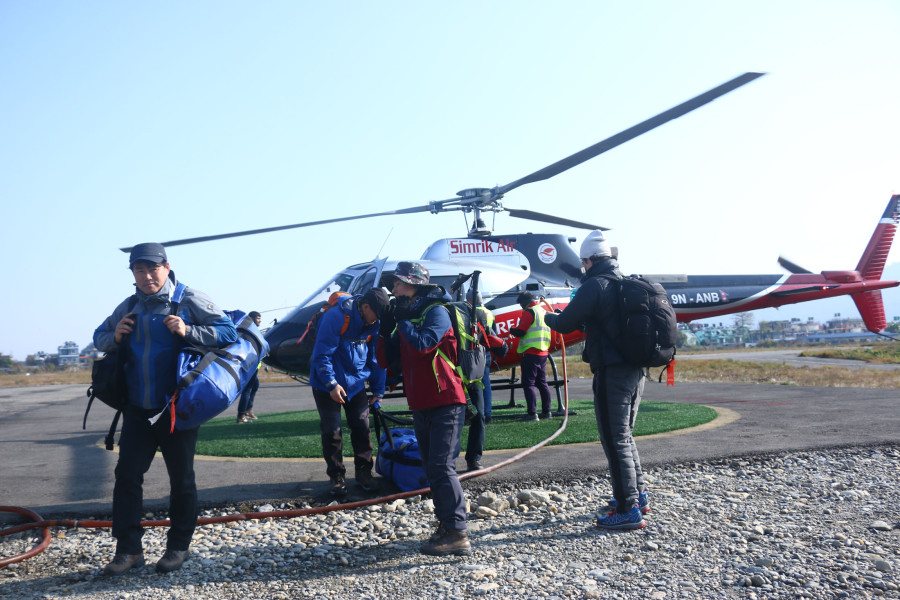
ImgScene photos all from news coverage; copyright belongs to the original authors
Deurali on 18 January 2020, with the road and lodges covered in heavy snowPhoto source: The Korea Herald · South Jeolla Provincial Office of Education, South KoreaMap of the Annapurna trekking route, marking the accident sitePhoto source: 뉴시스 · South Korean Ministry of Foreign Affairs
Between about 10:30 and 11:00 a.m. on 17 January, an avalanche occurred near Deurali, at an altitude of about 3230 meters on the Annapurna Base Camp trekking route. F11
The other 5 South Koreans in the party took shelter at a nearby mountain lodge and were safe. F17
A total of 7 people went missing: 4 South Koreans and 3 Nepalis. F14
South Korea's foreign ministry dispatched an emergency response team to Nepal, accompanied by family members of the 6 missing people. F24
Poor weather after the incident hampered helicopter search and rescue operations. F22
Over the weekend, approximately 200 trekkers stranded in the Annapurna region were evacuated by helicopter. F23
On 19 January (Sunday), further avalanches and poor weather hampered search and rescue efforts. F27
Air and ground searches planned for 20 January (Monday) were also cancelled that day because of poor weather. F29
Search and rescue personnel detected signals in the avalanche debris using electronic detection equipment and marked their locations. F30
On the morning of 21 January, an 11-person specialist team from the Nepali Army and South Korean personnel travelled to the site by helicopter. F32
Because of poor weather and subsequent avalanches, Nepali authorities suspended search and rescue operations about a week after the incident (Korea JoongAng Daily gave the date as 24 January). F34
In early April, temperatures rose and the ice and snow began to melt, and search and rescue operations resumed. F38
On 25 April (Saturday), search and rescue personnel found the bodies of two South Korean teachers. F42
On 1 May, search and rescue personnel found the last two bodies, one South Korean and one Nepali. The bodies of all 7 missing people had then been found. F43
Under each fact is a verbatim quote from the original. "Single source" means only one outlet mentioned it; "Accounts differ" means sources contradict each other and this site adopts neither side; "Speculation" is an inference by a reporter or a person involved, not a fact.
According to The Himalayan Times, Those involved in the search included the Nepal Army, police, Armed Police Force, local youth clubs, the Trekking Agencies' Association of Nepal, the Annapurna Conservation Area Project and the local lodge operators' association.
Quotes from the original 1
“Various organisations and agencies including Nepali Army, Nepal Police, Armed Police Force, local Sanctuary Youth Club, Trekking Agency Association of Nepal (TAAN), Annapurna Conservation Area Project, local hoteliers' association had been carrying out search operations in the region.”
Those caught in the incident were among 11 volunteer teachers sent to Nepal by South Korea's South Chungcheong Provincial Office of Education. They were scheduled to volunteer in education at schools around Kathmandu from 13 to 25 January.
Quotes from the original 2
“The missing trekkers are part of the 11-teacher team taking part in a volunteer teaching program at schools in Kathmandu from Jan. 13-25.”
“The Koreans were a part of a group of nine teachers from South Chungcheong who had been trekking in the Annapurna area during their time off from an educational volunteer program.”
According to Nepali Times, The Himalayan region experienced several snowstorms that winter, one of which deposited snow up to about 5 meters deep in the Annapurna Sanctuary.
Quotes from the original 1
“This winter saw several blizzards in the Himalaya and one of them dumped up to 5m of snow in the Annapurna Sanctuary”
According to 뉴시스, When the party reached an altitude of about 3000 meters, the weather deteriorated sharply, and the 9 people split into groups of 4 and 5 to descend.
Quotes from the original 1
“해발 3000m 지점을 지나던 중 기상 상황이 급격히 악화돼 4명과 5명으로 나눠 하산했다.”
“The group was descending near Annapurna base camp approximately 3,230 metres (10,600 feet) above sea level when the avalanche struck on Friday after heavy snowfall.”
Between about 10:30 and 11:00 a.m. on 17 January, an avalanche occurred near Deurali, at an altitude of about 3230 meters on the Annapurna Base Camp trekking route.
Quotes from the original 3
“17일(현지시간) 오전 10시30분~11시께 네팔 안나푸르나 베이스캠프(ABC) 트레킹 코스 중 해발 3230m 데우랄리(Deurali) 지역에서 눈사태가 발생해”
“The incident occurred Friday at about 10:30-11 a.m. (local time) when the avalanche swept the Deuralri area, at an altitude of 3,230 meters near a base camp in the Annapurna region”
“Four Korean trekkers and three Nepali guides went missing in the Deurali area at an elevation of 3,230 meters on the Annapurna trekking circuit after an avalanche on Jan. 17.”
According to Al Jazeera, A rescued veteran mountaineer said he had passed through the area about three hours before the major avalanche; by Friday, the snow was already neck-deep and several avalanches had occurred.
Quotes from the original 2
“By Friday, snow was neck-deep and several avalanches had occurred, a veteran climber who was rescued by helicopter said.”
According to 뉴시스, Around the same time, another South Korean trekking party heading to Machapuchare Base Camp withdrew immediately after seeing heavy snow and avalanches at an altitude of about 3000 meters.
Quotes from the original 1
“전날 마차푸차레 베이스캠프(3700m)로 향하던 중 3000m 지점에서 폭설과 눈사태를 보고 곧바로 철수했다”
According to 뉴시스, At about 3:00 p.m. on the day of the incident, the secretary-general of the Korea-Nepal Tour and Trekking Operators Association reported to the South Korean embassy in Nepal that South Koreans had gone missing in an avalanche while trekking.
Quotes from the original 1
“한·네팔 관광 및 트레킹 운영협회 사무총장은 전날 오후 3시께 우리 국민이 트레킹 도중 눈사태로 실종돼 수색 중에 있다고 주네팔대사관에 연락했다.”
Over the weekend, approximately 200 trekkers stranded in the Annapurna region were evacuated by helicopter.
The Kathmandu Post reported approximately 100 evacuees on 18 January, at an earlier point in the count.
Quotes from the original 3
“On Saturday, four rescue helicopters evacuated 200 people, including 140 foreigner hikers, stranded around Annapurna and other nearby mountains after the incident”
South Korea's foreign ministry dispatched an emergency response team to Nepal, accompanied by family members of the 6 missing people.
Quotes from the original 2
“A team consisting of two officials from the Foreign Ministry and two from the education office left for Kathmandu on Saturday along with three people from the tourism agency and six members of the missing people’s families.”
Accounts of the number of missing people differed: most reports said 7, including 3 Nepalis; The Korea Herald, citing South Korea's foreign ministry, reported 6, including 2 Nepali guides.
The difference lies in whether the Nepali accompanying another party was included.
Quotes from the original 2
“Six people, including four South Koreans, remain missing in Nepal’s northwestern Himalayan region after an avalanche hit the area on Friday, Seoul’s Foreign Ministry said Sunday.”
According to The Korea Herald, Among the first volunteer teachers to return to South Korea, some said that primary school pupils could walk the trekking route, so they had not realised the danger; communications networks were also poor, and even if they had known the weather was worsening, they could not have contacted the education office.
Quotes from the original 1
““The trekking course was the same one where elementary school students (are allowed), so we didn’t realize it was dangerous. If we were aware of the bad weather, we could have contacted the education office. But due to a poor (communication) network, we couldn’t.””
According to Khabarhub, Air and ground searches planned for 20 January (Monday) were also cancelled that day because of poor weather.
Quotes from the original 1
“Monday’s air and ground searches for the seven people missing at the Annapurna trekking site were called off for the day as unfavorable weather conditions blocked officials from approaching the scene”
According to Khabarhub, The search and rescue team found a red plastic bag and a yellow item, which they believed might be personal belongings of the missing people.
Quotes from the original 1
“the rescue team has secured a red plastic bag and an unidentified yellow item that are believed to be belongings of the missing people”
According to Al Jazeera, On the morning of 21 January, an 11-person specialist team from the Nepali Army and South Korean personnel travelled to the site by helicopter.
Quotes from the original 1
“On Tuesday morning, an 11-member specialised team from the Nepalese army departed by chopper for the site along with South Korean personnel.”
Because of poor weather and subsequent avalanches, Nepali authorities suspended search and rescue operations about a week after the incident (Korea JoongAng Daily gave the date as 24 January).
Quotes from the original 2
“Nepali authorities eventually decided to suspend the efforts on Jan. 24.”
According to Korea JoongAng Daily, In early February, more than 20 members of a Nepali trekking association and local rescue personnel searched again but did not find the missing people.
Quotes from the original 1
“In early February, a group of some two dozen members of a Nepali trekking association and local rescue experts tried again to search for the missing people, but their efforts were unsuccessful.”
Accounts differed on when the body of the first Nepali guide was found: The Himalayan Times said 27 February, while Korea JoongAng Daily said late February; a 26 April report in Nepali Times said it was found “last month”.
Quotes from the original 3
“Body of Nepali guide Saroj Pariyar was found on February 27”
According to Korea JoongAng Daily, Nepal went into lockdown during the COVID-19 pandemic, delaying the resumption of formal search and rescue operations. Local residents organised patrols on their own initiative to search.
Quotes from the original 1
“Nepal has been under lockdown for the past month because of the coronavirus pandemic, and the resumption of the official search has faced delays. Local residents have formed patrol teams to scour the area for the missing hikers.”
Accounts differed on when the body of the second Nepali was found: The Himalayan Times said the porter's body was found on 11 April; Korea JoongAng Daily and The Kathmandu Post said a Nepali person's body was found on a Wednesday in late April.
On 25 April (Saturday), search and rescue personnel found the bodies of two South Korean teachers.
Nepali Times said the bodies were found by the Nepali Army on Sunday.
Quotes from the original 3
“They were located by a local rescue team at 3 p.m. Saturday approximately 300 meters (984 feet) from where they were hiking in January when an avalanche hit”
On 1 May, search and rescue personnel found the last two bodies, one South Korean and one Nepali. The bodies of all 7 missing people had then been found.
Quotes from the original 2
“With this, all the dead bodies of that seven-member expedition team have been recovered”
“Spokesperson at Kaski District Police Office (DPO), Deputy Superintendent of Police (DSP) Raj Kumar KC said bodies of a Korean national and a Nepali man were found today.”
According to The Himalayan Times, The Annapurna Base Camp trekking route passes through Landruk, Ghandruk, Chhomrong, Sinuwa, Bamboo, Dovan, Himalaya, Deurali and Machhapuchhre Base Camp in that order before reaching Annapurna Base Camp. The journey takes approximately 5 to 7 days from Ghandruk or Landruk.
Quotes from the original 2
“The route runs through Landruk, Ghandruk, Chhomrong, Sinuwa, Bamboo, Dovan, Himalaya, Deurali, Machhapuchhre Base Camp to ABC.”
 GuituluGlobal Outdoor Accident Archive