GuituluGlobal Outdoor Accident Archive 中文
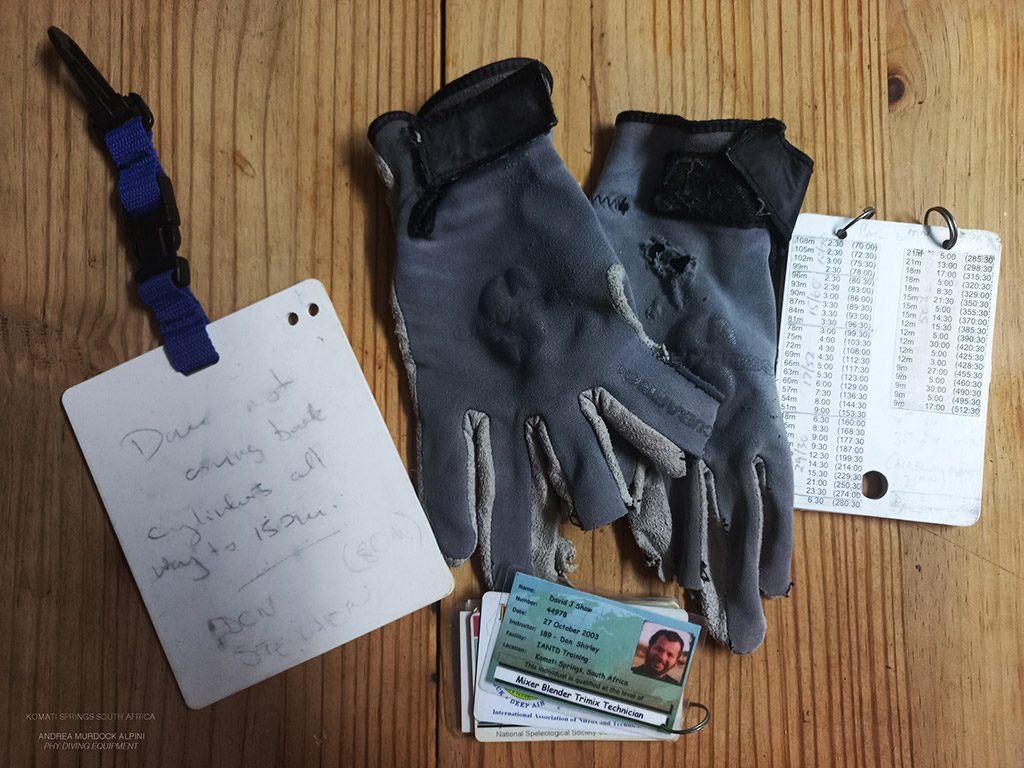
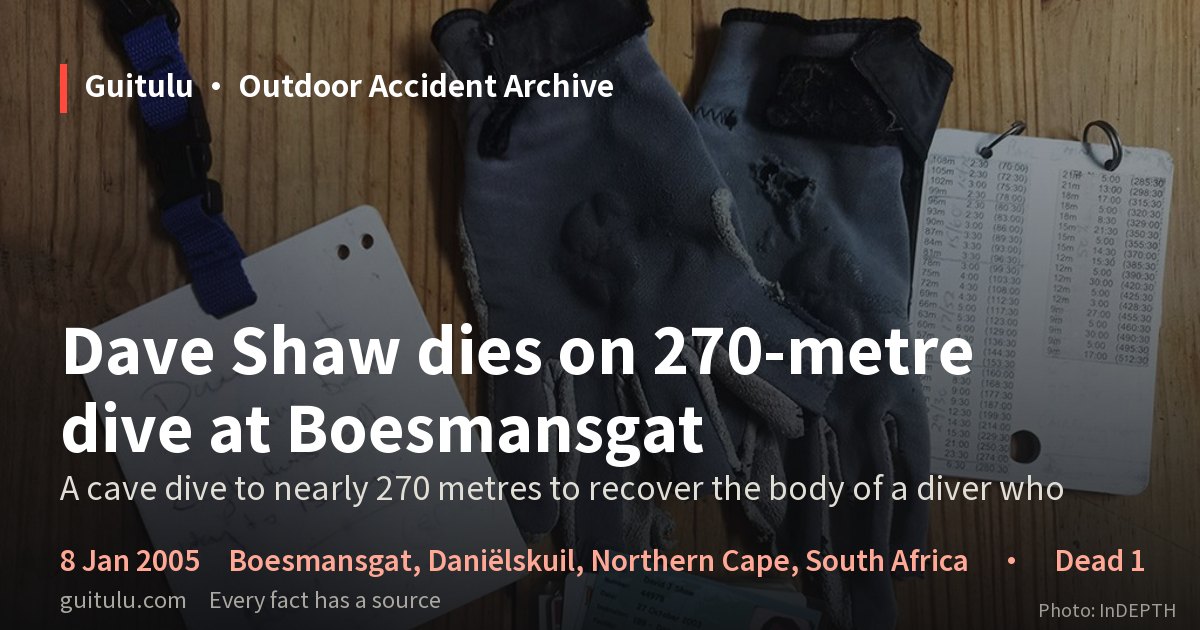
Original dive slate, gloves and decompression tables kept by Shirley, including the slate marked “Dave not coming back”

Archive / Diving and caving

Dave Shaw dies on 270-metre dive at Boesmansgat

A cave dive to nearly 270 metres to recover the body of a diver who died ten years earlier ends in tragedy

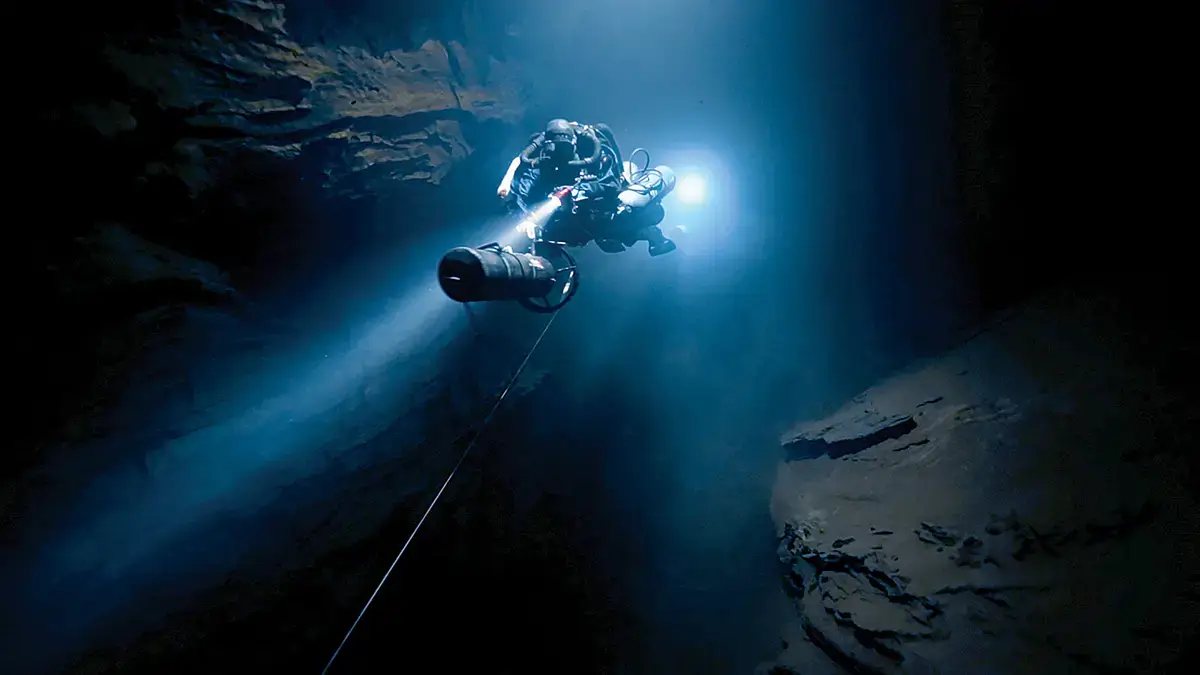
Both bodies were subsequently recovered, and the video was reviewed by experts.

Photo: InDEPTH

Date
Summer
Place
Boesmansgat, Daniëlskuil, Northern Cape, South AfricaSouth Africa › Northern Cape · Kalahari Desert23.642°E -27.922°N
Activity
Technical deep diving (cave/vertical shaft)Involves: Drowning and divingAustralian diver Dave Shaw, his dive partner Don Shirley, and several support divers
Casualties
Dead 1 Injured 1Shaw died; his dive partner Shirley suffered severe decompression sickness and was left with permanent balance impairment.
Material
38 facts · 7 sources2 accounts differ and are shown side by side

01What happened

Boesmansgat is a vertical-shaft freshwater cave in South Africa's Northern Cape province, described as the third-deepest known freshwater cave. In December 1994, a young diver, Deon Dreyer, sank into the depths while ascending from a practice dive there and could not be rescued. A remotely operated underwater vehicle later found only his helmet on the cave floor.Facts it rests onF35Multiple sourcesBoesmansgat is a shaft-like freshwater cave in South Africa's Northern Cape province, described as the third-deepest known freshwater cave.F01Multiple sourcesDuring the 1994 Christmas holiday, Deon Dreyer, a young South African diver around 20 years old, was invited by divers from the South African Cave Diving Association to serve as a support diver at Boesmansgat.F02Multiple sourcesOn 17 December 1994, Deon Dreyer was found below the rest of the group during the ascent from a practice dive. He quickly sank into the depths and could not be rescued.F04Multiple sourcesAfterward, a remotely operated underwater vehicle was sent into the cave to search. Only Deon Dreyer’s diving helmet was found at the bottom; his body was not found.

Original dive slate, gloves and decompression tables kept by Shirley, including the slate marked “Dave not coming back”Photo source: InDEPTH

On 28 October 2004, Australian pilot and cave explorer Dave Shaw descended using a closed-circuit rebreather and found a body at a depth of about 270 metres, which he recognised as Dreyer's. Unable to lift the body out of the mud, he tied a line to it to mark its location. Two days later, he told Dreyer's father that he was willing to bring his son back, and the family agreed.Facts it rests onF37Multiple sourcesDave Shaw was a 50-year-old Australian, a Cathay Pacific pilot based in Hong Kong, and a cave diving explorer.F07Multiple sourcesOn 28 October 2004, Shaw dived to explore near the bottom of the cave. At about 270 metres, he found a body and recognised it as Deon Dreyer, who had gone missing ten years earlier.F09Multiple sourcesShaw tried to lift the body, but it and the cylinders appeared to be stuck in the mud. He tied a line to mark the location and began his ascent.F11Multiple sourcesOn 30 October 2004, Shaw called Deon’s father and offered to bring his son back. The family agreed.

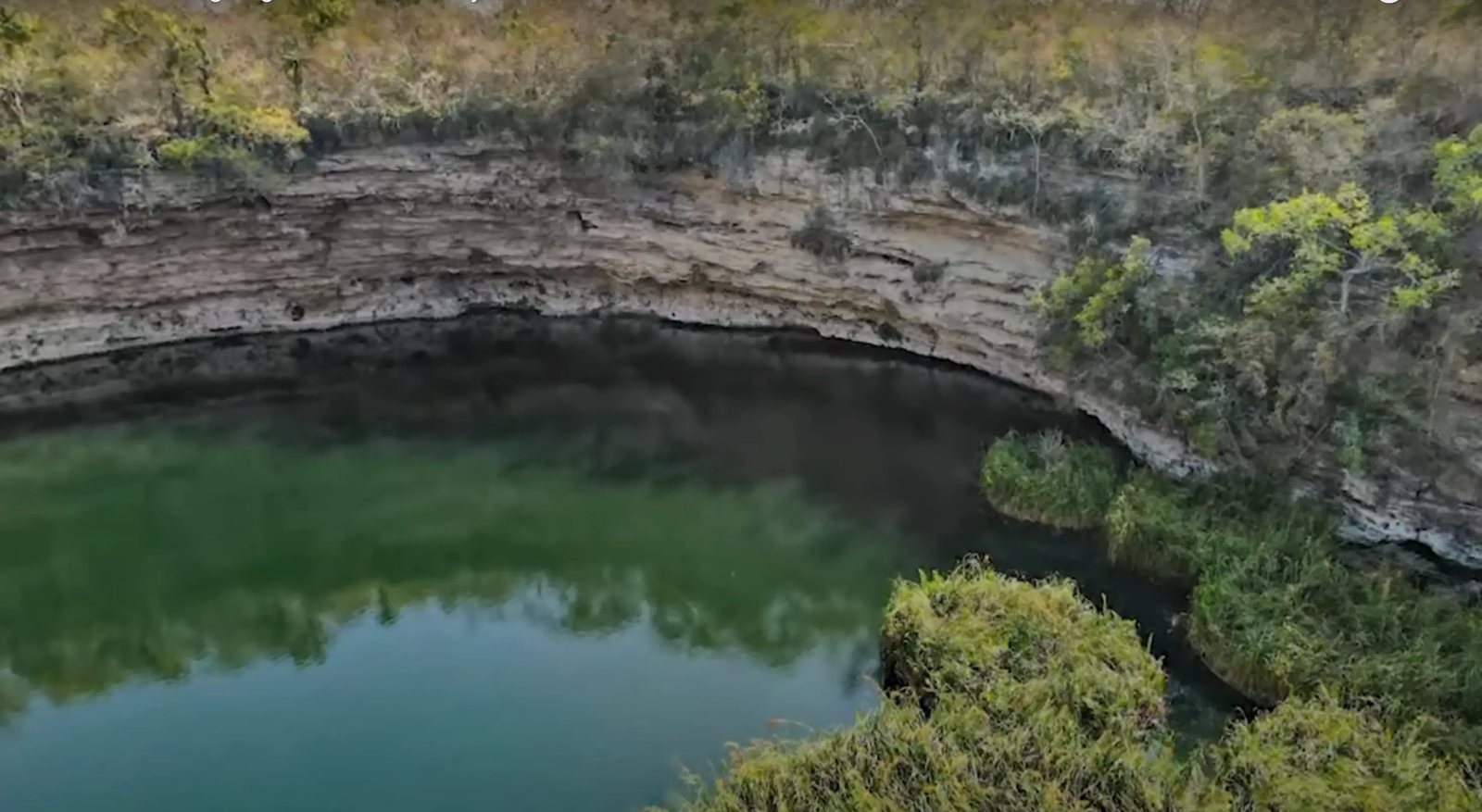
Entrance to Boesmansgat: a small pool covered with duckweedPhoto source: Dive-Scuba

Shaw and his dive partner Don Shirley devised a plan involving several divers working in a relay at different depths, and designed a body bag. They planned to carry it out on 8 January 2005. According to reports, Shaw's helmet was fitted with a newly designed camera that had not been tested in an actual operation, to record the entire process.Facts it rests onF12Multiple sourcesShaw and Shirley devised a complex plan requiring several divers to work in a relay at successive depths. Shaw and his wife also designed a silk body bag with a drawstring to prevent the body from coming apart during the ascent.F18Multiple sourcesThe plan was to be carried out on 8 January 2005: Shaw would descend to about 270 metres, place the body in a bag, ascend after about five minutes, and hand the body over to Shirley, who would be waiting at 220 metres.F14Single sourceShirley planned to place 35 spare cylinders in the water beforehand, and police also brought in a hyperbaric chamber.F15Multiple sourcesA camera was mounted on Shaw’s helmet to film a documentary. The camera was reportedly a new design that had not been tested in actual use.

Diving slate marked “Dave not coming back”Photo source: Dive-Scuba

Early on 8 January, Shaw entered the water and reached the cave floor in about 11 minutes. Video shows that the body was not embedded in the mud as expected, but was floating and rolling, making it much harder to put into the bag than planned; Shaw's dive light also became tangled in the line. During his descent, Shirley saw that the light below was motionless and concluded that something was wrong. At about 800 feet, he turned back because his controller had been crushed, and asked an ascending diver to pass on a message: Dave was not coming back.Facts it rests onF19Multiple sourcesShortly after six in the morning on 8 January 2005, Shaw entered the water wearing a helmet camera and began the planned dive of about 12 hours.F20Single sourceShaw reached the bottom of the cave in a little over 11 minutes, about one and a half minutes faster than planned. He then followed the line to the body and took out the body bag.F21Multiple sourcesThe body was not as expected: it was no longer stuck in the mud but was floating and rolling, making it harder to place in the bag. The team had not anticipated this situation.F22Multiple sourcesThe video shows Shaw’s diving light and the line becoming tangled. He tried to untangle them, but was held back by the line attached to the body and could not move forward.F25Multiple sourcesAt about 500 feet, Shirley saw that Shaw's light below him was motionless and no bubbles were rising. He concluded that something was seriously wrong and continued down to investigate.F26Single sourceWhen Shirley reached about 800 feet, the controller on his arm was damaged by the pressure, forcing him to abandon his descent and ascend instead.F27Multiple sourcesShirley wrote “DAVE NOT COMING BACK” on a slate; the message was relayed to the surface by an ascending diver and a slide line.

During his ascent, bubbles formed in Shirley's inner ear, causing severe vertigo. After about 12 and a half hours of decompression in the water, he was rescued and taken into a recompression chamber. He was later left with permanent balance impairment. On 12 January, the bodies of Shaw and Dreyer were found at a depth of about 20 metres in the cave and brought to the surface together. The helmet camera was also recovered.Facts it rests onF29Single sourceDuring Shirley's ascent, helium bubbles formed in his inner ear, causing severe vertigo and vomiting. After decompressing in the water for about 12 and a half hours, he was taken to a hyperbaric chamber.F13Multiple sourcesShirley was later left with a permanent balance disorder.F30Multiple sourcesOn 12 January 2005, the bodies of Shaw and Deon were found at a depth of about 20 metres in the cave and were subsequently brought to the surface together. The helmet camera was also recovered.F31Multiple sourcesAccording to reports, the two bodies rose from the bottom of the cave together with a line as divers were recovering cylinders and lines left inside.

The number at the end of a paragraph is how many facts it rests on; open it to see each fact and how well it is sourced: Multiple sourcesSingle source. Conflicting accounts and speculation are kept out of the narrative.

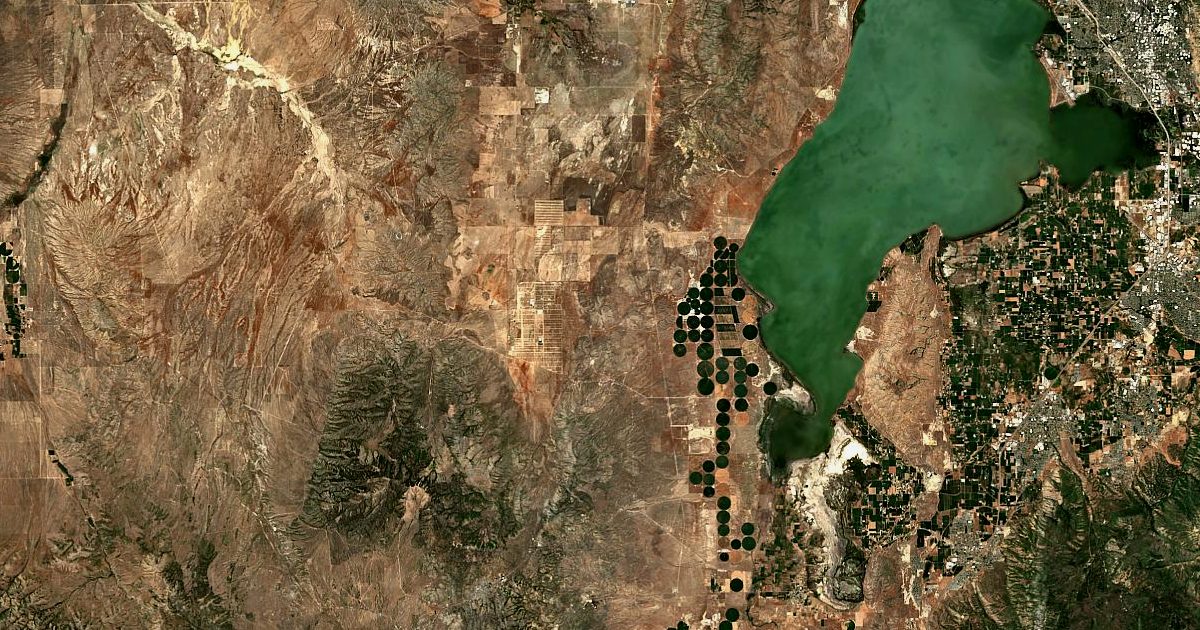
Satellite imagery Sentinel-2 cloudless 2024 © EOX · Terrain AWS Terrain Tiles · Position is schematic, geocoded from place names · Place coordinates not individually verified

Route review

6 scenes to understand what happened

Scroll down and the map flies to where each part happened.

01

The incident area

The reports do not provide enough locations along the way, so the map shows only the approximate location and terrain of the incident area.

02

The disappearance ten years earlier

In 1994, the young diver Dreyer sank into the depths at Boesmansgat. Only his helmet was found on the cave floor.Facts it rests onF35Multiple sourcesBoesmansgat is a shaft-like freshwater cave in South Africa's Northern Cape province, described as the third-deepest known freshwater cave.F02Multiple sourcesOn 17 December 1994, Deon Dreyer was found below the rest of the group during the ascent from a practice dive. He quickly sank into the depths and could not be rescued.F04Multiple sourcesAfterward, a remotely operated underwater vehicle was sent into the cave to search. Only Deon Dreyer’s diving helmet was found at the bottom; his body was not found.

03

Discovery on the cave floor

In October 2004, Shaw found the body at a depth of about 270 metres and promised the family he would bring him back.Facts it rests onF07Multiple sourcesOn 28 October 2004, Shaw dived to explore near the bottom of the cave. At about 270 metres, he found a body and recognised it as Deon Dreyer, who had gone missing ten years earlier.F09Multiple sourcesShaw tried to lift the body, but it and the cylinders appeared to be stuck in the mud. He tied a line to mark the location and began his ascent.F11Multiple sourcesOn 30 October 2004, Shaw called Deon’s father and offered to bring his son back. The family agreed.

04

A detailed plan

Several divers were to work in a relay at different depths, with gas cylinders and a recompression chamber also on hand. A camera was mounted on the helmet.Facts it rests onF12Multiple sourcesShaw and Shirley devised a complex plan requiring several divers to work in a relay at successive depths. Shaw and his wife also designed a silk body bag with a drawstring to prevent the body from coming apart during the ascent.F18Multiple sourcesThe plan was to be carried out on 8 January 2005: Shaw would descend to about 270 metres, place the body in a bag, ascend after about five minutes, and hand the body over to Shirley, who would be waiting at 220 metres.F14Single sourceShirley planned to place 35 spare cylinders in the water beforehand, and police also brought in a hyperbaric chamber.F15Multiple sourcesA camera was mounted on Shaw’s helmet to film a documentary. The camera was reportedly a new design that had not been tested in actual use.

05

The final dive

Early on 8 January 2005, Shaw entered the water. The body was not in the condition expected, and his light became tangled in the line.Facts it rests onF19Multiple sourcesShortly after six in the morning on 8 January 2005, Shaw entered the water wearing a helmet camera and began the planned dive of about 12 hours.F21Multiple sourcesThe body was not as expected: it was no longer stuck in the mud but was floating and rolling, making it harder to place in the bag. The team had not anticipated this situation.F22Multiple sourcesThe video shows Shaw’s diving light and the line becoming tangled. He tried to untangle them, but was held back by the line attached to the body and could not move forward.

06

The relay beneath the surface

Shirley relayed the message, “Dave’s not coming back,” and himself ran into trouble during decompression. He was later rescued in a relay by divers at successive depths.Facts it rests onF25Multiple sourcesAt about 500 feet, Shirley saw that Shaw's light below him was motionless and no bubbles were rising. He concluded that something was seriously wrong and continued down to investigate.F27Multiple sourcesShirley wrote “DAVE NOT COMING BACK” on a slate; the message was relayed to the surface by an ascending diver and a slide line.F29Single sourceDuring Shirley's ascent, helium bubbles formed in his inner ear, causing severe vertigo and vomiting. After decompressing in the water for about 12 and a half hours, he was taken to a hyperbaric chamber.

02Timeline

  1. On 17 December 1994, Deon Dreyer was found below the rest of the group during the ascent from a practice dive. He quickly sank into the depths and could not be rescued. F02

  2. On 28 October 2004, Shaw dived to explore near the bottom of the cave. At about 270 metres, he found a body and recognised it as Deon Dreyer, who had gone missing ten years earlier. F07

  3. On 30 October 2004, Shaw called Deon’s father and offered to bring his son back. The family agreed. F11

  4. Shaw and Shirley devised a complex plan requiring several divers to work in a relay at successive depths. Shaw and his wife also designed a silk body bag with a drawstring to prevent the body from coming apart during the ascent. F12

  5. The body was not as expected: it was no longer stuck in the mud but was floating and rolling, making it harder to place in the bag. The team had not anticipated this situation. F21

  6. Shortly after six in the morning on 8 January 2005, Shaw entered the water wearing a helmet camera and began the planned dive of about 12 hours. F19

  7. The video shows Shaw’s diving light and the line becoming tangled. He tried to untangle them, but was held back by the line attached to the body and could not move forward. F22

  8. Shaw reached the bottom of the cave in a little over 11 minutes, about one and a half minutes faster than planned. He then followed the line to the body and took out the body bag. F20

  9. Shirley wrote “DAVE NOT COMING BACK” on a slate; the message was relayed to the surface by an ascending diver and a slide line. F27

  10. At about 500 feet, Shirley saw that Shaw's light below him was motionless and no bubbles were rising. He concluded that something was seriously wrong and continued down to investigate. F25

  11. The plan was to be carried out on 8 January 2005: Shaw would descend to about 270 metres, place the body in a bag, ascend after about five minutes, and hand the body over to Shirley, who would be waiting at 220 metres. F18

  12. On 12 January 2005, the bodies of Shaw and Deon were found at a depth of about 20 metres in the cave and were subsequently brought to the surface together. The helmet camera was also recovered. F30

03Lessons

Teams and decisions

Set criteria for abandoning a plan when unexpected changes arise

The body was floating, a situation the team had not anticipated. According to reports, a teammate who reviewed the video afterward also noted that, when faced with changes outside the plan, a decision about when to abandon the operation needs to be made in advance if work is to continue under the original plan.Facts it rests onF21Multiple sourcesThe body was not as expected: it was no longer stuck in the mud but was floating and rolling, making it harder to place in the bag. The team had not anticipated this situation.F32Single sourceAfter watching the footage, diver Herbst believed that Shaw appeared to have overexerted himself and then become entangled in a line, unable to free himself.

Water, streams and caves

Do not leave equipment unsecured at depth

According to reports, Shaw placed his dive light at his side while working, and it became tangled in the line. A teammate considered this the kind of situation a diver should most avoid at depth, and a reason to secure equipment during deep dives.Facts it rests onF16Single sourceBecause the camera was mounted on his helmet, Shaw could no longer carry his diving light around his neck as he was accustomed to doing. He told the cameraman that he sometimes placed the light at his side.F22Multiple sourcesThe video shows Shaw’s diving light and the line becoming tangled. He tried to untangle them, but was held back by the line attached to the body and could not move forward.F32Single sourceAfter watching the footage, diver Herbst believed that Shaw appeared to have overexerted himself and then become entangled in a line, unable to free himself.

Teams and decisions

Practise with new equipment and temporary adjustments in advance

The helmet camera was newly designed, and Shaw consequently changed how he normally carried his dive light. Before an important mission, any new change to equipment is worth testing repeatedly under the same conditions.Facts it rests onF15Multiple sourcesA camera was mounted on Shaw’s helmet to film a documentary. The camera was reportedly a new design that had not been tested in actual use.F16Single sourceBecause the camera was mounted on his helmet, Shaw could no longer carry his diving light around his neck as he was accustomed to doing. He told the cameraman that he sometimes placed the light at his side.

Rescue and self-rescue

Layers of backup and relay support also have limits

The operation had positioned numerous spare gas cylinders, a recompression chamber and several support divers. After Shirley got into trouble, he was rescued through a relay at successive depths.Facts it rests onF14Single sourceShirley planned to place 35 spare cylinders in the water beforehand, and police also brought in a hyperbaric chamber.F26Single sourceWhen Shirley reached about 800 feet, the controller on his arm was damaged by the pressure, forcing him to abandon his descent and ascend instead.F29Single sourceDuring Shirley's ascent, helium bubbles formed in his inner ear, causing severe vertigo and vomiting. After decompressing in the water for about 12 and a half hours, he was taken to a hyperbaric chamber.F28Multiple sourcesThe surface commander announced that the emergency plan had been activated, and police said Shaw was almost certain not to have survived.

04Fact list 38 facts

Under each fact is a verbatim quote from the original. "Single source" means only one outlet mentioned it; "Accounts differ" means sources contradict each other and this site adopts neither side; "Speculation" is an inference by a reporter or a person involved, not a fact.

  1. F01Multiple sourcesBackground

    During the 1994 Christmas holiday, Deon Dreyer, a young South African diver around 20 years old, was invited by divers from the South African Cave Diving Association to serve as a support diver at Boesmansgat.

    Quotes from the original 2

    “Deon had logged about 200 dives when he was invited to join some South Africa Cave Diving Association divers at Bushman’s Hole over the 1994 Christmas break.”

    Outside · 2005-08-01

    “was invited by the South African Cave Diving Association to join them as a support diver at Bushman's Hole”

    ABC News · 2007-03-19
  2. F02Multiple sourcesEvent

    On 17 December 1994, Deon Dreyer was found below the rest of the group during the ascent from a practice dive. He quickly sank into the depths and could not be rescued.

    Quotes from the original 2

    “on December 17, 1994, the hole claimed Deon Dreyer”

    Outside · 2005-08-01

    “The dive team reported that while coming back up they looked down and saw Deon Dryer's cave light fading, sinking back into the abyss.”

    ABC News · 2007-03-19
  3. F03SpeculationSpeculation

    Deon Dreyer is thought to have died after a buildup of carbon dioxide in deep water caused him to lose consciousness. No one knows the actual cause for certain.

    Quotes from the original 2

    “No one knows for sure what killed Deon. The best guess is deep-water blackout from carbon dioxide buildup.”

    Outside · 2005-08-01

    “carbon dioxide can build up in the lungs, resulting in a blackout”

    ABC News · 2007-03-19
  4. F04Multiple sourcesAftermath

    Afterward, a remotely operated underwater vehicle was sent into the cave to search. Only Deon Dreyer’s diving helmet was found at the bottom; his body was not found.

    Quotes from the original 2

    “It found Deon’s dive helmet on the vast floor of Bushman’s, but there was no sign of his body.”

    Outside · 2005-08-01

    “I mean, there was no body.”

    ABC News · 2007-03-19
  5. F05Single sourceBackground

    According to Outside, In 1996, South African diver Nuno Gomes used open-circuit equipment to descend to the bottom of Boesmansgat, about 927 feet. It was once described as a world record.

    Quotes from the original 1

    “had claimed a world record in 1996 when he hit bottom, on open-circuit gear, at 927 feet”

    Outside · 2005-08-01
  6. F06Single sourceBackground

    According to Outside, Shaw used a closed-circuit rebreather. In June 2004, he dived to about 725 feet at Boesmansgat using a modified Mk15.5 rebreather, setting a depth record for a cave dive using a closed-circuit rebreather.

    Quotes from the original 1

    “Shaw turned up with his modified Mk15.5 and dived it to 725 feet, another world record for a closed-circuit rebreather in a cave.”

    Outside · 2005-08-01
  7. F07Multiple sourcesFound at scene

    On 28 October 2004, Shaw dived to explore near the bottom of the cave. At about 270 metres, he found a body and recognised it as Deon Dreyer, who had gone missing ten years earlier.

    Quotes from the original 3

    “Shaw knew immediately who it was: Deon Dreyer, a 20-year-old South African who had blacked out deep in Bushman’s ten years earlier and disappeared.”

    Outside · 2005-08-01

    “Shaw found Dreyer's remains at a depth of almost 270m”

    ScubaBoard · 2005-01-08

    “he found a body that had been there for nearly ten years, 20-year-old diver Deon Dreyer”

    InDEPTH · 2023-05-31
  8. F08Accounts differFound at scene

    Sources differ on the maximum depth of Shaw’s October dive: about 270 metres (886 feet), about 280 metres, or 876 feet (about 267 metres).

    Different sources give different depths and unit conversions

    Quotes from the original 3

    “his VR3 dive computer said he was now approaching 886 feet”

    Outside · 2005-08-01

    “Dave dove to 280 meters, touched the bottom and started exploring.”

    InDEPTH · 2023-05-31

    “At 876 feet, Shaw reached the cave floor”

    ABC News · 2007-03-19
  9. F09Multiple sourcesEvent

    Shaw tried to lift the body, but it and the cylinders appeared to be stuck in the mud. He tied a line to mark the location and began his ascent.

    Quotes from the original 2

    “Shaw quickly tied the cave reel to Deon’s tanks, so the body could be found again”

    Outside · 2005-08-01

    “Unable to pry the body from the silt, Shaw marked its location with a feeder line”

    ABC News · 2007-03-19
  10. F10Single sourceEvent

    According to Outside, During his ascent, Shaw used a writing slate to tell Don Shirley, “270 metres, found body.” Shirley then shook his hand.

    Quotes from the original 1

    “Shaw showed him an underwater slate on which he had written 270m, found body”

    Outside · 2005-08-01
  11. F11Multiple sourcesEvent

    On 30 October 2004, Shaw called Deon’s father and offered to bring his son back. The family agreed.

    Quotes from the original 2

    “I will go and fetch your son”

    Outside · 2005-08-01

    “But then, yes, we went for the recovery.”

    ABC News · 2007-03-19
  12. F12Multiple sourcesPlan

    Shaw and Shirley devised a complex plan requiring several divers to work in a relay at successive depths. Shaw and his wife also designed a silk body bag with a drawstring to prevent the body from coming apart during the ascent.

    Quotes from the original 2

    “Shaw and Shirley developed a complex dive plan that would require as many as nine different divers working at varying depths.”

    ABC News · 2007-03-19

    “Together with Ann, he designed a silk bag with drawstrings, long enough to fit over Deon’s fins.”

    Outside · 2005-08-01
  13. F13Multiple sourcesAftermath

    Shirley was later left with a permanent balance disorder.

    Quotes from the original 2

    “the helium bend left him with permanent damage that has impaired his balance”

    Outside · 2005-08-01

    “Don Shirley nearly died as well, and apparently was left with permanent damage that has impaired his balance”

    InDEPTH · 2023-05-31
  14. F14Single sourcePlan

    According to Outside, Shirley planned to place 35 spare cylinders in the water beforehand, and police also brought in a hyperbaric chamber.

    Quotes from the original 2

    “He planned to have 35 backup cylinders of gas in the water”

    Outside · 2005-08-01

    “a recompression chamber that the police trucked in”

    Outside · 2005-08-01
  15. F15Multiple sourcesPlan

    A camera was mounted on Shaw’s helmet to film a documentary. The camera was reportedly a new design that had not been tested in actual use.

    Quotes from the original 2

    “Shaw's helmet camera -- designed by Hiles -- was new and untried.”

    ABC News · 2007-03-19

    “attached it to a Petzl climbing helmet”

    Outside · 2005-08-01
  16. F16Single sourcePlan

    According to Outside, Because the camera was mounted on his helmet, Shaw could no longer carry his diving light around his neck as he was accustomed to doing. He told the cameraman that he sometimes placed the light at his side.

    Quotes from the original 1

    “He told Hiles that, instead of slinging his light around his neck, he would occasionally set it out to the side.”

    Outside · 2005-08-01
  17. F17Single sourceAftermath

    According to IOL, The video was given to experts for review to determine exactly what went wrong for Shaw.

    Quotes from the original 1

    “the footage will be reviewed by various experts to try and determine exactly what is going on”

    IOL · 2005-01-13
  18. F18Multiple sourcesPlan

    The plan was to be carried out on 8 January 2005: Shaw would descend to about 270 metres, place the body in a bag, ascend after about five minutes, and hand the body over to Shirley, who would be waiting at 220 metres.

    Quotes from the original 2

    “The dive would go off on the coming Saturday, January 8”

    Outside · 2005-08-01

    “Shaw would have had five minutes to do this before coming up to meet his back-up, Don Shirley, who was waiting for him at 220m.”

    IOL · 2005-01-13
  19. F19Multiple sourcesEvent

    Shortly after six in the morning on 8 January 2005, Shaw entered the water wearing a helmet camera and began the planned dive of about 12 hours.

    Quotes from the original 2

    “ducked into the dark waters of Bushman’s Hole”

    Outside · 2005-08-01

    “Shaw entering the water at 6:14am on Saturday”

    IOL · 2005-01-13
  20. F20Single sourceEvent

    According to Outside, Shaw reached the bottom of the cave in a little over 11 minutes, about one and a half minutes faster than planned. He then followed the line to the body and took out the body bag.

    Quotes from the original 1

    “He hit the bottom in just over 11 minutes”

    Outside · 2005-08-01
  21. F21Multiple sourcesFound at scene

    The body was not as expected: it was no longer stuck in the mud but was floating and rolling, making it harder to place in the bag. The team had not anticipated this situation.

    Some sources are of low reliability

    Quotes from the original 2

    “The body was not meant to be floating.”

    Outside · 2005-08-01

    “That substance has positive buoyancy, and that made Deon's body float”

    Dive-Scuba ·
  22. F22Multiple sourcesEvent

    The video shows Shaw’s diving light and the line becoming tangled. He tried to untangle them, but was held back by the line attached to the body and could not move forward.

    Quotes from the original 2

    “His errant cave light has apparently snagged the cave line tied to Deon’s tanks.”

    Outside · 2005-08-01

    “he got entangled in the cave line”

    IOL · 2005-01-13
  23. F23SpeculationSpeculation

    Shaw’s breathing became increasingly rapid in the video. Some have suggested that carbon dioxide built up under high pressure, exertion and nitrogen narcosis, eventually causing him to lose consciousness; he is believed to have died of respiratory failure.

    Quotes from the original 2

    “Dave Shaw, with carbon dioxide suffusing his lungs, is starting to pass out.”

    Outside · 2005-08-01

    “The physical effort of trying to free himself led to his death for what is believed to be respiratory insufficiency”

    InDEPTH · 2023-05-31
  24. F24Accounts differEvent

    Accounts differ on when Shaw stopped moving: Outside says the sound began to fade about 21 minutes into the dive, while IOL says movement and breathing stopped at about 26 minutes.

    The two sources cite different times, possibly reflecting different interpretations of the footage

    Quotes from the original 2

    “Twenty-one minutes into the dive, the sounds finally start to fade.”

    Outside · 2005-08-01

    “But then exactly 26 minutes into the dive all activity stops and then his breathing as well.”

    IOL · 2005-01-13
  25. F25Multiple sourcesEvent

    At about 500 feet, Shirley saw that Shaw's light below him was motionless and no bubbles were rising. He concluded that something was seriously wrong and continued down to investigate.

    Includes a low-reliability source

    Quotes from the original 2

    “There was only one problem: The light wasn’t moving.”

    Outside · 2005-08-01

    “Shirley descended to 250m to look for him”

    ScubaBoard · 2005-01-08
  26. F26Single sourceEvent

    According to Outside, When Shirley reached about 800 feet, the controller on his arm was damaged by the pressure, forcing him to abandon his descent and ascend instead.

    Quotes from the original 1

    “At about 800 feet, deeper than he had ever been, Shirley heard the slight, sharp crack of enormous pressure crushing something”

    Outside · 2005-08-01
  27. F27Multiple sourcesEvent

    Shirley wrote “DAVE NOT COMING BACK” on a slate; the message was relayed to the surface by an ascending diver and a slide line.

    Includes a low-reliability source

    Quotes from the original 2

    “It read, DAVE NOT COMING BACK.”

    Outside · 2005-08-01

    “He communicated to the surface through messages written on slates passed up a rope that Shaw's light had disappeared.”

    ScubaBoard · 2005-01-08
  28. F28Multiple sourcesEvent

    The surface commander announced that the emergency plan had been activated, and police said Shaw was almost certain not to have survived.

    Includes a low-reliability source

    Quotes from the original 2

    “we are on our emergency plan”

    Outside · 2005-08-01

    “there was little chance of an Australian diver returning from the depths of the world's third deepest freshwater cave”

    ScubaBoard · 2005-01-08
  29. F29Single sourceEvent

    According to Outside, During Shirley's ascent, helium bubbles formed in his inner ear, causing severe vertigo and vomiting. After decompressing in the water for about 12 and a half hours, he was taken to a hyperbaric chamber.

    Quotes from the original 2

    “a small bubble of helium had formed in his left inner ear, causing extreme vertigo”

    Outside · 2005-08-01

    “He had been in Bushman’s Hole almost 12 and a half hours.”

    Outside · 2005-08-01
  30. F30Multiple sourcesAftermath

    On 12 January 2005, the bodies of Shaw and Deon were found at a depth of about 20 metres in the cave and were subsequently brought to the surface together. The helmet camera was also recovered.

    Quotes from the original 3

    “The bodies were found at a depth of 20m in the freshwater cave.”

    IOL · 2005-01-13

    “The remains of 20-year-old Deon Dreyer and of Shaw were brought to the surface on Wednesday - with the camera.”

    IOL · 2005-01-13

    “We saw Deon and Dave stuck in the cave at 20 meters.”

    Outside · 2005-08-01
  31. F31Multiple sourcesAftermath

    According to reports, the two bodies rose from the bottom of the cave together with a line as divers were recovering cylinders and lines left inside.

    Quotes from the original 2

    “it had pulled the cave line—and with it Deon and Shaw—off the bottom”

    Outside · 2005-08-01

    “They were dislodged during the bid by Herbst and Petrus Roux, assisted by police divers, to recover the dive tanks attached to the shot line”

    IOL · 2005-01-13
  32. F32Single sourceParticipant's view

    According to IOL, After watching the footage, diver Herbst believed that Shaw appeared to have overexerted himself and then become entangled in a line, unable to free himself.

    Quotes from the original 1

    “it appears that Dave was working too hard”

    IOL · 2005-01-13
  33. F33Single sourceParticipant's view

    According to IOL, Shirley said Shaw “died nobly, if there is such a thing as a noble death,” and that he had done everything he could.

    Quotes from the original 1

    “He died a noble death, if there is such a thing. He tried his best.”

    IOL · 2005-01-13
  34. F34Single sourceAftermath

    According to Scubaverse, The incident was later covered in Phillip Finch's book “Raising the Dead”, published in 2008.

    Quotes from the original 1

    “Raising the Dead, by Phillip Finch”

    Scubaverse ·
  35. F35Multiple sourcesBackground

    Boesmansgat is a shaft-like freshwater cave in South Africa's Northern Cape province, described as the third-deepest known freshwater cave.

    Quotes from the original 2

    “a remote sinkhole in the Northern Cape province of South Africa and the third-deepest freshwater cave known to man”

    Outside · 2005-08-01

    “a deep, submerged freshwater cave (or sinkhole) in the Northern Cape province of South Africa”

    InDEPTH · 2023-05-31
  36. F36Multiple sourcesBackground

    The cave entrance is at an altitude of about 1500 to 1600 metres. The high altitude means that dives to the same depth require longer decompression times.

    Includes a low-reliability source

    Quotes from the original 2

    “at 1,600 meters (nearly 5,000 feet) altitude”

    InDEPTH · 2023-05-31

    “This means that the reduction of surface pressure creates a greater inert gas gradient and creates the necessity for longer decompression times.”

    Dive-Scuba ·
  37. F37Multiple sourcesBackground

    Dave Shaw was a 50-year-old Australian, a Cathay Pacific pilot based in Hong Kong, and a cave diving explorer.

    Quotes from the original 2

    “Shaw, a Cathay Pacific Airways pilot based in Hong Kong”

    Outside · 2005-08-01

    “a 50-year-old Australian pilot and ace cave diver”

    IOL · 2005-01-13
  38. F38Single sourceBackground

    According to Outside, Don Shirley was a 48-year-old Briton who ran a technical diving school in South Africa. He was Shaw's close friend and dive partner.

    Quotes from the original 1

    “Don Shirley, a 48-year-old British expat who runs a technical-diving school in Badplaas, South Africa”

    Outside · 2005-08-01