KayakingInvolves: Drowning and divingEast Greenland Expedition (funded by Pan American Airways), 4 members: Watkins, Rymill, Chapman and Riley
Casualties
Missing 1 Watkins went missing after setting out alone by kayak to hunt seals. His kayak was found floating upside down; his body has never been found, and he is presumed to have drowned
Material
38 facts · 7 sources1 account differs and are shown side by side
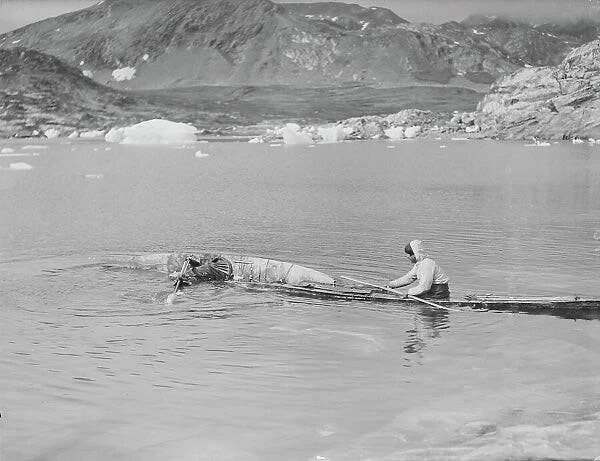
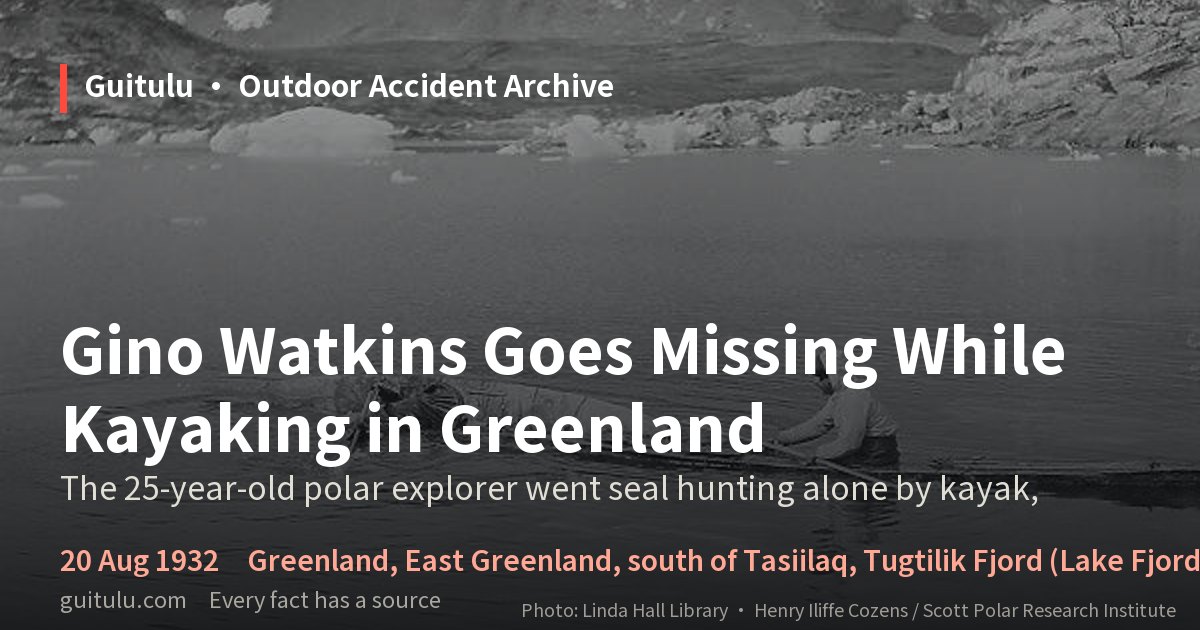
Expedition members practise Inuit kayak rolls in an East Greenland fjord during the 1930 British Arctic Air Route ExpeditionPhoto source: Linda Hall Library · Henry Iliffe Cozens / Scott Polar Research Institute
The number at the end of a paragraph is how many facts it rests on; open it to see each fact and how well it is sourced:
Multiple sourcesSingle source. Conflicting accounts and speculation are kept out of the narrative.
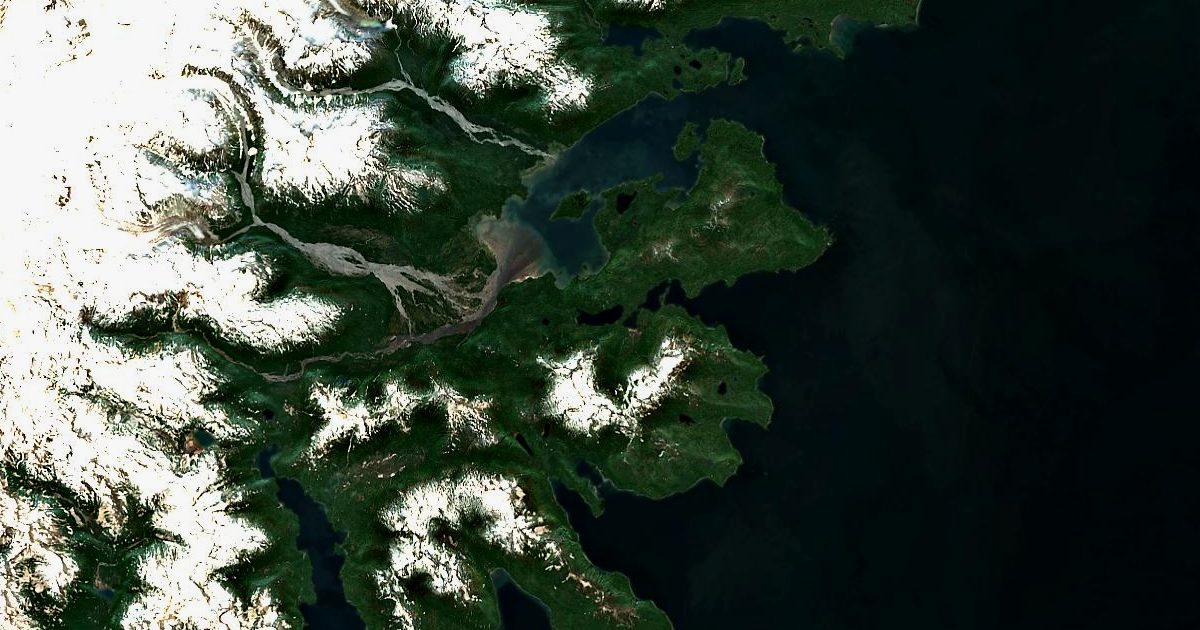
Reported places along the route (illustrative)Schematic
Scroll down and the map flies to where each part happened. The line is Schematic, The places mentioned in reports are connected in sequence, showing only the approximate direction, not the actual track. Sources for the place coordinates are in places.json.
01
Full route
Locations mentioned in reports are connected in sequence to show the approximate course (schematic).
In July 1932, the expedition travelled to Ammassalik aboard the Danish ship “Gertrud Rask”, stopping at Scoresby Sund on the way. F14
After confirming that Watkins had died, his three companions decided to remain in Greenland to complete the work, with Rymill taking over as leader. F18
They then travelled by boat to Lake Fjord, where Riley built a weather station, Rymill and Chapman began surveying and mapping, and Watkins began hunting seals to stock up on food for the winter, when there would be no seals to hunt. F15
It was Rymill and Chapman who found the empty kayak in Lake Fjord. F16
His companions began a search, but Watkins's body was never found. F17
Watkins did not return; his companions found his kayak floating overturned, with no one aboard. F21
On 20 August 1932, Watkins went out alone in a kayak to hunt seals. F19
On 2 September 1932, the expedition's hut and supplies were transported to Lake Fjord. F29
On 17 September 1933, the three left Ammassalik aboard the Polaris and arrived in Reykjavik on 24 September. F32
Under each fact is a verbatim quote from the original. "Single source" means only one outlet mentioned it; "Accounts differ" means sources contradict each other and this site adopts neither side; "Speculation" is an inference by a reporter or a person involved, not a fact.
In 1930–1931, Watkins led the British Arctic Air Route Expedition, with support from the Royal Geographical Society, to investigate the possibility of an air route via Greenland.
Quotes from the original 2
“Watkins gained the support of the Royal Geographical Society for the British Arctic Air Route Expedition [BAARE], 1930 – 1931”
According to Freeze Frame, Pan American Airways contributed £500, the Royal Geographical Society £200, and The Times £100 in exchange for reporting rights, far less than the £14,000 raised for the previous expedition.
Quotes from the original 2
“offered Watkins £500 to follow up his work of the previous year”
According to Freeze Frame, The work was divided as follows: Riley built a weather station, Rymill and Chapman conducted surveying and mapping, and Watkins hunted seals to supplement the team's food supply.
Several quotations come from different reports by the same media outlet and are counted as one source.
Quotes from the original 2
“The plan was that Riley would establish a meteorological station, Rymill and Chapman would survey the area, and Watkins would supplement their food supplies by hunting seals.”
According to Freeze Frame, With one fewer member, the planned major sledge journey to Godthåb was abandoned, and the expedition's objectives had to be scaled back.
Quotes from the original 2
“the large sledging trip to Godhaab would need to be abandoned as they no longer had enough men”
According to Freeze Frame, With their best hunter gone, time originally intended for scientific work had to be spent hunting, because the team's survival depended on fresh meat.
Quotes from the original 1
“As their survival counted on there being a supply of fresh meat and their best hunter had died, time that was meant to have been spent carrying out scientific experiments had to be given over to hunting.”
According to Freeze Frame, In July 1932, the expedition travelled to Ammassalik aboard the Danish ship “Gertrud Rask”, stopping at Scoresby Sund on the way.
Quotes from the original 1
“The sailed in July on a Danish ship the Gertrud Rask to Angmagssalik, calling in at Scoresby Sound on the way.”
According to Freeze Frame, They then travelled by boat to Lake Fjord, where Riley built a weather station, Rymill and Chapman began surveying and mapping, and Watkins began hunting seals to stock up on food for the winter, when there would be no seals to hunt.
Quotes from the original 2
“They then travelled by boat up to Lake Fjord; Riley set up a meteorological station, and Rymill and Chapman began surveying.”
It was Rymill and Chapman who found the empty kayak in Lake Fjord.
The SNAC text was transcribed from the Scott Polar Research Institute's archival guide and shares the same source as Freeze Frame; it is not counted as an independent source.
Quotes from the original 2
“In August 1932, Rymill and Chapman discovered Watkins’ empty kayak on Lake Fjord where Watkins had been seal-hunting alone.”
According to Freeze Frame, After confirming that Watkins had died, his three companions decided to remain in Greenland to complete the work, with Rymill taking over as leader.
Several quotations come from different reports by the same media outlet and are counted as one source.
Quotes from the original 2
“Once it became clear that Watkins was dead, his three companions decided to stay on in Greenland to complete their work under the leadership of Rymill.”
Speculation (according to the biography written by Ridgway): While he was on a piece of floating ice arranging his equipment, a wave raised by falling ice behind him surged beneath the floe and knocked him into the icy water. He could neither climb back onto the floe nor reach the kayak as it drifted away.
No one witnessed this sequence of events; it is the biographer's reconstruction.
Quotes from the original 2
“He got out and stood on an ice floe on a routine stop to sort his gear out better, when a falling ice block behind him caused a strong wave to pass under the floe”
According to Freeze Frame, The other three members persevered and completed the expedition, surveying and mapping about 175 square miles of mountainous terrain, making meteorological observations and collecting plant and animal specimens.
Quotes from the original 2
“Their survey covered 175 square miles of mountainous country.”
Watkins could perform an Inuit roll to right his kayak after capsizing without outside assistance. He was reportedly the only member of the expedition who had mastered the technique.
Quotes from the original 2
“He was the only member of the crew who mastered the “Inuit roll,” whereby he could return a kayak to its upright position without aid when it had rolled over.”
According to Paul Gauguin Cruises, Lake Fjord (locally called Tugtilik) is a small fjord fed by a glacier whose terminus is more than 30 metres high; Watkins gave it the name 'Lake Fjord'.
Quotes from the original 2
“Tugtilik is a magnificent, small sheltered fjord fed by a glacier front that stands more than thirty metres (100 feet) tall.”
The Gino Watkins Memorial Fund was later established to support young people undertaking polar exploration and research.
Quotes from the original 2
“The Gino Watkins Memorial fund was set up in his memory with the aim to inspire and guide enterprising, particularly young, people towards exploration and research in the polar regions.”
According to Paddler, The biographer Ridgway wrote that, even though Inuit were highly skilled kayakers, drowning still accounted for a quarter of their deaths.
Quotes from the original 1
“In spite of their great expertise in the kayaks, the stark fact remained that one-quarter of all Eskimo deaths was caused by drowning”
 GuituluGlobal Outdoor Accident Archive