Five hikers in New Jersey fled and became separated after encountering a bear; one died
The findings of the police, New Jersey Department of Environmental Protection Division of Fish and Wildlife, and medical examiner were released in November 2014
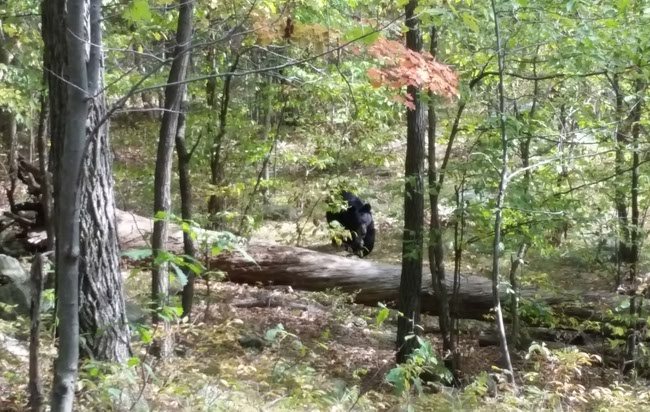
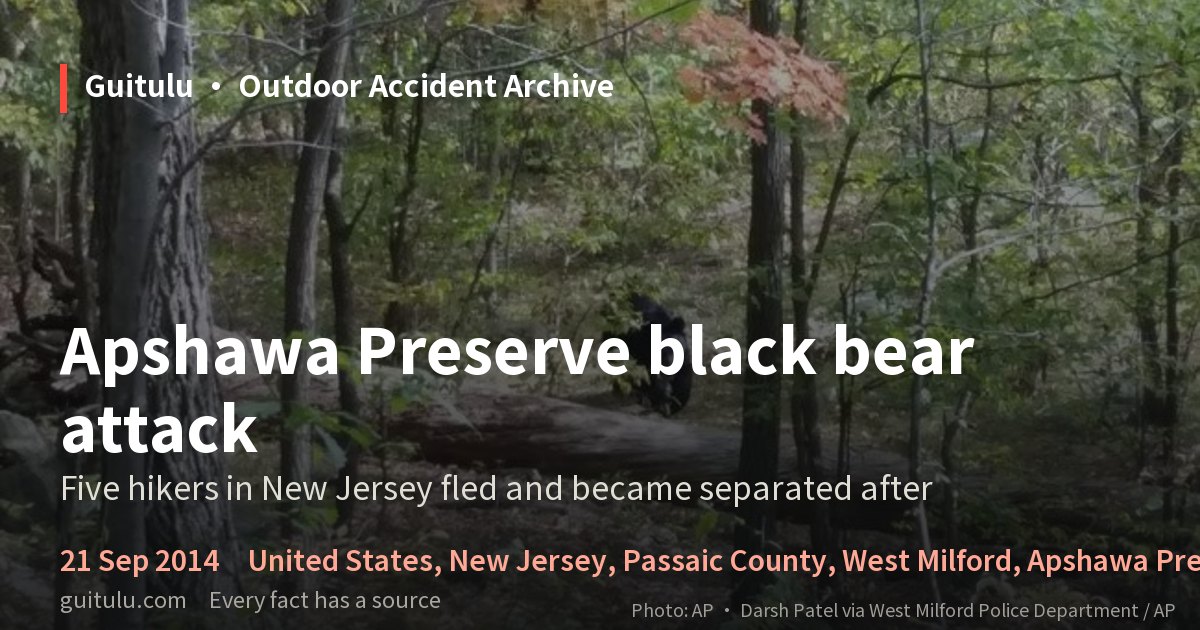
One of Patel's phone photographs released by police: a black bear behind a fallen tree in the woodsPhoto source: AP · Darsh Patel via West Milford Police Department / AP
The number at the end of a paragraph is how many facts it rests on; open it to see each fact and how well it is sourced:
Multiple sourcesSingle source. Conflicting accounts and speculation are kept out of the narrative.
Four later regrouped and found they could not locate Patel. They called police at about 3:45 p.m. F11
Department of Environmental Protection officials said this was the first recorded fatal bear attack in New Jersey. F23
The police and state Department of Environmental Protection investigation concluded that the bear had shown stalking behavior before the attack. F27
Test results released by the state Department of Environmental Protection showed that the bear did not have rabies, was in good physical condition and showed no signs of malnutrition. F25
In November 2014, West Milford police released photographs of the bear that Patel had taken with his phone before he died. F31
Under each fact is a verbatim quote from the original. "Single source" means only one outlet mentioned it; "Accounts differ" means sources contradict each other and this site adopts neither side; "Speculation" is an inference by a reporter or a person involved, not a fact.
According to Advertiser News North, Residents opposed to extending the bear hunting season believed education was key: knowing what to do when encountering a bear and placing garbage in bear-resistant containers could prevent similar tragedies.
Quotes from the original 1
“Knowing what to do during a bear encounter and keeping trash in bear-proof containers could prevent tragedies such as this one, they said.”
According to Township Journal, The incident was investigated by the New Jersey medical examiner, the state Department of Environmental Protection's Division of Fish and Wildlife, and the West Milford Police Department.
Quotes from the original 1
“The matter is under investigation by the New Jersey State Medical Examiner, New Jersey Department of Environmental Protection Fish and Wildlife and the West Milford Police Department.”
According to West Milford Messenger, Before the incident, two other hikers in the preserve noticed a black bear following them at a distance of about 30 to 40 yards for about 10 minutes.
Quotes from the original 1
“The bear was approximately 30 to 40 yards away and continued following for about 10 minutes.”
According to WABC, According to the recording of the emergency call released by police, the friend who called said they had run in one direction for about two minutes and reached a residential area.
Quotes from the original 1
“No, no, no, we ran one way for about two minutes and we got on to a neighborhood.”
Accounts differ on when the body was found: Township Journal said about 5:54 p.m.; Advertiser News North said about 7:54 p.m.; and AP said police found it about two hours after the emergency call.
The times reported by the two local weekly newspapers differ by two hours.
“The bear euthanized by the police officers stayed near the victim as they approached and would not leave, despite attempts by the officers to scare it away.”
Accounts differ on who shot the bear and what firearm was used: West Milford Messenger said West Milford police fired two shotgun rounds; AP said wildlife officials killed the bear with two rifle shots, and NBC New York also said two rifle shots were fired.
Quotes from the original 3
“Police characterized the bear as aggressive and shot the 302-pound male twice with a shotgun, killing him.”
“This bear had not been tagged, a tactic utilized by the New Jersey Department of Environmental Protection to keep track of black bears having a history of aggression.”
The day after the incident, Burguess, head of the state Division of Fish and Wildlife's black bear program, speculated that the bear may have been naturally inclined toward aggression, but was more likely looking for food, because officials believed that the acorns and berries eaten by bears were in short supply at the time.
Quotes from the original 1
“said the bear could have been predisposed to attack but more likely was looking for food, particularly since wildlife officials believe there is a current shortage of the acorns and berries that bears eat.”
According to AP, Department of Environmental Protection spokesman Larry Ragonese said that when encountering a bear, people should remain calm, not run, leave the bear an escape route, avoid direct eye contact, back away slowly, and speak in a low, firm voice.
Several quotations come from different reports by the same media outlet and are counted as one source.
Quotes from the original 2
“You must remain calm, do not run, you want to make sure the bear has an escape route, you want to avoid direct eye contact with the bear, back up slowly, speak with a low, assertive voice.”
According to Township Journal, West Milford Mayor Bieri said bear attacks on people are extremely rare, but bears remain unpredictable wild animals and taking appropriate precautions is essential.
Quotes from the original 1
“Bears are nevertheless wild animals with an element of unpredictability, as proven in this very unfortunate situation, so taking appropriate precautions is imperative.”
Test results released by the state Department of Environmental Protection showed that the bear did not have rabies, was in good physical condition and showed no signs of malnutrition.
Quotes from the original 3
“A bear that attacked and killed a Rutgers University student in Passaic County did not have rabies, New Jersey state wildlife officials said Tuesday.”
According to Advertiser News North, The investigation confirmed that the bear police shot and killed at the scene was the bear responsible for the fatal attack.
Quotes from the original 1
“The bear that was euthanized by police at the scene of the attack was the bear that was involved in the fatal attack.”
The investigation concluded that the bear was not interested in food: Patel had a sealed granola bar in his backpack, and neither the backpack nor the bar had been disturbed afterward.
Quotes from the original 2
“It was noted that after the incident, the victim’s backpack and the granola bar within remained untouched.”
According to West Milford Messenger, Police publicly sought two hikers who had encountered the five before the incident, and subsequently found and questioned them.
Several quotations come from different reports by the same news outlet and are counted as one source
Quotes from the original 2
“police are seeking the identity of two hikers that came into contact with a the group of five from Edison”
State and local officials said the area's dense forests may be home to as many as 2,400 black bears, but bear attacks on people are rare.
This sentence from NBC New York uses the same wording as an Associated Press dispatch.
Quotes from the original 2
“State and local officials stressed that bear attacks are rare even in a region of the state that may have as many as 2,400 bruins in its dense forests.”
“State and local officials have stressed that bear attacks are rare even in a region of the state that may have as many as 2,400 bruins in its dense forests.”
According to AP, West Milford Police Chief Stoeckel said the police department received 6 to 12 bear-related calls a week, usually about bears rummaging through garbage cans.
Quotes from the original 1
“noting that his department receives six to 12 calls per week regarding bears, usually involving them breaking into trash cans.”
According to Advertiser News North, Autopsy results released by the regional medical examiner's office determined that Patel died from a bear attack.
Quotes from the original 1
“The cause of death for the hiker killed in September at Apshawa Preserve was mauling, according to autopsy results released Friday by the Regional medical Examiner's Office.”
 GuituluGlobal Outdoor Accident Archive