GuituluGlobal Outdoor Accident Archive 中文
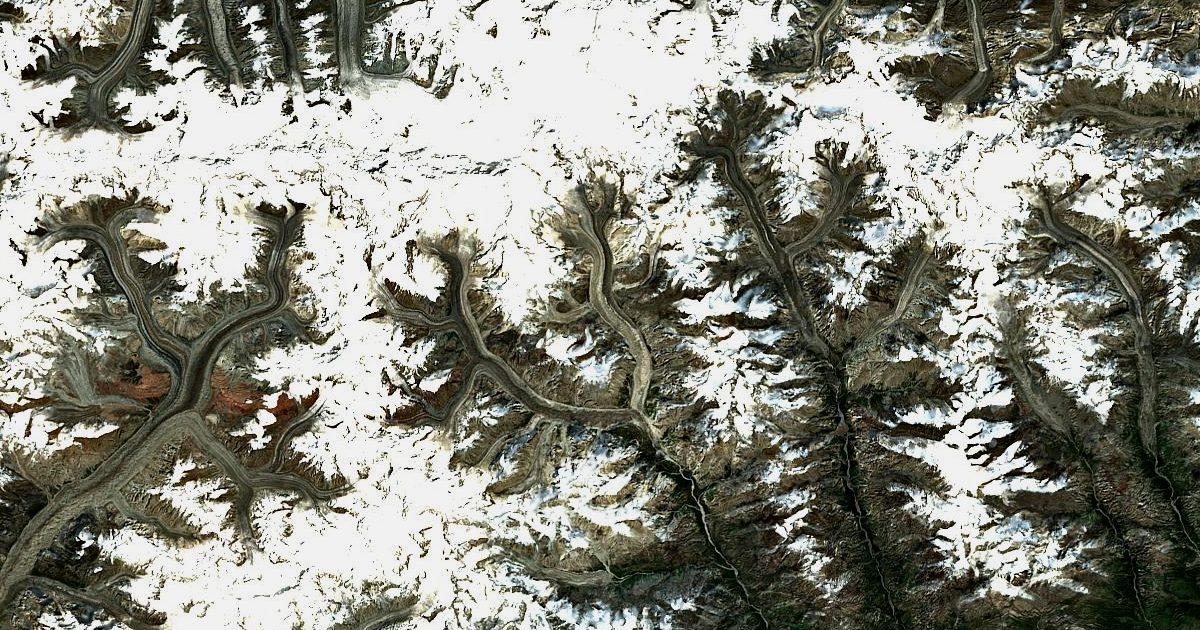
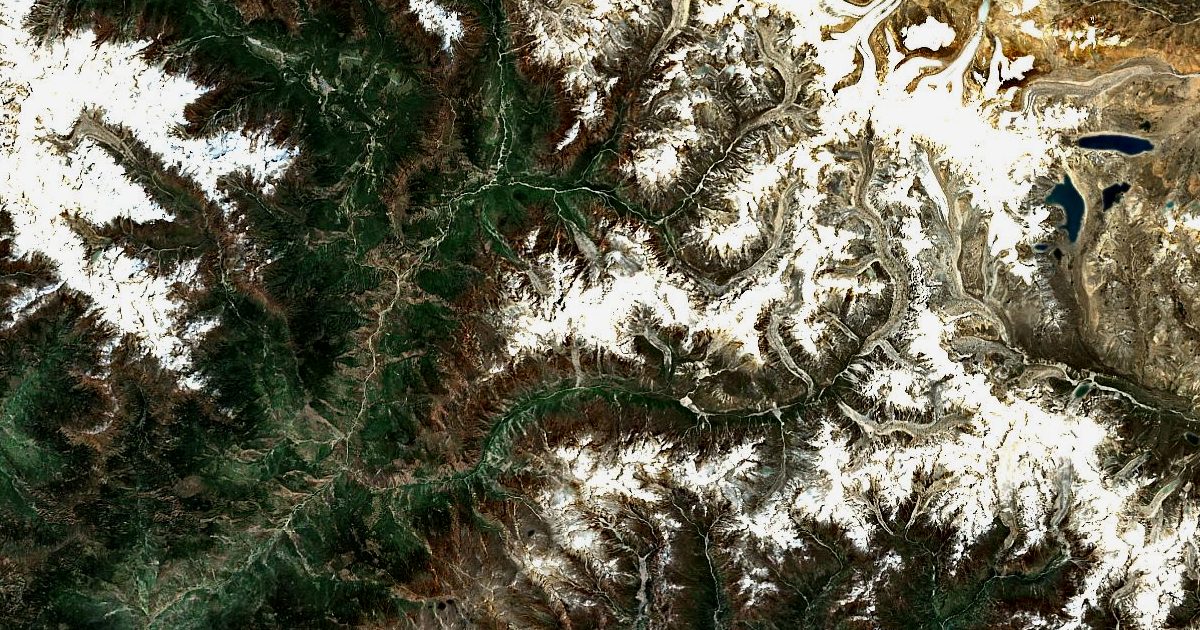
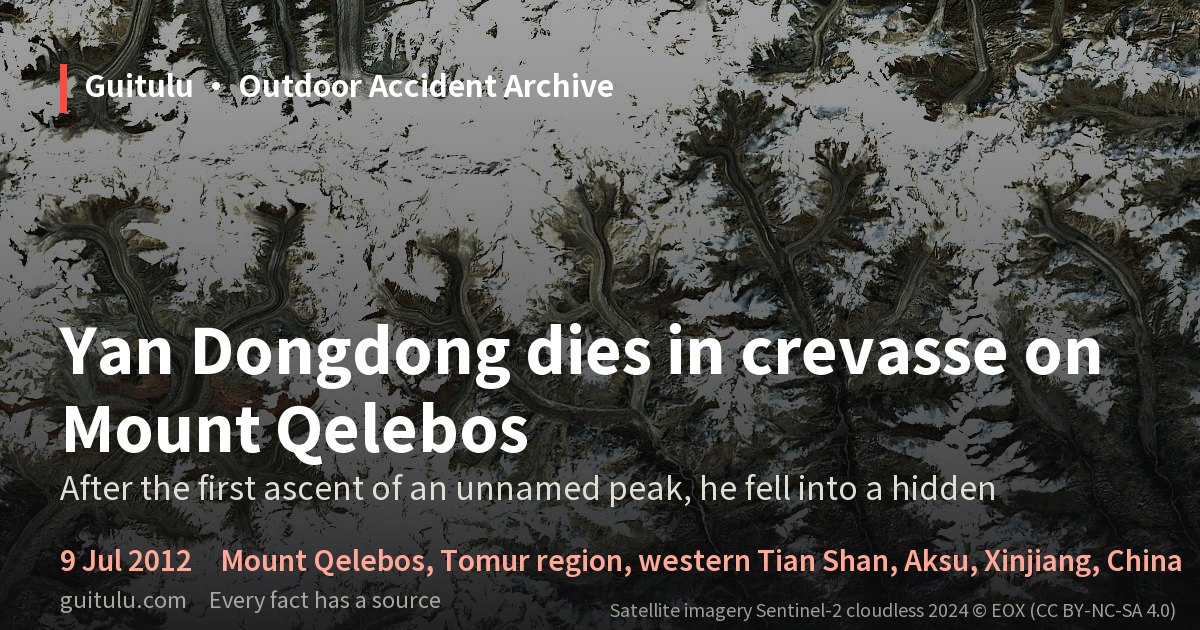
Satellite view of the area around Mount Qelebos, Tomur region, western Tian Shan, Aksu, Xinjiang, China

Archive / Mountaineering

Yan Dongdong dies in crevasse on Mount Qelebos

After the first ascent of an unnamed peak, he fell into a hidden crevasse during the descent; his companions' rescue efforts were unsuccessful after more than five hours

Two teammates came out of the mountains on 12 July; Zhou Peng wrote an account of the accident

Satellite imagery Sentinel-2 cloudless 2024 © EOX (CC BY-NC-SA 4.0)

Date
Summer
Place
Mount Qelebos, Tomur region, western Tian Shan, Aksu, Xinjiang, ChinaChina › Xinjiang · Tian Shan80.266°E 41.966°N
Activity
MountaineeringInvolves: Crevasses and glaciers3 people (Yan Dongdong, Zhou Peng, Li Shuang)
Casualties
Dead 1 Yan Dongdong died after falling into a hidden crevasse; teammates Zhou Peng and Li Shuang descended on their own and were met and taken back to Aksu
Material
42 facts · 10 sources2 accounts differ and are shown side by side

01What happened

Yan Dongdong was a mountaineer who graduated from Tsinghua University. In 2008, he reached the summit of Mount Everest with the Olympic torch mountaineering team as a support team member. He later turned to lightweight, small-team alpine-style climbing and completed several new routes with Zhou Peng. In late June 2012, he arrived in Aksu with Zhou Peng and photographer Li Shuang, originally planning to climb Mount Qelebos in the Tomur region of the western Tian Shan.Facts it rests onF02Multiple sourcesYan Dongdong studied in Tsinghua University's Department of Biological Sciences and Biotechnology. While at university, he joined the mountaineering team and served as climbing team leader. After graduating in 2005, he continued to climb with the Tsinghua mountaineering team as a technical adviser.F04Multiple sourcesOn 8 May 2008, Yan Dongdong reached the summit of Everest as a support member of the Beijing Olympic torch relay mountaineering team, becoming the first Tsinghua student to summit Everest.F05Multiple sourcesIn 2009, Yan Dongdong and Zhou Peng opened a new route on the south face of Mount Siguniang, for which they received a Piolet d'Or honorary award.F09Multiple sourcesYan Dongdong, Zhou Peng and Li Shuang arrived in Aksu on 23 June 2012, originally planning to climb Mount Qelebos in the western Tian Shan (written by Zhou Peng as ‘Mount Quelebosi’).F38Multiple sourcesYan Dongdong advocated what he called “free mountaineering”, climbing technical peaks in small teams, travelling light and using an alpine style.F40Multiple sourcesLi Shuang was the photographer accompanying the climb; both Zhou Peng and Li Shuang were Yan Dongdong's longtime partners.

According to Zhou Peng's account, the three entered the mountains from the Xiaotailan coal mine in late June and established camps in stages in early July. After reconnaissance on 6 July, they abandoned their original plan and instead climbed an unnamed peak of approximately 5900 metres beside the route; they camped at 5300 metres and 5650 metres on 7 and 8 July respectively, and reached the summit on 9 July.Facts it rests onF10Single sourceOn 28 June, the three set out from Xiaotailan Coal Mine and arrived the following afternoon at base camp, set up in the Xiaotailan Coal Mine valley at an altitude of about 2500 meters.F13Single sourceAccording to Zhou Peng's account, from 2 to 5 July the three climbed in succession to Camps 1 through 4, at altitudes of 3000 metres, 3700 metres, 4300 metres and 4700 metres.F14Multiple sourcesAfter scouting on 6 July, the three abandoned their attempt on Mount Qelebos and instead chose to climb an unnamed peak beside the route. That night they camped at Camp 5 at 4400 metres.F16Multiple sourcesThe three climbed the unnamed peak by a snow and ice route on its northwest face, bivouacked at 5300 metres on 7 July, climbed onto the ridge and camped at 5650 metres on 8 July, and reached the summit on 9 July.

At approximately 17:30 on 9 July, the three descended to the 4400-metre camp. It began to snow at around 18:00, and they continued their descent after packing up camp. At approximately 18:15, Yan Dongdong fell into a hidden crevasse on the glacier. According to the American Alpine Journal and the British Mountaineering Council, he was not roped up when he fell, and fell more than 20 metres.Facts it rests onF17Multiple sourcesAfter reaching the summit on 9 July, the three descended back to the camp at 4400 metres at about 17:30. Snow began to fall at about 18:00, and they packed up the camp and continued their descent.F18Multiple sourcesAt about 18:15, shortly after setting out, Yan Dongdong fell into a hidden crevasse on the glacier at an altitude of about 4400 metres.F19Multiple sourcesAccording to AAJ and BMC, Yan Dongdong was not roped up when he fell more than 20 metres into the crevasse.

Zhou Peng immediately rappelled to the bottom of the crevasse and found Yan Dongdong wedged in the ice, soaked in glacial meltwater and largely unconscious. The two set up a pulley system to haul him out, during which Yan Dongdong fell another approximately 5 metres. According to Zhou Peng's account, after 22:00 he no longer responded to calls; at approximately 23:30, the rope sheath wore through, the rescue device failed, and the two were physically exhausted and forced to stop the rescue.Facts it rests onF20Multiple sourcesZhou Peng immediately rappelled to the bottom of the crevasse and found Yan Dongdong wedged in the ice, soaked in icy water and largely unconscious from the impact.F22Multiple sourcesWhile they were hauling him up, Yan Dongdong fell another approximately 5 metres into an area of pooled water.F24Multiple sourcesZhou Peng descended into the crevasse again and tied a rope to Yan Dongdong, then climbed out and continued hauling, but was unable to pull him out.F25Single sourceAccording to Zhou Peng's account, after 22:00 Yan Dongdong no longer responded to their calls, but they continued the rescue effort.F26Multiple sourcesAt about 23:30, the sheath of the rescue rope wore through and the rescue device could no longer work. The two were also exhausted and were forced to stop the rescue.

Zhou Peng and Li Shuang bivouacked beside the crevasse that night and descended at 11:00 the following day. On the afternoon of 11 July, they contacted the Chinese Mountaineering Association using the satellite phone at the advanced base camp; the association subsequently made the news public. On 12 July, rescue personnel met the two at base camp and took them back to Aksu. A briefing on the mountaineering accident was held on 13 July.Facts it rests onF28Multiple sourcesThat night Zhou Peng and Li Shuang bivouacked beside the crevasse. Because the main rope was no longer usable, they did not have the equipment to descend to the bottom of the crevasse again to check on Yan Dongdong.F30Multiple sourcesOn the morning of 10 July, the two called out to Yan Dongdong repeatedly but still received no response. At 11:00 they stopped the rescue effort completely and descended, bivouacking at 3300 metres that day.F31Multiple sourcesAt around 15:00 on 11 July, the two descended to advanced base camp and used the satellite phone stored there to contact Ma Xinxiang of the Chinese Mountaineering Association. They returned to base camp that evening.F32Multiple sourcesOn the afternoon of 11 July, Ma Xinxiang, director of the Chinese Mountaineering Association's training department, posted news of Yan Dongdong's death on Weibo.F33Multiple sourcesRescuers from the Xinjiang Mountaineering Management Center and the China Mountaineering Management Center entered the mountains from Xiaotailan Coal Mine on 12 July. At about 16:00, they met Zhou Peng and Li Shuang at base camp and took them back to Aksu.F37Single sourceA briefing on the mountain accident was held in Aksu on 13 July. Zhou Peng described what had happened, and Yan Dongdong's father expressed trust in and approval of Zhou Peng's actions in his remarks.

The number at the end of a paragraph is how many facts it rests on; open it to see each fact and how well it is sourced: Multiple sourcesSingle source. Conflicting accounts and speculation are kept out of the narrative.

  • Reported locations along the route (schematic)Schematic

Satellite imagery Sentinel-2 cloudless 2024 © EOX · Terrain AWS Terrain Tiles · Orange line is schematic · Place coordinates not individually verified

Route review

6 scenes to understand what happened

Scroll down and the map flies to where each part happened. The line is Schematic, Lines connect the locations mentioned in reports in sequence, showing only the approximate direction, not the actual track.

01

Full route

Locations mentioned in reports are connected in sequence to show the approximate route (schematic).

03

Entering the mountains and establishing camp

They set out from the Xiaotailan coal mine on 28 June and reached base camp the next day.Facts it rests onF10Single sourceOn 28 June, the three set out from Xiaotailan Coal Mine and arrived the following afternoon at base camp, set up in the Xiaotailan Coal Mine valley at an altitude of about 2500 meters.F13Single sourceAccording to Zhou Peng's account, from 2 to 5 July the three climbed in succession to Camps 1 through 4, at altitudes of 3000 metres, 3700 metres, 4300 metres and 4700 metres.

04

Change to an unnamed peak

On 6 July, they abandoned the original plan and changed to an unnamed peak beside the route, reaching its summit on 9 July.Facts it rests onF14Multiple sourcesAfter scouting on 6 July, the three abandoned their attempt on Mount Qelebos and instead chose to climb an unnamed peak beside the route. That night they camped at Camp 5 at 4400 metres.F16Multiple sourcesThe three climbed the unnamed peak by a snow and ice route on its northwest face, bivouacked at 5300 metres on 7 July, climbed onto the ridge and camped at 5650 metres on 8 July, and reached the summit on 9 July.

05

Fall into a crevasse during descent

At about 18:15 during the descent, Yan Dongdong fell into a hidden crevasse on the glacier at 4400 meters.Facts it rests onF17Multiple sourcesAfter reaching the summit on 9 July, the three descended back to the camp at 4400 metres at about 17:30. Snow began to fall at about 18:00, and they packed up the camp and continued their descent.F18Multiple sourcesAt about 18:15, shortly after setting out, Yan Dongdong fell into a hidden crevasse on the glacier at an altitude of about 4400 metres.

02Timeline

  1. Yan Dongdong, Zhou Peng and Li Shuang arrived in Aksu on 23 June 2012, originally planning to climb Mount Qelebos in the western Tian Shan (written by Zhou Peng as ‘Mount Quelebosi’). F09

  2. After scouting on 6 July, the three abandoned their attempt on Mount Qelebos and instead chose to climb an unnamed peak beside the route. That night they camped at Camp 5 at 4400 metres. F14

  3. After reaching the summit on 9 July, the three descended back to the camp at 4400 metres at about 17:30. Snow began to fall at about 18:00, and they packed up the camp and continued their descent. F17

  4. The three climbed the unnamed peak by a snow and ice route on its northwest face, bivouacked at 5300 metres on 7 July, climbed onto the ridge and camped at 5650 metres on 8 July, and reached the summit on 9 July. F16

  5. At about 18:15, shortly after setting out, Yan Dongdong fell into a hidden crevasse on the glacier at an altitude of about 4400 metres. F18

  6. Zhou Peng immediately rappelled to the bottom of the crevasse and found Yan Dongdong wedged in the ice, soaked in icy water and largely unconscious from the impact. F20

  7. While they were hauling him up, Yan Dongdong fell another approximately 5 metres into an area of pooled water. F22

  8. At about 23:30, the sheath of the rescue rope wore through and the rescue device could no longer work. The two were also exhausted and were forced to stop the rescue. F26

  9. On the morning of 10 July, the two called out to Yan Dongdong repeatedly but still received no response. At 11:00 they stopped the rescue effort completely and descended, bivouacking at 3300 metres that day. F30

  10. On the afternoon of 11 July, Ma Xinxiang, director of the Chinese Mountaineering Association's training department, posted news of Yan Dongdong's death on Weibo. F32

  11. At around 15:00 on 11 July, the two descended to advanced base camp and used the satellite phone stored there to contact Ma Xinxiang of the Chinese Mountaineering Association. They returned to base camp that evening. F31

  12. Rescuers from the Xinjiang Mountaineering Management Center and the China Mountaineering Management Center entered the mountains from Xiaotailan Coal Mine on 12 July. At about 16:00, they met Zhou Peng and Li Shuang at base camp and took them back to Aksu. F33

  13. A briefing on the mountain accident was held in Aksu on 13 July. Zhou Peng described what had happened, and Yan Dongdong's father expressed trust in and approval of Zhou Peng's actions in his remarks. F37

03Lessons

Teams and decisions

Hidden crevasses remain a danger during glacier descents

The accident occurred during the descent after the summit, on the glacier near the 4400-metre camp. According to reports, Yan Dongdong was not roped up when he fell into a hidden crevasse covered by snow. The way climbers travel on glaciers requires the same careful attention at camp and during descent.Facts it rests onF18Multiple sourcesAt about 18:15, shortly after setting out, Yan Dongdong fell into a hidden crevasse on the glacier at an altitude of about 4400 metres.F19Multiple sourcesAccording to AAJ and BMC, Yan Dongdong was not roped up when he fell more than 20 metres into the crevasse.

Weather and retreat

Descending in deteriorating weather

It was already evening when the three returned to camp after reaching the summit. Snow began falling shortly afterwards, and they continued their descent after packing up camp; the accident occurred soon afterwards. Evening and snowfall can make the ground harder to discern, making it worthwhile to allow more margin in the timing and route of a descent.Facts it rests onF17Multiple sourcesAfter reaching the summit on 9 July, the three descended back to the camp at 4400 metres at about 17:30. Snow began to fall at about 18:00, and they packed up the camp and continued their descent.F18Multiple sourcesAt about 18:15, shortly after setting out, Yan Dongdong fell into a hidden crevasse on the glacier at an altitude of about 4400 metres.

Rescue and self-rescue

Companion rescue is limited by equipment and physical endurance

According to Zhou Peng's account, the rescue continued until around 23:30, when the rope wore through, the device failed and the two were physically exhausted. Ma Xinxiang said that continuing the rescue without effective equipment and while physically exhausted would also put the other two in danger. Rescue capability is inherently limited when a small team climbs light.Facts it rests onF20Multiple sourcesZhou Peng immediately rappelled to the bottom of the crevasse and found Yan Dongdong wedged in the ice, soaked in icy water and largely unconscious from the impact.F22Multiple sourcesWhile they were hauling him up, Yan Dongdong fell another approximately 5 metres into an area of pooled water.F26Multiple sourcesAt about 23:30, the sheath of the rescue rope wore through and the rescue device could no longer work. The two were also exhausted and were forced to stop the rescue.F35Single sourceAccording to Beijing Youth Daily, Ma Xinxiang confirmed that Zhou Peng's article had indeed been written by Zhou himself, and said that if the rescue had not been stopped, the other two would also have been at risk of losing their lives.

Communication and location

Satellite phone carries news out of the mountains

Only after descending to the advanced base camp did the two use the satellite phone stored there to contact the Chinese Mountaineering Association. News of the accident was made public on 11 July. In mountain areas without signal, carrying communications equipment and keeping it ready for use can shorten the time needed to call for help.Facts it rests onF31Multiple sourcesAt around 15:00 on 11 July, the two descended to advanced base camp and used the satellite phone stored there to contact Ma Xinxiang of the Chinese Mountaineering Association. They returned to base camp that evening.F32Multiple sourcesOn the afternoon of 11 July, Ma Xinxiang, director of the Chinese Mountaineering Association's training department, posted news of Yan Dongdong's death on Weibo.

04Fact list 42 facts

Under each fact is a verbatim quote from the original. "Single source" means only one outlet mentioned it; "Accounts differ" means sources contradict each other and this site adopts neither side; "Speculation" is an inference by a reporter or a person involved, not a fact.

  1. F01Multiple sourcesBackground

    Yan Dongdong was born on 16 November 1984 in Anshan, Liaoning.

    Quotes from the original 2

    “严冬冬,1984年11月16生于辽宁鞍山”

    Yan Dongdong was born on 16 November 1984 in Anshan, Liaoning (machine translation)

    Oriental Morning Post · 2012-07-13

    “Yan Dongdong was born on November 16, 1984 in Anshan city, Liaoning Province, China.”

    Alpinist · 2012-07-25
  2. F02Multiple sourcesBackground

    Yan Dongdong studied in Tsinghua University's Department of Biological Sciences and Biotechnology. While at university, he joined the mountaineering team and served as climbing team leader. After graduating in 2005, he continued to climb with the Tsinghua mountaineering team as a technical adviser.

    Quotes from the original 2

    “严冬冬考入清华后不久便加入登山队,还担任过攀登队队长。2005年毕业后仍以技术指导身份和清华登山队一起攀登。”

    Soon after entering Tsinghua, Yan Dongdong joined the mountaineering team and also served as climbing team leader. After graduating in 2005, he continued to climb with the Tsinghua mountaineering team as a technical adviser. (machine translation)

    The Beijing News · 2012-07-13

    “After graduating in 2005 Dongdong continued to work for the Tsinghua mountaineering team as technical advisor”

    Alpinist · 2012-07-25
  3. F03Single sourceBackground

    According to AAJ, According to AAJ, Yan Dongdong later called the Everest torch ascent his worst experience in the mountains, and the experience prompted him to turn to alpine-style climbing.

    Quotes from the original 1

    “This experience, which he later called his worst ever in the mountains, contributed to his embracing alpine-style climbing.”

    AAJ · 2013
  4. F04Multiple sourcesBackground

    On 8 May 2008, Yan Dongdong reached the summit of Everest as a support member of the Beijing Olympic torch relay mountaineering team, becoming the first Tsinghua student to summit Everest.

    Quotes from the original 2

    “2008年5月8日,北京奥运圣火成功登顶珠峰,严冬冬作为登山队后援队员随队登顶,成为首位成功登顶珠峰的清华学子。”

    On 8 May 2008, the Beijing Olympic flame successfully reached the summit of Everest. Yan Dongdong reached the summit with the mountaineering team as a support member, becoming the first Tsinghua student to successfully summit Everest. (machine translation)

    The Beijing News · 2012-07-13

    “In 2008 he was given the opportunity to participate in China’s Mt. Everest Olympic torch climb, summiting on May 8.”

    Alpinist · 2012-07-25
  5. F05Multiple sourcesBackground

    In 2009, Yan Dongdong and Zhou Peng opened a new route on the south face of Mount Siguniang, for which they received a Piolet d'Or honorary award.

    Quotes from the original 2

    “For the Siguniang climb, he and Zhou were awarded an honorary Piolet d’Or”

    AAJ · 2013

    “Only two weeks later Yan joined Zhou Peng in the Siguniang National Park to make mountaineering history.”

    BMC · 2012-07
  6. F06Multiple sourcesBackground

    In 2011, Yan Dongdong and Zhou Peng completed a new route on the west face of Mount Jiazi, winning the 2011 Golden Rhino Award for Best Ascent.

    Quotes from the original 2

    “并凭借与周鹏一起完成嘉子峰西壁新路线登顶而获得2011年度 中国户外金犀牛奖 最佳攀登奖。”

    And for reaching the summit via a new route on the west face of Mount Jiazi completed together with Zhou Peng, he received the 2011 China Outdoor Golden Rhino Award for Best Ascent. (machine translation)

    Metropolitan Times · 2012-07-13

    “However, the highlight of the trip was the much acclaimed Liberal Dance on the west face of Jiazi (6,540m) by Yan and Zhou.”

    BMC · 2012-07
  7. F07Multiple sourcesBackground

    In 2012, Yan Dongdong and Zhou Peng received the Mugs Stump Award.

    Quotes from the original 2

    “this year both Yan and Zhou gained a Mugs Stump Award”

    BMC · 2012-07

    “a recipient of this year’s Mugs Stump Award”

    Alpinist · 2012-07-13
  8. F08Multiple sourcesBackground

    On 28 April 2012, Yan Dongdong published a ‘Disclaimer’ on his blog, stating that if he were injured or died while mountaineering for reasons not deliberately caused by himself or his companions, his companions should not be held responsible.

    Quotes from the original 2

    “今年4月28日,他在搜狐博客上发表了一篇《免责宣言》,这也是他的最后一篇博文。”

    On 28 April this year, he published a ‘Disclaimer’ on his Sohu blog, which was also his last blog post. (machine translation)

    The Beijing News · 2012-07-13

    “今年4月份,严冬冬在自己的个人微博(@自由登山)中发布了一条免责宣言,以免将来自己不幸遇难后搭档受到外界舆论的压力。”

    In April this year, Yan Dongdong posted a liability disclaimer on his personal Weibo account (@自由登山), so that his climbing partners would not face pressure from public opinion if he were to die in an accident in the future. (machine translation)

    Metropolitan Times · 2012-07-13
  9. F09Multiple sourcesPlan

    Yan Dongdong, Zhou Peng and Li Shuang arrived in Aksu on 23 June 2012, originally planning to climb Mount Qelebos in the western Tian Shan (written by Zhou Peng as ‘Mount Quelebosi’).

    Quotes from the original 2

    “我、严冬冬、李爽一行三人于6月23号到达阿克苏,原计划攀登西天山却勒博斯峰。”

    The three of us, Yan Dongdong, Li Shuang and I, arrived in Aksu on 23 June, originally planning to climb Mount Quelebosi in the western Tian Shan. (machine translation)

    Zhou Peng's account · 2012-07-13

    “Yan planned to make the first ascent of Chulebos (6,769m)”

    AAJ · 2013
  10. F10Single sourceMovement

    According to Zhou Peng's account, On 28 June, the three set out from Xiaotailan Coal Mine and arrived the following afternoon at base camp, set up in the Xiaotailan Coal Mine valley at an altitude of about 2500 meters.

    Quotes from the original 1

    “6月28号我们三人从小台兰煤矿出发,于次日下午到达此次登山的大本营。大本营设在小台兰煤矿河谷,海拔约2500米。”

    On 28 June, the three of us set out from Xiaotailan Coal Mine and arrived at the base camp for this climb the following afternoon. The base camp was set up in the Xiaotailan Coal Mine valley, at an altitude of about 2500 meters. (machine translation)

    Zhou Peng's account · 2012-07-13
  11. F11Accounts differEvent

    Accounts differ on the date of the accident: most sources say 9 July; a BMC report gives 10 July.

    Teammate Zhou Peng's account explicitly states that the fall happened on 9 July, the day of the summit

    Quotes from the original 3

    “At 6:15pm on the 10th July the three had descended to 4,400m”

    BMC · 2012-07

    “7月9号登顶”

    Reached the summit on 9 July (machine translation)

    Zhou Peng's account · 2012-07-13

    “On July 9 the internationally recognized Chinese alpinist Yan Dongdong was killed in a crevasse fall”

    AAJ · 2013
  12. F12Single sourceAftermath

    According to Metropolitan Times, Yan Dongdong's death prompted discussion online about the meaning of mountaineering, with some questioning it and more expressing support.

    Quotes from the original 1

    “虽然网络上大多数人都非常钦佩严冬冬敢于追求自己所热爱的生活的勇气,但也有一些不理解的声音”

    Although most people online greatly admired Yan Dongdong's courage to pursue the life he loved, there were also some voices that did not understand (machine translation)

    Metropolitan Times · 2012-07-13
  13. F13Single sourceMovement

    According to Zhou Peng's account, According to Zhou Peng's account, from 2 to 5 July the three climbed in succession to Camps 1 through 4, at altitudes of 3000 metres, 3700 metres, 4300 metres and 4700 metres.

    Quotes from the original 2

    “7月5号攀登至海拔4700米的4号营地”

    On 5 July, climbed to Camp 4 at an altitude of 4700 metres (machine translation)

    Zhou Peng's account · 2012-07-13

    “7月2号从大本营出发,直接上到海拔3000米的1号营地。”

    On 2 July, we set out from base camp and went straight up to Camp 1 at an altitude of 3000 metres. (machine translation)

    Zhou Peng's account · 2012-07-13
  14. F14Multiple sourcesMovement

    After scouting on 6 July, the three abandoned their attempt on Mount Qelebos and instead chose to climb an unnamed peak beside the route. That night they camped at Camp 5 at 4400 metres.

    Quotes from the original 2

    “7月6号经过侦查后,放弃攀登却勒博斯峰的原计划,改为攀登路线边的5900米未名峰。当日晚在4400米处5号营地宿营”

    After scouting on 6 July, we abandoned the original plan to climb Mount Qelebos and instead climbed an unnamed 5900-metre peak beside the route. That evening we camped at Camp 5 at 4400 metres (machine translation)

    Zhou Peng's account · 2012-07-13

    “it appears they could find no safe route on this mountain and settled for a different, lower summit”

    BMC · 2012-07
  15. F15Single sourceFound at scene

    According to AAJ, According to AAJ, the three explored two passes and found broken slopes and a glacier riddled with crevasses below, with another 12 to 15 kilometres to Mount Qelebos.

    Quotes from the original 1

    “found themselves looking down dangerously broken slopes to further long and crevassed glaciers draining north, still some 12 to 15km distant from Chulebos”

    AAJ · 2013
  16. F16Multiple sourcesMovement

    The three climbed the unnamed peak by a snow and ice route on its northwest face, bivouacked at 5300 metres on 7 July, climbed onto the ridge and camped at 5650 metres on 8 July, and reached the summit on 9 July.

    Quotes from the original 2

    “7月8号翻上山脊,在5650米处露营”

    On 8 July, climbed onto the ridge and camped at 5650 metres (machine translation)

    Zhou Peng's account · 2012-07-13

    “They spent a full day pioneering a route up snow and ice on the northwest face, and after a bivouac on the summit ridge they reached the top and descended.”

    AAJ · 2013
  17. F17Multiple sourcesMovement

    After reaching the summit on 9 July, the three descended back to the camp at 4400 metres at about 17:30. Snow began to fall at about 18:00, and they packed up the camp and continued their descent.

    Quotes from the original 2

    “17点30分左右下撤至4400米营地。18点左右开始下雪,我们再次出发下撤。”

    At around 17:30, we descended to the camp at 4400 metres. At around 18:00, it began to snow, and we set off again to descend. (machine translation)

    Zhou Peng's account · 2012-07-13

    “They quickly packed up that camp and then continued to descend as it started to snow.”

    Alpinist · 2012-07-25
  18. F18Multiple sourcesEvent

    At about 18:15, shortly after setting out, Yan Dongdong fell into a hidden crevasse on the glacier at an altitude of about 4400 metres.

    Quotes from the original 3

    “出发不久(18点15分左右),严冬冬不幸坠入暗冰裂缝。”

    Shortly after setting out (at around 18:15), Yan Dongdong unfortunately fell into a hidden crevasse. (machine translation)

    Zhou Peng's account · 2012-07-13

    “At 6:15 p.m. the three had reached 4,400m and had packed up their camp.”

    AAJ · 2013

    “4400米左右高度的冰川上,冬冬掉入很深的暗裂缝被卡住”

    On the glacier at an altitude of around 4400 metres, Dongdong fell into a very deep hidden crevasse and became wedged (machine translation)

    The Beijing News · 2012-07-13
  19. F19Multiple sourcesEvent

    According to AAJ and BMC, Yan Dongdong was not roped up when he fell more than 20 metres into the crevasse.

    Quotes from the original 2

    “Only 100m down the glacier, Yan fell unroped more than 20m into a hidden crevasse.”

    AAJ · 2013

    “Yan fell unroped more than 20m into a hidden crevasse”

    BMC · 2012-07
  20. F20Multiple sourcesEvent

    Zhou Peng immediately rappelled to the bottom of the crevasse and found Yan Dongdong wedged in the ice, soaked in icy water and largely unconscious from the impact.

    Quotes from the original 2

    “严冬冬坠落后被卡在冰缝,并被冰水浸透,又因为坠落时的撞击,大部分意识也已经失去。”

    After falling, Yan Dongdong was wedged in the crevasse and soaked in icy water, and because of the impact of the fall, he had also largely lost consciousness. (machine translation)

    Zhou Peng's account · 2012-07-13

    “Zhou lowered a rope and climbed down, finding Yan to be badly injured and drifting in and out of consciousness.”

    AAJ · 2013
  21. F21Single sourceEvent

    According to AAJ, According to AAJ, Zhou Peng helped Yan Dongdong remove his backpack, freed him from where he was wedged and attached him to a rope, then climbed out of the crevasse to set up a pulley system.

    Quotes from the original 1

    “Zhou helped to remove Yan’s pack, unwedged him, clipped him into a rope, and then climbed out to set up a pulley system.”

    AAJ · 2013
  22. F22Multiple sourcesEvent

    While they were hauling him up, Yan Dongdong fell another approximately 5 metres into an area of pooled water.

    Quotes from the original 2

    “he fell a further five meters into a pool of water”

    AAJ · 2013

    “in the process Yan fell a further five metres into a pool of water”

    BMC · 2012-07
  23. F23Single sourceEvent

    According to AAJ, According to AAJ, Yan Dongdong appeared to panic before falling again; he shouted and gathered in the rope.

    Quotes from the original 1

    “However, Yan apparently began to panic, shouting and gathering up the rope”

    AAJ · 2013
  24. F24Multiple sourcesEvent

    Zhou Peng descended into the crevasse again and tied a rope to Yan Dongdong, then climbed out and continued hauling, but was unable to pull him out.

    Quotes from the original 2

    “Zhou descended again and managed to attach another rope to Yan, who was now unconscious and breathing poorly.”

    AAJ · 2013

    “Zhou descended and managed to get the rope attached to Yan, then climbed out. However, his efforts to extract Yan were to no avail”

    BMC · 2012-07
  25. F25Single sourceEvent

    According to Zhou Peng's account, According to Zhou Peng's account, after 22:00 Yan Dongdong no longer responded to their calls, but they continued the rescue effort.

    Quotes from the original 1

    “22时以后,严冬冬对我们的呼叫已无任何反应。但我们仍然继续施救”

    After 22:00, Yan Dongdong no longer responded at all to our calls. But we continued the rescue effort (machine translation)

    Zhou Peng's account · 2012-07-13
  26. F26Multiple sourcesEvent

    At about 23:30, the sheath of the rescue rope wore through and the rescue device could no longer work. The two were also exhausted and were forced to stop the rescue.

    Quotes from the original 2

    “持续至23时30分左右,救援的绳索绳皮磨破,救援装置无法工作,此时我们的体力也已经完全透支。”

    This continued until around 23:30, when the sheath of the rescue rope wore through and the rescue device could no longer work. By then, our strength was also completely exhausted. (machine translation)

    Zhou Peng's account · 2012-07-13

    “Near midnight they were forced to give up the arduous rescue attempt as the rope was worn through and the two of them were completely exhausted.”

    Alpinist · 2012-07-25
  27. F27Single sourceEvent

    According to Zhou Peng's account, According to Zhou Peng's account, heavy snow continued throughout the rescue and eased slightly only at around midnight, 24:00.

    Quotes from the original 1

    “救援期间,大雪一直持续,直至午夜24时左右大雪稍弱。”

    During the rescue, the heavy snow continued, until it eased slightly at around midnight, 24:00. (machine translation)

    Zhou Peng's account · 2012-07-13
  28. F28Multiple sourcesEvent

    That night Zhou Peng and Li Shuang bivouacked beside the crevasse. Because the main rope was no longer usable, they did not have the equipment to descend to the bottom of the crevasse again to check on Yan Dongdong.

    Quotes from the original 2

    “因为主绳已无法使用,我们没有任何装备可以支撑重新下降至冰裂缝底部观察严冬冬的生命状态。”

    Because the main rope was no longer usable, we had no equipment that would allow us to descend again to the bottom of the crevasse to check Yan Dongdong's vital signs. (machine translation)

    Zhou Peng's account · 2012-07-13

    “Zhou and Li dug a small shelter next to the crevasse and waited out the night.”

    BMC · 2012-07
  29. F29Accounts differFound at scene

    Accounts differ on when Yan Dongdong died: BMC says he died at about 23:00; AAJ says the two heard no sound the following day and concluded that he had died of his injuries during the night.

    Quotes from the original 2

    “Chinese mountaineer died at around 11:00pm”

    BMC · 2012-07

    “surmised that the Chinese mountaineer had died during the night from his injuries”

    AAJ · 2013
  30. F30Multiple sourcesMovement

    On the morning of 10 July, the two called out to Yan Dongdong repeatedly but still received no response. At 11:00 they stopped the rescue effort completely and descended, bivouacking at 3300 metres that day.

    Quotes from the original 2

    “7月10日早上,我们多次和严冬冬交流,仍然无任何回应。11时,我们完全停止营救,向下撤离。”

    On the morning of 10 July, we tried repeatedly to communicate with Yan Dongdong, but there was still no response. At 11:00, we stopped the rescue completely and descended. (machine translation)

    Zhou Peng's account · 2012-07-13

    “As there was no response from Dongdong the following morning and the two descended off the mountain.”

    Alpinist · 2012-07-25
  31. F31Multiple sourcesMovement

    At around 15:00 on 11 July, the two descended to advanced base camp and used the satellite phone stored there to contact Ma Xinxiang of the Chinese Mountaineering Association. They returned to base camp that evening.

    Quotes from the original 2

    “拿到存放在前进营地的卫星电话后,立刻和马欣祥沟通了山上的情况。傍晚回到大本营。”

    After retrieving the satellite phone stored at advanced base camp, we immediately spoke with Ma Xinxiang about the situation on the mountain. We returned to base camp that evening. (machine translation)

    Zhou Peng's account · 2012-07-13

    “where they were able to transmit the tragic news by telephone”

    BMC · 2012-07
  32. F32Multiple sourcesAftermath

    On the afternoon of 11 July, Ma Xinxiang, director of the Chinese Mountaineering Association's training department, posted news of Yan Dongdong's death on Weibo.

    Quotes from the original 3

    “11日15时23分,中国登山协会培训部部长马欣祥发微博称”

    At 15:23 on the 11th, Ma Xinxiang, director of the Chinese Mountaineering Association's training department, posted on Weibo that (machine translation)

    The Beijing News · 2012-07-13

    “7月11日下午,中国登山协会培训部部长马欣祥发出这样一条微博”

    On the afternoon of 11 July, Ma Xinxiang, director of the Chinese Mountaineering Association's training department, posted the following message on Weibo (machine translation)

    Oriental Morning Post · 2012-07-13

    “7月11日,中国登山协会培训部部长马欣祥在微博上证实了严冬冬遇难的噩耗。”

    On 11 July, Ma Xinxiang, director of the Chinese Mountaineering Association's training department, confirmed the tragic news of Yan Dongdong's death on Weibo. (machine translation)

    Metropolitan Times · 2012-07-13
  33. F33Multiple sourcesAftermath

    Rescuers from the Xinjiang Mountaineering Management Center and the China Mountaineering Management Center entered the mountains from Xiaotailan Coal Mine on 12 July. At about 16:00, they met Zhou Peng and Li Shuang at base camp and took them back to Aksu.

    Quotes from the original 2

    “12日早上从托木尔地区切勒薄斯峰山口小台蓝煤矿处入山,于16时许在登山大本营接应上周鹏与李爽。”

    On the morning of the 12th, they entered the mountains from Xiaotailan Coal Mine at the entrance to Mount Qelebos in the Tomur region, and at about 16:00 met Zhou Peng and Li Shuang at the mountaineering base camp. (machine translation)

    The Beijing News · 2012-07-13

    “7月12号,从大本营出山到达小台兰煤矿,由接应人员接回阿克苏。”

    On 12 July, we came out of the mountains from base camp and reached Xiaotailan Coal Mine, where personnel sent to meet us took us back to Aksu. (machine translation)

    Zhou Peng's account · 2012-07-13
  34. F34Single sourceAftermath

    According to The Beijing News, According to The Beijing News, Hu Wenshan, director of the Xinjiang Mountaineering Management Center, said the two teammates were in good physical condition but mentally exhausted.

    Quotes from the original 1

    “目前,周鹏、李爽身体状况良好,但“失去队友的打击使得他们精神极度疲惫。””

    At present, Zhou Peng and Li Shuang are in good physical condition, but “the shock of losing their teammate has left them mentally exhausted.” (machine translation)

    The Beijing News · 2012-07-13
  35. F35Single sourcePost-incident analysis

    According to Beijing Youth Daily, According to Beijing Youth Daily, Ma Xinxiang confirmed that Zhou Peng's article had indeed been written by Zhou himself, and said that if the rescue had not been stopped, the other two would also have been at risk of losing their lives.

    Quotes from the original 1

    “他说停止救援的原因在文中写得很清楚,在没有有效装备且体力透支的情况下,如果不停止救援的话,另外两人也会有生命危险。”

    He said the reason for stopping the rescue was written very clearly in the article: without effective equipment and with their physical strength depleted, if they had not stopped the rescue, the other two would also have been at risk of losing their lives. (machine translation)

    Beijing Youth Daily · 2012-07-14
  36. F36Single sourceParticipant's view

    According to Beijing Youth Daily, Wang Yongfeng, captain of the Chinese mountaineering team, said he was not familiar with the circumstances at the time and could not comment, but that any rescue required rescuers first to have the ability to carry it out and to ensure their own safety.

    Quotes from the original 1

    “任何救援的原则,都要求救援队首先有救援能力、保证救援队的安全。”

    The principles of any rescue require that the rescue team first have the ability to carry out the rescue and ensure the safety of the rescue team. (machine translation)

    Beijing Youth Daily · 2012-07-14
  37. F37Single sourceAftermath

    According to Beijing Youth Daily, A briefing on the mountain accident was held in Aksu on 13 July. Zhou Peng described what had happened, and Yan Dongdong's father expressed trust in and approval of Zhou Peng's actions in his remarks.

    Quotes from the original 1

    “周鹏对山难进行了简单说明,冬冬父亲在发言时对周鹏的做法表示相信与认可。”

    Zhou Peng gave a brief account of the mountain accident, and Dongdong's father expressed trust in and approval of Zhou Peng's actions when he spoke. (machine translation)

    Beijing Youth Daily · 2012-07-14
  38. F38Multiple sourcesBackground

    Yan Dongdong advocated what he called “free mountaineering”, climbing technical peaks in small teams, travelling light and using an alpine style.

    Quotes from the original 2

    “Dongdong took up the cause of what he called free mountaineering”

    Alpinist · 2012-07-25

    “Yan and a group of friends began to attempt more technical ascents, as small parties, in alpine style.”

    BMC · 2012-07
  39. F39Multiple sourcesBackground

    Yan Dongdong translated English-language books for a living and translated mountaineering books including “Extreme Alpinism” and “Mountaineering: The Freedom of the Hills”.

    Quotes from the original 2

    “严冬冬毕业后,除了痴迷登山外,还是英语翻译高手,生前曾以翻译书籍为职业。”

    After graduating, Yan Dongdong was not only passionate about mountaineering but also highly skilled at English translation, and translated books for a living during his lifetime. (machine translation)

    The Beijing News · 2012-07-13

    “He also translated climbing books such as “Extreme Alpinism” and “The Mountaineering Handbook” into Chinese.”

    Alpinist · 2012-07-25
  40. F40Multiple sourcesBackground

    Li Shuang was the photographer accompanying the climb; both Zhou Peng and Li Shuang were Yan Dongdong's longtime partners.

    Quotes from the original 2

    “with two regular climbing partners, the accomplished Zhou Peng and filmmaker Li Shuang”

    AAJ · 2013

    “Dongdong, his climbing partner Zhou Peng and camera-woman Li Shuang”

    Alpinist · 2012-07-25
  41. F41Multiple sourcesPlan

    Mount Qelebos, at an altitude of 6769 metres, is the highest point on a ridge about 25 kilometres long west of the Xuelian Peak group. It had not previously been summited; Yan Dongdong intended to approach from the south.

    Quotes from the original 2

    “the highest point of a 25-kilometer unbroken crest immediately to the west of the Xuelian Massif”

    AAJ · 2013

    “Chulebos, which the three Chinese approached via the Muzart river to the south, was previously unvisited”

    BMC · 2012-07
  42. F42Single sourceAftermath

    According to AAJ, The peak summited by the three was later informally named “Yan Dongdong Peak”. AAJ records its altitude as approximately 5861 metres.

    Quotes from the original 1

    “The peak ascended by the three Chinese was subsequently given the unofficial name of Yan Dongdong Feng (5,861m, 42°03’15” N, 80°23’40” E).”

    AAJ · 2013