GuituluGlobal Outdoor Accident Archive 中文
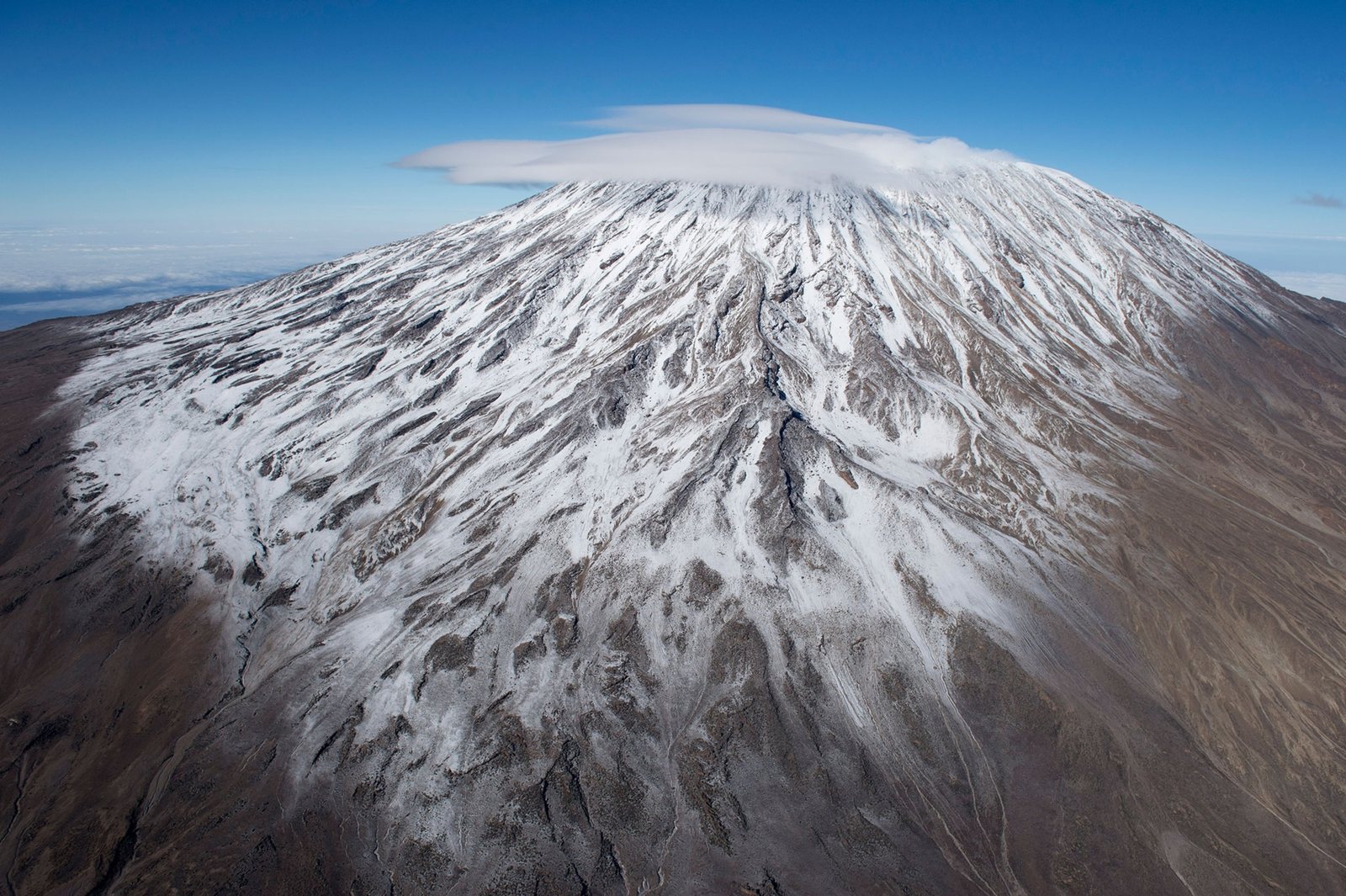
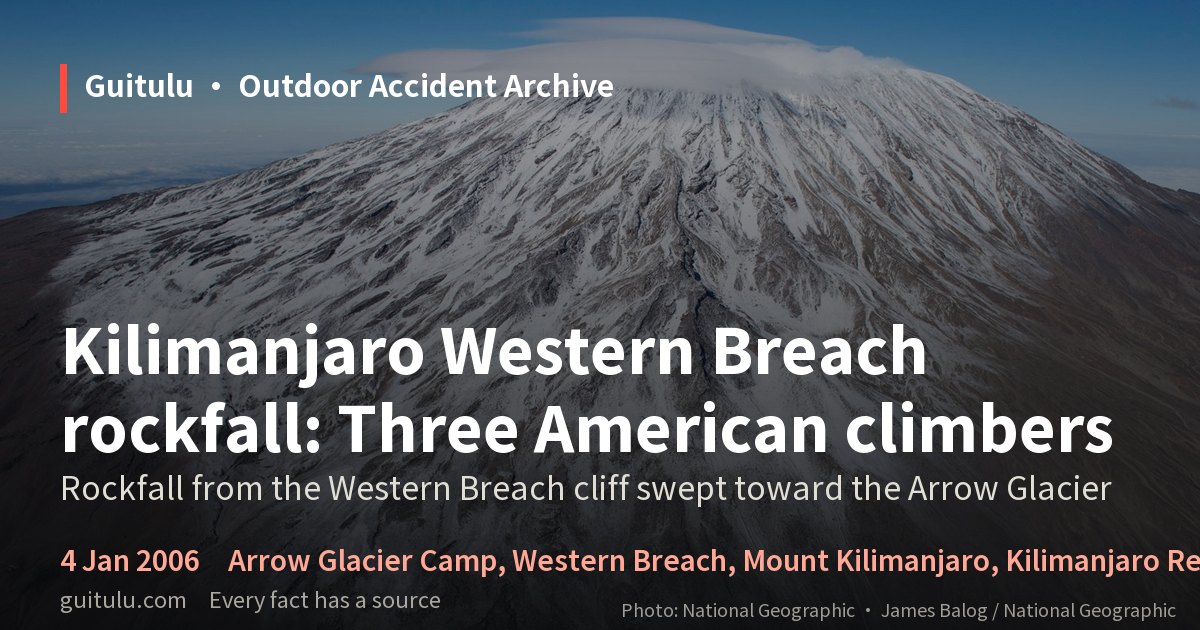
Aerial view of Kibo, Mount Kilimanjaro, with remaining glaciers on the summit (photographed around 2015)

Archive / Mountaineering

Kilimanjaro Western Breach rockfall: Three American climbers killed at Arrow Glacier Camp

Rockfall from the Western Breach cliff swept toward the Arrow Glacier Camp area, killing three American climbers

The Western Breach route was closed and investigated after the accident, and reopened in 2007.

Photo: National Geographic · James Balog / National Geographic

Date
January
Place
Arrow Glacier Camp, Western Breach, Mount Kilimanjaro, Kilimanjaro Region, TanzaniaTanzania › Kilimanjaro Region · Mount Kilimanjaro37.336°E -3.073°N
Activity
MountaineeringInvolves: Rockfall and collapseSeveral foreign climbing teams organized by multiple tour operators, along with local guides and porters
Casualties
Dead 3 Injured 5Three American climbers were killed; reports differ on the number seriously injured. AFP quoted the national park's acting chief warden as saying five people were seriously injured (one American and four Tanzanians), while several porters sustained minor injuries.
Material
33 facts · 9 sources3 accounts differ and are shown side by side

01What happened

Around 31 December 2005, climbing parties organised by several tour operators set out along the Umbwe Route, taking several days to reach Arrow Glacier Camp below Kilimanjaro's Western Breach. Climbers on this route usually reach the camp before dark to rest, then set out around 2 a.m. to reach the summit by dawn. According to reports, dozens of foreign climbers were near the camp at the time.Facts it rests onF01Single sourceThe climbing teams set out the previous Saturday on the Umbwe route and took several days to reach Arrow Glacier Camp.F29Single sourceClimbers on this route usually arrive at camp before dark to rest, then set out around 2 a.m. to reach the summit by dawn.F09Single sourceAt the time, there were dozens of foreign climbers from several tour operators near the camp.F05Multiple sourcesThe rockfall occurred near Arrow Glacier Camp, which is on the Western Breach route, one of the most difficult routes on Kilimanjaro.

Aerial view of Kibo, Mount Kilimanjaro, with remaining glaciers on the summit (photographed around 2015)Photo source: National Geographic · James Balog / National Geographic

Early on Wednesday, 4 January 2006, rocks fell from the cliffs above the Western Breach, killing three American climbers. A tour operator said the first few boulders fell from near the crater rim, dislodging more rocks as they came down. The national park's acting chief warden attributed the rockfall to a sudden change in the weather.Facts it rests onF04Multiple sourcesEarly on Wednesday, 4 January 2006, a rockfall occurred on the western side of Mount Kilimanjaro, killing three American climbers.F08Single sourceThe head of the tour operator that organized the climb said the first few boulders fell from near the crater rim, about 300 meters below the summit, and dislodged more rocks as they fell.F13Multiple sourcesThe acting chief conservation officer of Kilimanjaro National Park said a sudden change in the weather caused several rocks to roll down the slope; the Associated Press also reported that officials said the weather at the summit had changed before the rockfall.

View of Lava Tower from a tent, in the area of a camp on the Western Breach routePhoto source: National Geographic · James Balog / National Geographic

The three people killed were Christian Ferguson, Mary Lou Sammis and Betty Orrick Sapp, who belonged to different climbing parties. Those seriously injured were taken to Nairobi for treatment by the Flying Doctor Service; the national park sent rescue teams and porters up the mountain, and by the morning of 5 January more than 50 foreign climbers had been brought down. Reports differed on the number of people injured and whether those killed were in their tents or already on the move at the time.Facts it rests onF15Single sourceThe victims were Christian Ferguson (27) of Longmont, Colorado, Mary Lou Sammis (58) of Huntington, New York, and Betty Orrick Sapp (63).F16Single sourceThe three victims belonged to different climbing teams: two were with a team from the tour operator African Environments, and the other was with a team from Zara Tanzanian Adventures.F18Multiple sourcesThe seriously injured were evacuated by a flying doctor service and taken to a hospital in Nairobi, the capital of Kenya, for treatment.F19Single sourceThe national park immediately sent a rescue team and all available porters up the mountain to bring down the dead and injured; by the morning of 5 January, more than 50 foreign climbers had been brought down, some with minor injuries.

Distant view of Kilimanjaro from Shira 1 Camp, with the Western Breach visiblePhoto source: Alpinist · Christian Pondella / Alpinist

After the accident, the national park closed the Western Breach route and organized an investigation, which found that the increased danger was linked to glacial melting. The route reopened in 2007, with the park requiring climbing teams to set out earlier. Another fatal rockfall occurred here in 2015, very close to the site of the 2006 accident.Facts it rests onF02Multiple sourcesAfter the accident, Kilimanjaro National Park closed the Western Breach route and organized an investigation.F03Multiple sourcesThe investigation concluded that the increased danger was related to glacial melt.F24Multiple sourcesThe Western Breach route reopened in 2007, and the park required climbing parties to set out earlier for the ascent.F26Multiple sourcesIn 2015, another fatal rockfall occurred on the Western Breach, killing an American entrepreneur, Dinsmore, very close to the site of the 2006 accident.

The number at the end of a paragraph is how many facts it rests on; open it to see each fact and how well it is sourced: Multiple sourcesSingle source. Conflicting accounts and speculation are kept out of the narrative.

ImgScene photos all from news coverage; copyright belongs to the original authors

  • Reported locations along the route (schematic)Schematic

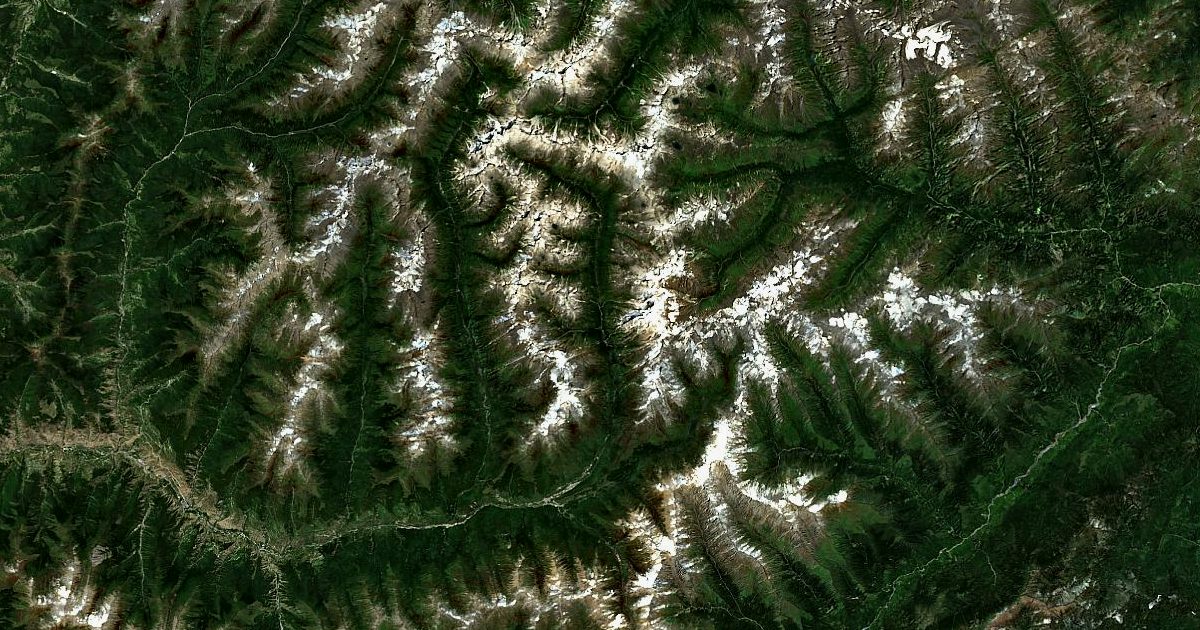
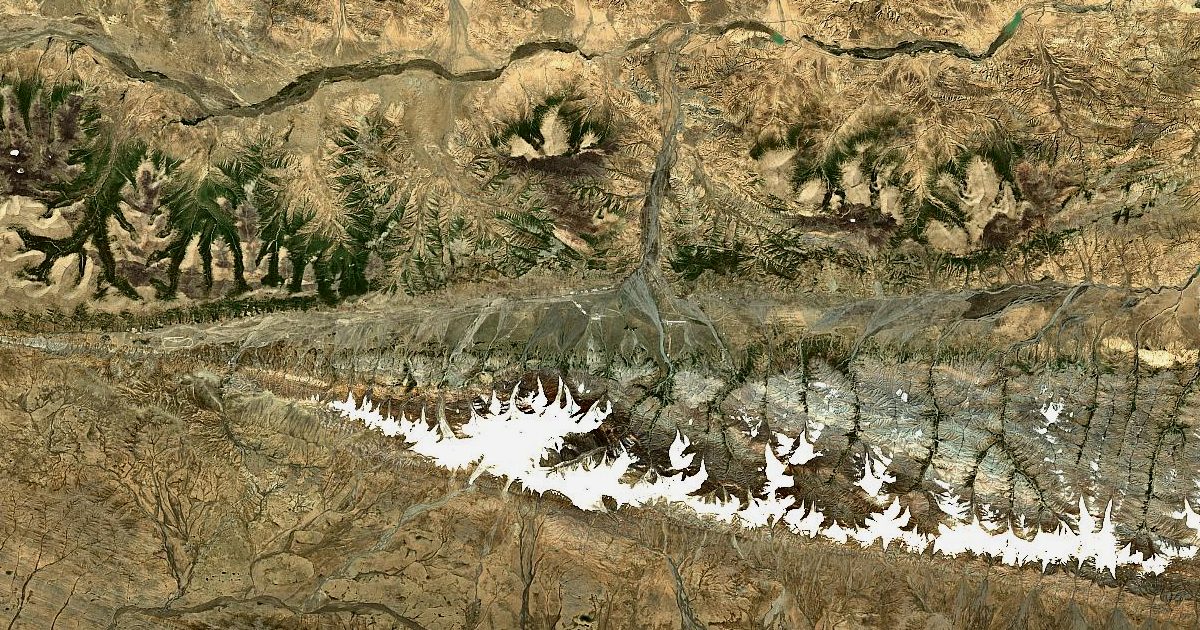
Satellite imagery Sentinel-2 cloudless 2024 © EOX · Terrain AWS Terrain Tiles · Orange line is schematic · Place coordinates not individually verified

Route review

6 scenes to understand what happened

Scroll down and the map flies to where each part happened. The line is Schematic, Connects the locations mentioned in reports in sequence, showing only the approximate direction, not the actual track. Sources for the location coordinates are in places.json.

01

Entire route

The locations mentioned in reports are connected in sequence to show the approximate course of events (schematic).

04

Rockfall from the cliff

Early on 4 January, boulders fell from near the crater rim, dislodging more rocks and killing three American climbers.Facts it rests onF04Multiple sourcesEarly on Wednesday, 4 January 2006, a rockfall occurred on the western side of Mount Kilimanjaro, killing three American climbers.F08Single sourceThe head of the tour operator that organized the climb said the first few boulders fell from near the crater rim, about 300 meters below the summit, and dislodged more rocks as they fell.

05

Rescue and evacuation

The national park sent a rescue team and porters up the mountain, and the seriously injured were taken to Nairobi for treatment.Facts it rests onF19Single sourceThe national park immediately sent a rescue team and all available porters up the mountain to bring down the dead and injured; by the morning of 5 January, more than 50 foreign climbers had been brought down, some with minor injuries.F18Multiple sourcesThe seriously injured were evacuated by a flying doctor service and taken to a hospital in Nairobi, the capital of Kenya, for treatment.

06

Closure and reopening

The route was closed and investigated after the accident, then reopened in 2007; another fatal rockfall occurred nearby in 2015.Facts it rests onF02Multiple sourcesAfter the accident, Kilimanjaro National Park closed the Western Breach route and organized an investigation.F24Multiple sourcesThe Western Breach route reopened in 2007, and the park required climbing parties to set out earlier for the ascent.F26Multiple sourcesIn 2015, another fatal rockfall occurred on the Western Breach, killing an American entrepreneur, Dinsmore, very close to the site of the 2006 accident.

02Timeline

  1. The climbing teams set out the previous Saturday on the Umbwe route and took several days to reach Arrow Glacier Camp. F01

  2. After the accident, Kilimanjaro National Park closed the Western Breach route and organized an investigation. F02

  3. Early on Wednesday, 4 January 2006, a rockfall occurred on the western side of Mount Kilimanjaro, killing three American climbers. F04

  4. The seriously injured were evacuated by a flying doctor service and taken to a hospital in Nairobi, the capital of Kenya, for treatment. F18

  5. After the incident, police said experts had gone up the mountain to investigate the cause of the rockfall, and climbers on other routes were allowed to continue climbing. F22

  6. The national park immediately sent a rescue team and all available porters up the mountain to bring down the dead and injured; by the morning of 5 January, more than 50 foreign climbers had been brought down, some with minor injuries. F19

  7. The acting chief conservation officer of Kilimanjaro National Park said a sudden change in the weather caused several rocks to roll down the slope; the Associated Press also reported that officials said the weather at the summit had changed before the rockfall. F13

  8. Early reports said several Tanzanian guides had also died, but the regional police commander later said there were no Tanzanians among the dead. F17

  9. The Western Breach route reopened in 2007, and the park required climbing parties to set out earlier for the ascent. F24

  10. In 2015, another fatal rockfall occurred on the Western Breach, killing an American entrepreneur, Dinsmore, very close to the site of the 2006 accident. F26

03Lessons

Avalanche and high altitude

No safe zone for camps or routes in a rockfall channel

The terrain of the Western Breach funnels rocks falling from different parts of the cliff into a relatively narrow gully, which the climbing route also crosses. When camping or travelling through this kind of terrain, the longer the exposure, the greater the risk.Facts it rests onF31Single sourceThe upper approximately 305 meters of the Western Breach consists of nearly vertical, loose, broken rock fractured by freezing; the slope below collects rocks falling from across the cliff face and channels them into a narrower gully below.F32Single sourceThe problem with the Western Breach is that the terrain leads climbers into a dangerous passage, while falling rocks are also channeled into the same area.F07Single sourceA local tour operator said that above the camp was a steep slope of loose scree, and above that were the crater cliffs of the extinct volcano. Boulders and rocks broke away from the cliffs and fell onto the camp.

Avalanche and high altitude

Glacial retreat can change the risks on an old route

The accident investigation found that the increased danger was linked to glacial melting. A route that has seen no incidents for years is not necessarily safe; before setting out, check its recent rockfall record and restrictions imposed by the authorities.Facts it rests onF03Multiple sourcesThe investigation concluded that the increased danger was related to glacial melt.F24Multiple sourcesThe Western Breach route reopened in 2007, and the park required climbing parties to set out earlier for the ascent.

Closed areas and rules

Another accident at the same location

After the route reopened in 2007, another fatal rockfall occurred in 2015 at a location very close by. When choosing a route, other routes with lower objective risk can be considered as the first choice.Facts it rests onF24Multiple sourcesThe Western Breach route reopened in 2007, and the park required climbing parties to set out earlier for the ascent.F26Multiple sourcesIn 2015, another fatal rockfall occurred on the Western Breach, killing an American entrepreneur, Dinsmore, very close to the site of the 2006 accident.F27Single sourceA National Geographic photographer who experienced the 2015 rockfall believed the objective risks of the Western Breach made it entirely unsuitable for ordinary hikers and recommended choosing another route up the mountain.

04Fact list 33 facts

Under each fact is a verbatim quote from the original. "Single source" means only one outlet mentioned it; "Accounts differ" means sources contradict each other and this site adopts neither side; "Speculation" is an inference by a reporter or a person involved, not a fact.

  1. F01Single sourceMovement

    According to Fox News, The climbing teams set out the previous Saturday on the Umbwe route and took several days to reach Arrow Glacier Camp.

    Quotes from the original 2

    “The climbers set out Saturday to climb the Umbwe route, the most difficult on Mount Kilimanjaro”

    Fox News · 2006-01-06

    “The group had taken several days to reach the camp at Arrow glacier, the normal resting point at 15,800 feet”

    Fox News · 2006-01-06
  2. F02Multiple sourcesAftermath

    After the accident, Kilimanjaro National Park closed the Western Breach route and organized an investigation.

    Quotes from the original 3

    “After the accident, the park closed the route and commissioned a team to investigate the accident.”

    Alpinist · 2021-01-28

    “In response, Kilimanjaro National Park (KINAPA) closed the Western Breach.”

    Ultimate Kilimanjaro ·

    “The route up the Breach was closed.”

    National Geographic · 2016-02-08
  3. F03Multiple sourcesFound at scene

    The investigation concluded that the increased danger was related to glacial melt.

    Includes a low-credibility source

    Quotes from the original 2

    “They determined that the increased hazard resulted from melting glaciers.”

    Alpinist · 2021-01-28

    “The investigation that followed confirmed the initial suspicions that the rock fall was due to the glacier melting and retreating.”

    Mount Kilimanjaro Guide ·
  4. F04Multiple sourcesEvent

    Early on Wednesday, 4 January 2006, a rockfall occurred on the western side of Mount Kilimanjaro, killing three American climbers.

    Quotes from the original 3

    “The dead and injured were in two groups that were hit early on Wednesday by a cascade of falling rocks and boulders”

    Mail & Guardian · 2006-01-05

    “Three Americans were killed and two others seriously injured.”

    Fox News · 2006-01-06

    “On the fourth of January in 2006 a group of American climbers was making their way from the Arrow Glacier Camp to the Western Breach.”

    Mount Kilimanjaro Guide ·
  5. F05Multiple sourcesEvent

    The rockfall occurred near Arrow Glacier Camp, which is on the Western Breach route, one of the most difficult routes on Kilimanjaro.

    Quotes from the original 3

    “five other people were injured by the rock slide close to Arrow Glacier base camp early on Wednesday.”

    NBC News · 2006-01-05

    “The camp, located at an altitude of some 4,700 meters, lies on one of the mountain’s most arduous routes.”

    NBC News · 2006-01-05

    “camped near Arrow glacier on Kilimanjaro's difficult Western Breach when the rock slide occurred Wednesday.”

    Fox News · 2006-01-06
  6. F06Accounts differEvent

    Accounts differ on what the victims were doing when they were struck by the falling rocks: the Associated Press reported that the climbers were resting in their tents and preparing for an early-morning summit attempt when boulders fell into the camp; Agence France-Presse reported that they had already been heading toward the summit for several hours that morning and were at about 4877 meters above Arrow Glacier. One injured person also said he was climbing upward at the time.

    The two news agencies' accounts differ; Agence France-Presse said the dead and injured belonged to two different teams. The two situations may correspond to the different teams, but the reports did not say.

    Quotes from the original 4

    “The climbers were asleep in their tents, hoping to get a few hours rest before a pre-dawn ascent of Africa's highest peak, when the boulders rained down.”

    Fox News · 2006-01-06

    “Krause said the climbers were several hours into a morning trek to the peak when they were hit by a freak rockslide”

    Mail & Guardian · 2006-01-05

    “The climbers were located above the Arrow Glacier at about 4 877m, on the western breach of the 5 963m mountain”

    Mail & Guardian · 2006-01-05

    “We were walking up … when we heard cracks but didn’t see where they were coming from.”

    Mail & Guardian · 2006-01-05
  7. F07Single sourceFound at scene

    According to Fox News, A local tour operator said that above the camp was a steep slope of loose scree, and above that were the crater cliffs of the extinct volcano. Boulders and rocks broke away from the cliffs and fell onto the camp.

    Quotes from the original 1

    “Above the camp site is a steep slope of loose gravel and above that is the crater wall of a now extinct volcano.”

    Fox News · 2006-01-06
  8. F08Single sourceFound at scene

    According to Mail & Guardian, The head of the tour operator that organized the climb said the first few boulders fell from near the crater rim, about 300 meters below the summit, and dislodged more rocks as they fell.

    Quotes from the original 2

    “began with several large boulders falling from near the rim of Kilimanjaro’s volcanic crater, about 300m below the summit.”

    Mail & Guardian · 2006-01-05

    “The initial rocks then cascaded other rocks down. This is a rare, rare occurrence.”

    Mail & Guardian · 2006-01-05
  9. F09Single sourceBackground

    According to Fox News, At the time, there were dozens of foreign climbers from several tour operators near the camp.

    Quotes from the original 1

    “The Americans were among several dozen foreign climbers from various tour groups”

    Fox News · 2006-01-06
  10. F10Accounts differEvent

    Accounts differ on the number injured: Agence France-Presse quoted the national park's acting chief conservation officer as saying five people were seriously injured (one American and four Tanzanians); the Associated Press said two Americans were seriously injured; Alpinist said four porters were injured.

    The reports used different counting criteria.

    Quotes from the original 3

    “Five other people were seriously injured, among them one American and four Tanzanians,”

    Mail & Guardian · 2006-01-05

    “Three Americans were killed and two others seriously injured.”

    Fox News · 2006-01-06

    “In 2006 three American climbers died and four porters were injured when stones tore through Arrow Glacier Camp.”

    Alpinist · 2021-01-28
  11. F11Single sourceEvent

    According to Mail & Guardian, An injured American said he saw large rocks rolling down at great speed while many people were climbing; one rock struck him and broke his left shoulder.

    Quotes from the original 2

    “Then, we noticed big rocks coming down so fast and there were so many people climbing at that time,”

    Mail & Guardian · 2006-01-05

    “The rock hit my left shoulder and broke it.”

    Mail & Guardian · 2006-01-05
  12. F12Single sourceParticipant's view

    According to Fox News, A local tour operator believed that global warming had melted glaciers, loosening rocks that had been held in place by ice. He also said the route needed to be controlled, but many tourists favored challenging routes.

    Quotes from the original 2

    “Global warming has melted some of Mount Kilimanjaro's glaciers, Kimaro said, which has loosened rocks once held in place by the ice.”

    Fox News · 2006-01-06

    “The route needs control, but there are many tourists who seek a challenging ascent and they prefer this route,”

    Fox News · 2006-01-06
  13. F13Multiple sourcesPost-incident analysis

    The acting chief conservation officer of Kilimanjaro National Park said a sudden change in the weather caused several rocks to roll down the slope; the Associated Press also reported that officials said the weather at the summit had changed before the rockfall.

    Quotes from the original 2

    “A rapid change of weather forced several rocks to tumble and slide down the gradient,”

    Mail & Guardian · 2006-01-05

    “There had been a change in the weather at the peak before the rock fall, officials said”

    Fox News · 2006-01-06
  14. F14Single sourceParticipant's view

    According to Mail & Guardian, The head of the tour operator that organized the climb believed a gust of wind blew the rocks loose.

    Quotes from the original 1

    “A big wind came and blew the rocks down on to them,”

    Mail & Guardian · 2006-01-05
  15. F15Single sourceBackground

    According to Fox News, The victims were Christian Ferguson (27) of Longmont, Colorado, Mary Lou Sammis (58) of Huntington, New York, and Betty Orrick Sapp (63).

    Quotes from the original 1

    “The dead were identified as Kristian Ferguson, 27, of Longmont, Colo.; Mary Lou Sammis, 58, of Huntington, N.Y., and Betty Orrik Sapp, 63, of Melrose, Mass.”

    Fox News · 2006-01-06
  16. F16Single sourceBackground

    According to Mail & Guardian, The three victims belonged to different climbing teams: two were with a team from the tour operator African Environments, and the other was with a team from Zara Tanzanian Adventures.

    Quotes from the original 1

    “said two of the dead were part of his firm’s group. Zainab Ansell, of Zara Tanzanian Adventures that had 15 clients on the mountain, said the third was in her company’s group.”

    Mail & Guardian · 2006-01-05
  17. F17Single sourceAftermath

    According to Fox News, Early reports said several Tanzanian guides had also died, but the regional police commander later said there were no Tanzanians among the dead.

    Quotes from the original 1

    “Several Tanzanian guides also were initially reported killed, but regional police commander Mohamed Chico said Thursday that no Tanzanians had been found among the dead.”

    Fox News · 2006-01-06
  18. F18Multiple sourcesAftermath

    The seriously injured were evacuated by a flying doctor service and taken to a hospital in Nairobi, the capital of Kenya, for treatment.

    Quotes from the original 2

    “Wakibara said the seriously injured had been evacuated by a flying doctor service and were being treated at a hospital in the Kenyan capital of Nairobi.”

    Mail & Guardian · 2006-01-05

    “The injured Americans were flown to Nairobi, Kenya, for treatment”

    Fox News · 2006-01-06
  19. F19Single sourceAftermath

    According to Fox News, The national park immediately sent a rescue team and all available porters up the mountain to bring down the dead and injured; by the morning of 5 January, more than 50 foreign climbers had been brought down, some with minor injuries.

    Quotes from the original 2

    “Wakibara said a rescue team was immediately sent up the mountain along with every available porter to help bring down the dead and injured.”

    Fox News · 2006-01-06

    “By Thursday morning, more than 50 foreign climbers had been brought down, some with minor injuries”

    Fox News · 2006-01-06
  20. F20Single sourceParticipant's view

    According to Fox News, National park officials said a possible explanation was ground movement or vibration, and that nothing like this had ever happened before.

    Quotes from the original 2

    “The possible explanation I hear on this could be earth movement or vibration,”

    Fox News · 2006-01-06

    “It has never happened like this in the past.”

    Fox News · 2006-01-06
  21. F21Single sourceParticipant's view

    According to Mail & Guardian, The head of the tour operator that organized the climb disagreed that melting snow had loosened the rocks, pointing out that the area where the rockfall began had been free of ice for years.

    Quotes from the original 2

    “Krause downplayed speculation that the rocks could have been dislodged by melting snow”

    Mail & Guardian · 2006-01-05

    “He noted that there has not been ice in the area where the slide began for many years.”

    Mail & Guardian · 2006-01-05
  22. F22Single sourceAftermath

    According to Fox News, After the incident, police said experts had gone up the mountain to investigate the cause of the rockfall, and climbers on other routes were allowed to continue climbing.

    Quotes from the original 2

    “Chico said experts were on the mountain Thursday trying to determine what caused the slide.”

    Fox News · 2006-01-06

    “Climbers on other routes were allowed to continue on Thursday, Wakibara said.”

    Fox News · 2006-01-06
  23. F23SpeculationSpeculation

    A personal blog speculated that glacial melt had left loose rocks without ice to hold them in place, and that strong winds often triggered such rockfalls.

    Quotes from the original 1

    “indeed, high winds often trigger slides of rock loosened by melting ice.”

    The Mountain World · 2006-01-06
  24. F24Multiple sourcesAftermath

    The Western Breach route reopened in 2007, and the park required climbing parties to set out earlier for the ascent.

    Quotes from the original 2

    “When the Western Breach route reopened in 2007, the park ordered that groups climb earlier in the day.”

    Alpinist · 2021-01-28

    “The Western Breach re-opened in December 2007.”

    Ultimate Kilimanjaro ·
  25. F25Accounts differAftermath

    Accounts differ on whether the route was changed after it reopened: some tour operators and guide websites say it was adjusted to reduce exposure to rockfall; the National Geographic author says consulting geologists and Tanzanian guides had recommended moving the route out of the center of the gully and onto a ridge, but the recommendation was not adopted and the route reopened in roughly the same place.

    Quotes from the original 3

    “The route was been modified to reduce exposure to rock slides.”

    Ultimate Kilimanjaro ·

    “A consulting geologist and team of Tanzanian guides recommended the ascent route be moved from the center of the funnel and onto the rock rib we climbed after the slide. It wasn’t.”

    National Geographic · 2016-02-08

    “Not long after, the route was reopened in more or less the same place it had always been.”

    National Geographic · 2016-02-08
  26. F26Multiple sourcesAftermath

    In 2015, another fatal rockfall occurred on the Western Breach, killing an American entrepreneur, Dinsmore, very close to the site of the 2006 accident.

    Both sources are climbing guide websites.

    Quotes from the original 2

    “In 2006 the route was closed for a short period due to three climbers being killed by rockfall very near the point that Dinsmore was hit.”

    Climb Kilimanjaro Guide · 2015-09-22

    “Sadly, this led to another deadly accident in 2015, when a well known American entrepreneur was killed.”

    Mount Kilimanjaro Guide ·
  27. F27Single sourceParticipant's view

    According to National Geographic, A National Geographic photographer who experienced the 2015 rockfall believed the objective risks of the Western Breach made it entirely unsuitable for ordinary hikers and recommended choosing another route up the mountain.

    Quotes from the original 2

    “The simple fact is that the objective hazard of the Breach makes it a route completely unsuited for ordinary hiking and trekking.”

    National Geographic · 2016-02-08

    “Our recommendation: Pick one of the several other routes up the mountain.”

    National Geographic · 2016-02-08
  28. F28Single sourceBackground

    According to Fox News, Ferguson was traveling with his wife and other members of the Colorado Mountain Club.

    Quotes from the original 1

    “had been hiking with his wife and others from the Colorado Mountain Club, friends and club officials said.”

    Fox News · 2006-01-06
  29. F29Single sourcePlan

    According to Fox News, Climbers on this route usually arrive at camp before dark to rest, then set out around 2 a.m. to reach the summit by dawn.

    Quotes from the original 1

    “Climbers usually arrive before nightfall and sleep until they begin the ascent at around 2 a.m. to reach the summit at dawn.”

    Fox News · 2006-01-06
  30. F30Single sourceFound at scene

    According to Mount Kilimanjaro Guide, According to an investigation as reported by a climbing guide website, the rockfall area could be delineated and was designated a high-risk zone; the old route spent nearly an hour in this area, while the new route reduced the time to about five minutes.

    Quotes from the original 2

    “While it is impossible to predict when rocks will fall, it is possible to predict where.”

    Mount Kilimanjaro Guide ·

    “spent nearly an hour in this high risk area. The new path reduced that time to about five minutes.”

    Mount Kilimanjaro Guide ·
  31. F31Single sourceBackground

    According to National Geographic, The upper approximately 305 meters of the Western Breach consists of nearly vertical, loose, broken rock fractured by freezing; the slope below collects rocks falling from across the cliff face and channels them into a narrower gully below.

    Quotes from the original 2

    “The top 1,000 feet (305 meters) of it are vertical and near-vertical layers of soft, loose, ice-shattered rock.”

    National Geographic · 2016-02-08

    “It collects rocks falling from all across the head wall and propels them into a relatively narrow chute lower down.”

    National Geographic · 2016-02-08
  32. F32Single sourcePost-incident analysis

    According to Ultimate Kilimanjaro, The problem with the Western Breach is that the terrain leads climbers into a dangerous passage, while falling rocks are also channeled into the same area.

    Quotes from the original 1

    “What makes the Western Breach problematic is that the geography of the mountain puts climbers into a dangerous channel. Tumbling rock is also funneled into this same area.”

    Ultimate Kilimanjaro ·
  33. F33Single sourceBackground

    According to Fox News, More than 20,000 people attempt to climb Kilimanjaro each year, and about ten die during the climb each year, most from altitude sickness.

    Quotes from the original 1

    “More than 20,000 tourists attempt to climb the mountain every year. About 10 people die each year during the climb, usually from high altitude sickness.”

    Fox News · 2006-01-06